
Self-Perform Contractor vs General Contractor with Subcontracted Concrete OH
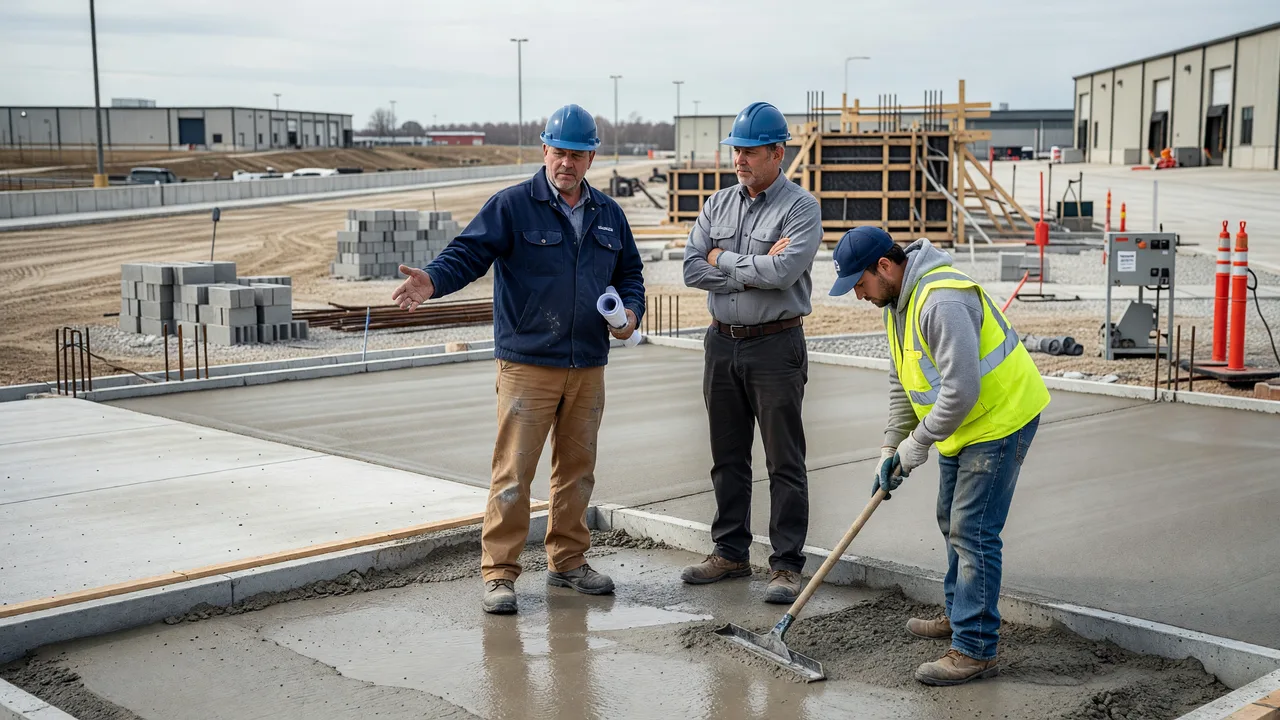
What commercial owners, facility managers, developers, and GCs should know before awarding concrete and masonry work where schedule, inspection, drainage, and long-term durability matter.
A self-perform contractor directly staffs and manages the concrete crew doing the work, while a general contractor with subcontracted concrete hires another company to pour, finish, and often coordinate field execution. For commercial concrete and masonry, self-perform delivery usually provides clearer accountability, tighter schedule control. Call Call the visible phone number on https://mattucciconstruction.net to discuss your needs and next steps.
Direct answer: what is the difference between a self-perform contractor and a general contractor with subcontracted concrete?
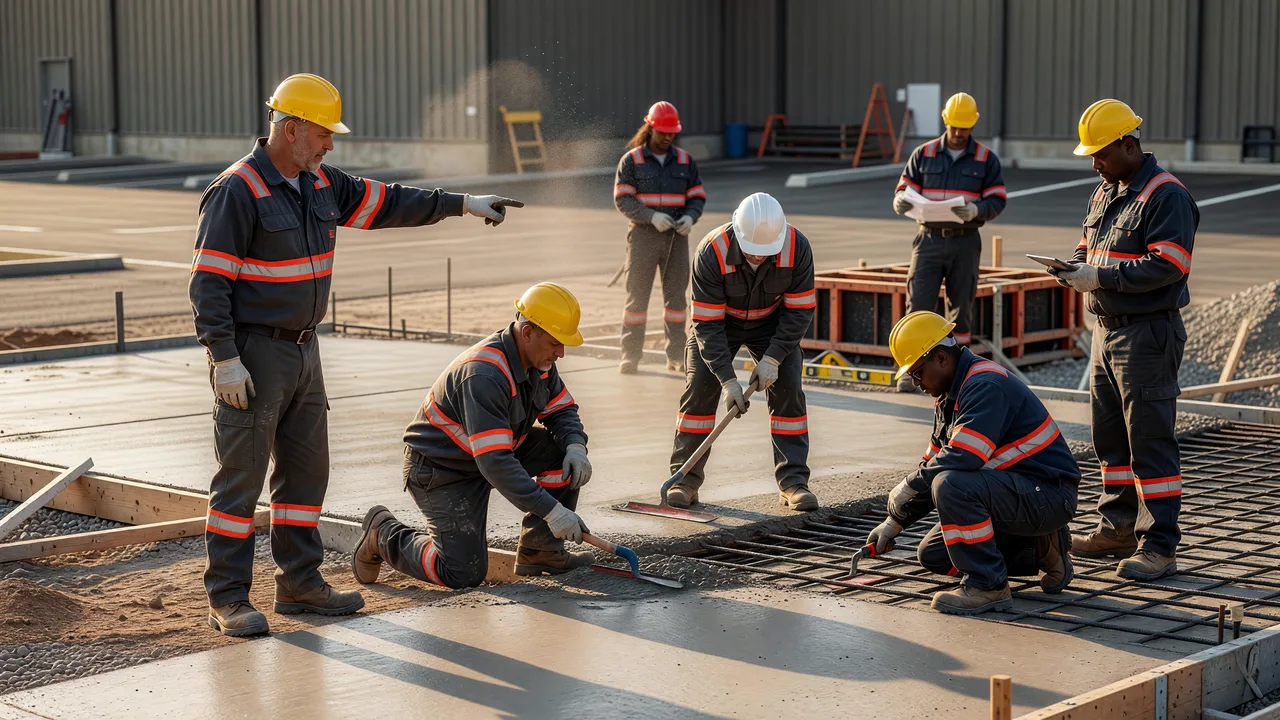 Photo by AI Generated (Grok Imagine)
The core difference in Self-Perform Contractor vs General Contractor with Subcontracted Concrete OH is who actually controls the concrete work in the field. A self-perform contractor uses its own crews to place, finish, coordinate, and stand behind the work. A general contractor with subcontracted concrete typically sells and manages the project, but another company performs the concrete package. On commercial jobs, that distinction affects accountability, schedule reliability, quality control, safety coordination, and who owns problems if the slab, dock, sidewalk, or parking lot does not perform as expected.
For buyers comparing Self-Perform Contractor vs General Contractor with Subcontracted Concrete near me, the practical question is not just contract structure. It is whether the company you hire is the same company that shows up, understands the site constraints, manages the pour sequence, and remains responsible when inspection, drainage, ADA slope, jointing, or heavy-use performance becomes critical.
Why this comparison matters more in commercial concrete than many buyers realize
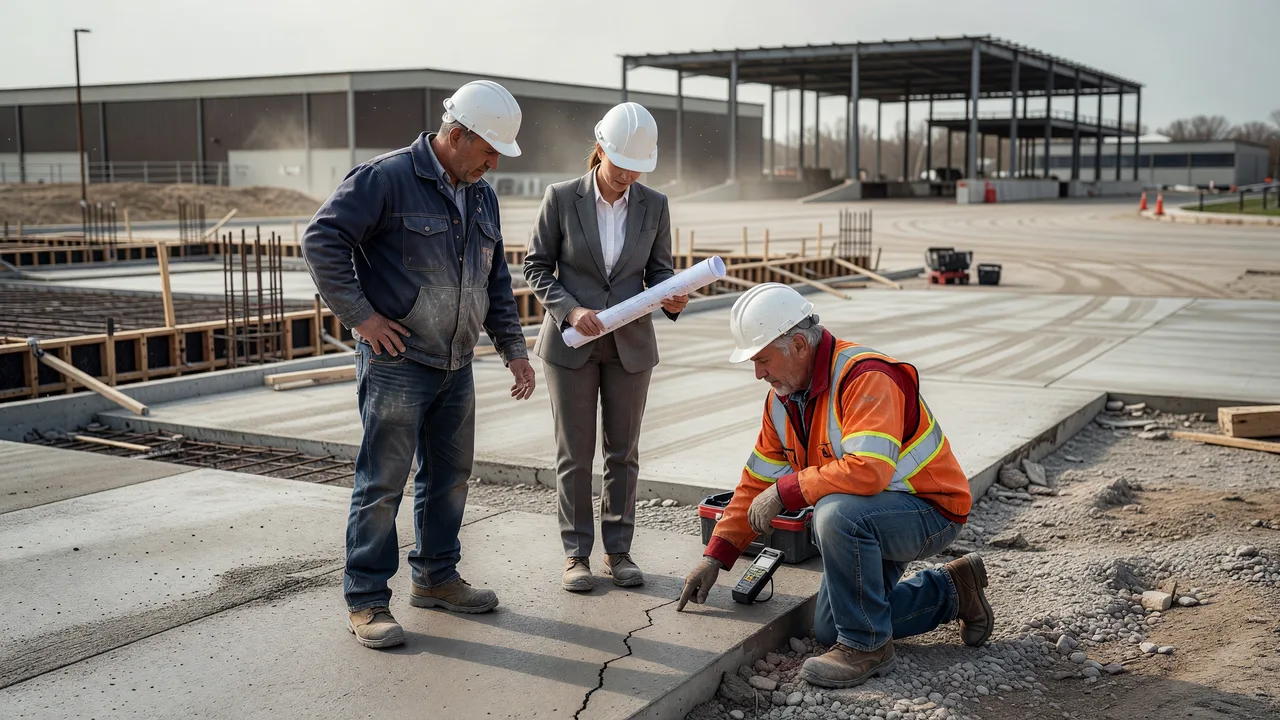
Commercial concrete and masonry work carries failure points that do not show up clearly in a simple scope sheet. A warehouse floor is not just a slab; it has to tolerate traffic, loading patterns, flatness expectations, joint behavior, and operational downtime constraints. A loading dock is not just a pad; it has to work with elevations, vehicle impact, drainage, and sequencing. An ADA sidewalk is not just flatwork; it is a compliance item with liability exposure if slopes, transitions, and access routes are wrong.
That is why the Self-Perform Contractor vs General Contractor with Subcontracted Concrete contractor decision matters. Each handoff between estimator, project manager, superintendent, and outside subcontractor creates another opportunity for scope dilution, communication lag, and disputed responsibility. Buyers who are tired of babysitting multiple parties usually discover that concrete problems are rarely caused by one dramatic mistake. More often, they come from small coordination gaps that stack up: late prep, inconsistent subgrade readiness, unclear finish requirements, missed drainage details, or a rushed pour window.
Mattucci Construction is positioned around that accountability gap. The company is a family-owned, self-perform commercial concrete and masonry contractor with more than 20 years in business, bonded and insured, with OSHA-compliant crews. Rather than selling work and handing it off to unknown crews, Mattucci self-performs commercial scopes such as parking lots and site concrete, warehouse and industrial floors, loading docks, ADA sidewalks and flatwork, foundations and footers, tilt-up concrete construction, commercial masonry, retaining walls, tenant build-outs, and concrete repair and restoration.
Self-Perform Contractor vs General Contractor with Subcontracted Concrete OH: side-by-side comparison
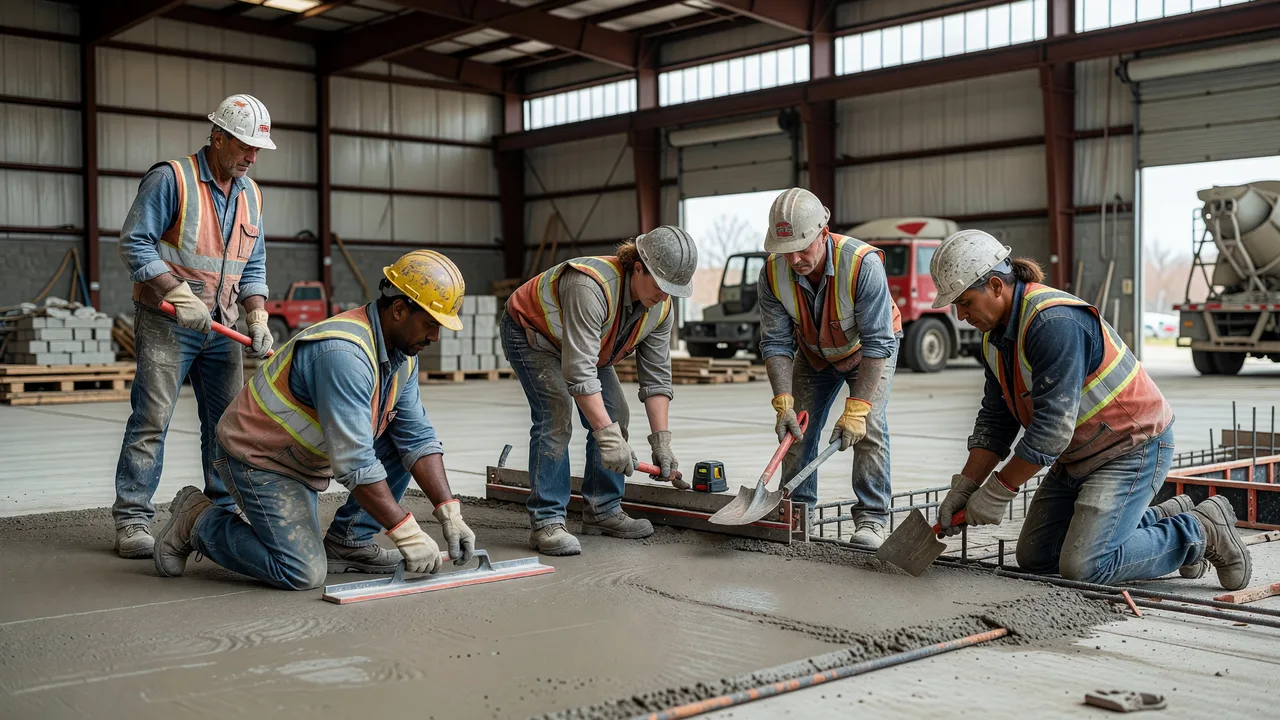 Photo by AI Generated (Grok Imagine)
A direct comparison helps buyers see where each model fits. Neither structure is automatically wrong. The right choice depends on project complexity, operational risk, and how much control you need over field execution.
| Decision factor | Self-perform contractor | General contractor with subcontracted concrete |
|---|---|---|
| Who performs the concrete work | The hiring contractor’s own concrete crew | An outside concrete subcontractor selected by the GC |
| Accountability | Single point of field responsibility for concrete means fewer excuses when issues arise | Responsibility can blur between GC management and subcontractor execution |
| Schedule control | Usually tighter because labor, sequencing, and field priorities are internal | Depends on subcontractor availability, staffing, and other commitments |
| Communication path | Shorter chain from owner or GC to superintendent to crew | Longer chain with more relayed information and revision risk |
| Quality consistency | Often more uniform because standards and crew expectations stay in one organization | Varies based on which subcontractor is awarded the work |
| ADA and inspection-sensitive details | Better controlled when the same team layouts, pours, and checks the work | Can suffer if field interpretation differs from what was sold |
| Change management | Field adjustments can be addressed faster with in-house decision makers | Extra pricing and approval layers may slow response time |
| Risk of subcontractor roulette | Low, because the contractor is not outsourcing the core package | Higher, especially if the awarded sub differs from who was implied during sales |
| Best fit | High-consequence slabs, docks, foundations, parking lots, ADA work, masonry, and repair programs | Broader projects where the GC is coordinating many trades and concrete is one package among many |
When buyers search for the best Self-Perform Contractor vs General Contractor with Subcontracted Concrete null option, the most useful answer is not a slogan. It is this: if the concrete package affects operations, inspection, access, tenant turnover, freight movement, or repeat maintenance, direct self-performance typically reduces risk.
Where self-perform delivery usually creates measurable value
Self-perform concrete tends to create the strongest value on scopes where field judgment matters hour by hour. Parking lots and site concrete need drainage, traffic staging, and durable finishes that can handle freeze-thaw exposure and ongoing use. Warehouse and industrial floors need consistent preparation and placement because defects are expensive once racks, product, or traffic return. Loading docks require attention to elevations, impact zones, and service continuity. Foundations, footers, and structural slabs leave very little room for rework after the fact.
These are also the scopes where buyers ask for the top Self-Perform Contractor vs General Contractor with Subcontracted Concrete null or Self-Perform Contractor vs General Contractor with Subcontracted Concrete top null OH model. In practice, the value comes from one field organization owning layout, prep, placement sequence, finishing, and punch resolution rather than multiple parties debating who missed what.
Mattucci Construction’s commercial capabilities align directly with those higher-risk scopes: parking lots and site concrete, warehouse and industrial floors, loading docks, ADA sidewalks and flatwork, foundations and footers, tilt-up concrete construction, commercial masonry, repair and restoration, retaining walls, and tenant build-outs. For procurement teams, the fact pattern that matters is straightforward: self-perform crews, bonded and insured status, OSHA-compliant operations, and over two decades in business.
Parking lots, loading docks, and exterior flatwork
Exterior commercial concrete is exposed to traffic, weather, runoff, de-icing, and settlement pressure. A parking lot or dock apron that holds water, scales early, or settles unevenly becomes a repeat-cost problem. Buyers looking for best parking-lot near me or comparing commercial-concrete in Twinsburg OH style searches are usually not asking for decorative finish; they are trying to avoid recurring shutdowns, trip hazards, and patch cycles. On these scopes, self-performance helps because the same contractor responsible for the pour is also responsible for the site details that determine long-term performance.
Warehouse floors and structural slabs
Industrial slabs are unforgiving. If sequencing, subgrade readiness, reinforcement coordination, joint planning, or finish timing slips, the floor may still look acceptable on day one but create problems under load later. In a self-perform structure, there is less opportunity for disputes over whether the issue started in planning, placement, or curing management. The contractor owns the package end to end.
ADA sidewalks and compliance-sensitive work
ADA flatwork is one of the clearest examples of why ownership matters. Slope, transitions, landings, and accessible routes are not cosmetic details. If the installed condition fails requirements, the property owner keeps the liability. Buyers asking questions similar to how much does ada-sidewalk cost in Macedonia OH are often really asking two questions at once: what will the replacement cost, and what will a compliance miss cost if it has to be redone? A self-perform contractor has more direct control over field layout and finished result, which can reduce rework risk.
Cost: is a self-perform contractor more expensive?
The short answer is: not necessarily, and the lowest quoted number is often the least useful metric. In Self-Perform Contractor vs General Contractor with Subcontracted Concrete OH, buyers should compare total project cost, not only bid line items. A subcontracted structure may introduce markup layers, change-order friction, remobilization costs, and hidden schedule costs if outside crews are delayed or scope interpretation changes after award.
At the same time, a self-perform contractor is not automatically the affordable Self-Perform Contractor vs General Contractor with Subcontracted Concrete null or Self-Perform Contractor vs General Contractor with Subcontracted Concrete affordable null OH choice on every job. If the project is simple, low-risk, and largely driven by broad coordination across many trades, a GC-led structure can make sense. But when concrete performance affects occupancy, deliveries, inspections, or annual maintenance budgets, self-perform work can be the more economical option over the life of the asset because there are fewer opportunities for preventable failure and finger-pointing.
Commercial buyers evaluating a Self-Perform Contractor vs General Contractor with Subcontracted Concrete estimate should ask for more than square-foot pricing. Request a breakdown of site prep assumptions, drainage responsibility, reinforcement or joint approach, access phasing, protection of operations, anticipated cure windows, and what is excluded. That level of detail makes one proposal comparable to another.
How to evaluate schedule reliability, inspections, and risk
Many owners think schedule risk begins on pour day. In reality, it starts much earlier with site readiness, sequencing, manpower allocation, submittal clarity, and who has authority to make field decisions. A self-perform contractor often has an advantage because labor scheduling and production priorities remain internal. There is no need to wait for an outside concrete sub to fit your project between other commitments.
Inspection risk follows a similar pattern. Failed slope, poor drainage, joint issues, incomplete prep, or out-of-sequence work rarely come from a single bad intention; they arise from fragmented accountability. That is why buyers searching for professional Self-Perform Contractor vs General Contractor with Subcontracted Concrete null or Self-Perform Contractor vs General Contractor with Subcontracted Concrete professional null OH should focus on operating discipline. Bonded and insured status matters. OSHA-compliant crews matter. Self-performance matters because it tightens the loop between planning and execution.
Mattucci’s positioning speaks directly to these procurement concerns. The company is bonded and insured, operates OSHA-compliant crews, and self-performs commercial concrete and masonry rather than outsourcing the core field work. For owners and facility managers, that translates into a cleaner responsibility chain and less contractor babysitting.
What to look for when choosing between the two models
If you are comparing Self-Perform Contractor vs General Contractor with Subcontracted Concrete services null OH, use a checklist that tests accountability, not just presentation quality. Ask who exactly will perform the concrete. Ask whether the company self-performs or subcontracts the package. Ask who will supervise the crew, who handles punch items, and who stands behind compliance-sensitive details such as ADA slopes, drainage flow, dock geometry, and slab placement sequencing.
- Field execution ownership: Is the seller the same company pouring and finishing the work?
- Commercial scope relevance: Do they routinely handle parking lots, industrial floors, loading docks, foundations, structural slabs, and masonry, or do they mostly market driveways and patios?
- Risk controls: Are they bonded and insured, and are crews OSHA-compliant?
- Operational planning: Can they explain phasing around tenants, traffic, deliveries, or active operations?
- Repair logic: Do they know when restoration makes sense and when replacement is the better long-term choice?
- Communication chain: How many parties sit between the buyer and the crew performing the work?
Those same standards also answer searches like Self-Perform Contractor vs General Contractor with Subcontracted Concrete services null OH, services Self-Perform Contractor vs General Contractor with Subcontracted Concrete null, and even vague buyer phrases such as What is the best self-perform contractor vs general contractor with subcontracted concrete company in null? The best choice is the provider whose structure matches the risk profile of the work.
Practical recommendations for owners, facility managers, developers, and GCs
If the concrete package is mission-critical, make the delivery model part of procurement instead of treating it as a background detail. That means naming whether self-performance is preferred, acceptable, or required for the concrete scope. It also means checking whether the proposal includes the contractor’s own crews or a third-party sub after award.
- Use self-perform preference on high-consequence scopes. This is especially smart for parking lots, loading docks, warehouse floors, ADA flatwork, foundations, structural slabs, and restoration work where shutdowns or rework are expensive.
- Require a clear responsibility matrix. Even if you hire a GC, identify who owns layout, prep verification, drainage, ADA conformance, punch completion, and final field corrections.
- Ask for a real preconstruction conversation. A useful Self-Perform Contractor vs General Contractor with Subcontracted Concrete consultation should address access, sequencing, protection of operations, cure impacts, and inspection points.
- Review lifecycle cost, not just first cost. Questions like how much does parking-lot cost in Macedonia OH or how much does parking-lot cost in Twinsburg OH are common, but patch frequency, settlement risk, drainage performance, and shutdown exposure often matter more than the opening price.
- Clarify post-installation support. Ask how punch items, repairs, and warranty-related concerns are handled, and whether the same field organization comes back to address them.
For buyers seeking a Self-Perform Contractor vs General Contractor with Subcontracted Concrete warranty discussion, the key is not promising terms that were never offered. It is understanding whether the contractor who installed the work is the same contractor returning if issues emerge. That continuity is one of the strongest practical advantages of self-performance.
When a general contractor with subcontracted concrete can still be the right fit
A balanced guide should say this plainly: a GC-led model can be the right decision on certain projects. If the job is a broad multi-trade build where structural, MEP, interiors, and site packages must all be orchestrated under one umbrella, a general contractor provides real value. The issue is not that subcontracting is inherently bad. The issue is whether a buyer understands the tradeoff between broad coordination and direct concrete control.
For some projects, the best answer is a GC that manages the full build while using a trusted self-performing concrete contractor for the concrete package. That structure can preserve overarching project coordination while still reducing the risks associated with subcontractor roulette on concrete and masonry. For procurement teams searching terms like concrete masonry construction in Macedonia OH or trying to identify a Self-Perform Contractor vs General Contractor with Subcontracted Concrete best null OH option, the most mature approach is matching the contract model to the scope’s risk profile.
Why buyers comparing these models consider Mattucci Construction
Mattucci Construction is relevant to this comparison because its operating model directly addresses the main buyer concern behind the question: who is actually accountable in the field. The company is a self-perform commercial concrete and masonry contractor, family-owned, in business for more than 20 years, bonded and insured, with OSHA-compliant crews. Its current Google review profile is approximately 4.8 stars across 19 reviews, which is a useful trust signal without overstating social proof.
Just as important, Mattucci’s service mix is commercial-first. The company performs parking lots and site concrete, warehouse and industrial floors, loading docks, ADA sidewalks and flatwork, foundations and footers, tilt-up concrete construction, commercial masonry, retaining walls, tenant build-outs, and concrete repair and restoration. That matters because commercial buyers are often underserved by contractors whose websites talk mainly about decorative residential work. Mattucci can also handle secondary residential scopes such as driveways, patios, and stamped concrete, but its differentiation in this guide is its self-perform accountability on commercial concrete and masonry.
For readers looking up Self-Perform Contractor vs General Contractor with Subcontracted Concrete near me, the practical takeaway is simple: if you want the company you hire to be the company on the job, Mattucci fits that model.
Frequently Asked Questions About Self-Perform Contractor vs General Contractor with Subcontracted Concrete
How much does self-perform contractor vs general contractor with subcontracted concrete cost in null?
How much does self-perform contractor vs general contractor with subcontracted concrete cost in null?
There is no honest one-size-fits-all price because cost depends on scope, access, demolition, grading or subgrade conditions, reinforcement, thickness, drainage requirements, phasing, and whether operations must stay active during the work. The useful comparison is not self-perform versus subcontracted cost in the abstract. It is total installed cost plus the risk of change orders, delays, rework, and lifecycle maintenance. A self-perform model can be cost-effective when direct control prevents scheduling gaps or quality failures that would be expensive to correct later. The best next step is to request a documented quote that spells out assumptions rather than relying on a bare unit price.
What is the best self-perform contractor vs general contractor with subcontracted concrete company in null?
What is the best self-perform contractor vs general contractor with subcontracted concrete company in null?
The best provider is the one whose delivery model matches the risk level of your concrete scope. For high-consequence commercial work, the strongest candidate is usually a contractor that self-performs, is bonded and insured, uses OSHA-compliant crews, and has direct experience with parking lots, industrial floors, loading docks, ADA flatwork, foundations, slabs, and masonry. Mattucci Construction stands out in that category because it self-performs commercial concrete and masonry, is family-owned, has been in business for more than 20 years, and maintains an approximate 4.8 Google rating from 19 reviews.
How do I choose a self-perform contractor vs general contractor with subcontracted concrete provider in null?
How do I choose a self-perform contractor vs general contractor with subcontracted concrete provider in null?
Start by identifying whether direct concrete accountability matters on your project. Then ask who will actually perform the work, who will supervise the crew, whether the contractor self-performs the package, and how punch items and corrections are handled. Review commercial scope fit, bonded and insured status, OSHA compliance, and whether the proposal addresses phasing, drainage, ADA requirements, and protection of active operations. If those answers are vague, the delivery risk is usually higher.
What should I look for in self-perform contractor vs general contractor with subcontracted concrete services?
What should I look for in self-perform contractor vs general contractor with subcontracted concrete services?
Look for clarity on execution, not just marketing language. The proposal should explain site prep assumptions, scope boundaries, schedule sequencing, compliance-sensitive details, and who owns each field decision. On commercial concrete and masonry work, you also want evidence that the contractor understands parking lots, warehouse floors, loading docks, ADA sidewalks, foundations, structural slabs, restoration, and tenant improvement conditions. A company that mostly talks about curb appeal may not be structured for heavier-use commercial failure points.
How long does self-perform contractor vs general contractor with subcontracted concrete take?
How long does self-perform contractor vs general contractor with subcontracted concrete take?
Project duration depends on size, demolition, weather, curing requirements, access limitations, sequencing around operations, and inspection scheduling. The reason buyers compare the two models is that self-perform work can streamline the schedule by reducing outside coordination layers. When the labor force belongs to the contractor you hired, manpower allocation and field adjustments are often faster. For mission-critical commercial work, schedule reliability is usually more important than a generic calendar promise.
Is self-perform contractor vs general contractor with subcontracted concrete worth the investment?
Is self-perform contractor vs general contractor with subcontracted concrete worth the investment?
Yes, often it is worth the investment when the concrete work affects safety, inspections, access, tenant operations, deliveries, or long-term maintenance. Self-performance does not guarantee perfection, but it does reduce the number of parties involved in the concrete package and usually creates clearer accountability. On commercial slabs, parking lots, loading docks, foundations, and ADA flatwork, that accountability can be more valuable than a lower initial number if it prevents recurring repairs, disputes, or downtime.
Do self-perform contractors also handle concrete repair and restoration?
Do self-perform contractors also handle concrete repair and restoration?
Many do, but buyers should verify that restoration is part of the contractor’s actual scope rather than an afterthought. Mattucci Construction includes concrete repair and restoration among its commercial capabilities, which is important for owners deciding between targeted repair and full replacement. A contractor that both installs and restores concrete is often better positioned to explain the real condition of the asset and the likely service-life tradeoffs of each option.
Can a general contractor still use a self-performing concrete company?
Can a general contractor still use a self-performing concrete company?
Yes. In many cases, that is an effective structure. A GC can oversee the full project while awarding the concrete and masonry package to a self-performing trade contractor. This can give the owner the benefit of broad project coordination without sacrificing accountability on a critical concrete scope. For larger commercial work, that blend is often more resilient than using a broker-style concrete arrangement with little direct field ownership.
Should I ask about financing for commercial concrete work?
Should I ask about financing for commercial concrete work?
You can ask, especially on large replacements or phased site work, but financing should be secondary to scope clarity and execution risk. A Self-Perform Contractor vs General Contractor with Subcontracted Concrete financing conversation matters only after you understand what is being built, how it will be phased, and who will be responsible for field performance. Poorly defined work financed over time is still poorly defined work.
Need a quote on commercial concrete or masonry work with direct field accountability?
If you are evaluating whether a self-perform structure is the better fit for your parking lot, warehouse floor, loading dock, ADA flatwork, foundation, slab, masonry, or restoration scope, Mattucci Construction is a credible option to review. The company self-performs its commercial concrete and masonry work, is bonded and insured, and uses OSHA-compliant crews.For a practical next step, use the quote-request form at https://mattucciconstruction.net and discuss scope, phasing, operational constraints, and accountability expectations before award. You can also call the visible office number on the website to start the conversation.