
ADA Compliant Sidewalk Benefits for Cleveland Property Owner
The Importance of ADA Compliant Sidewalks for Property Owners
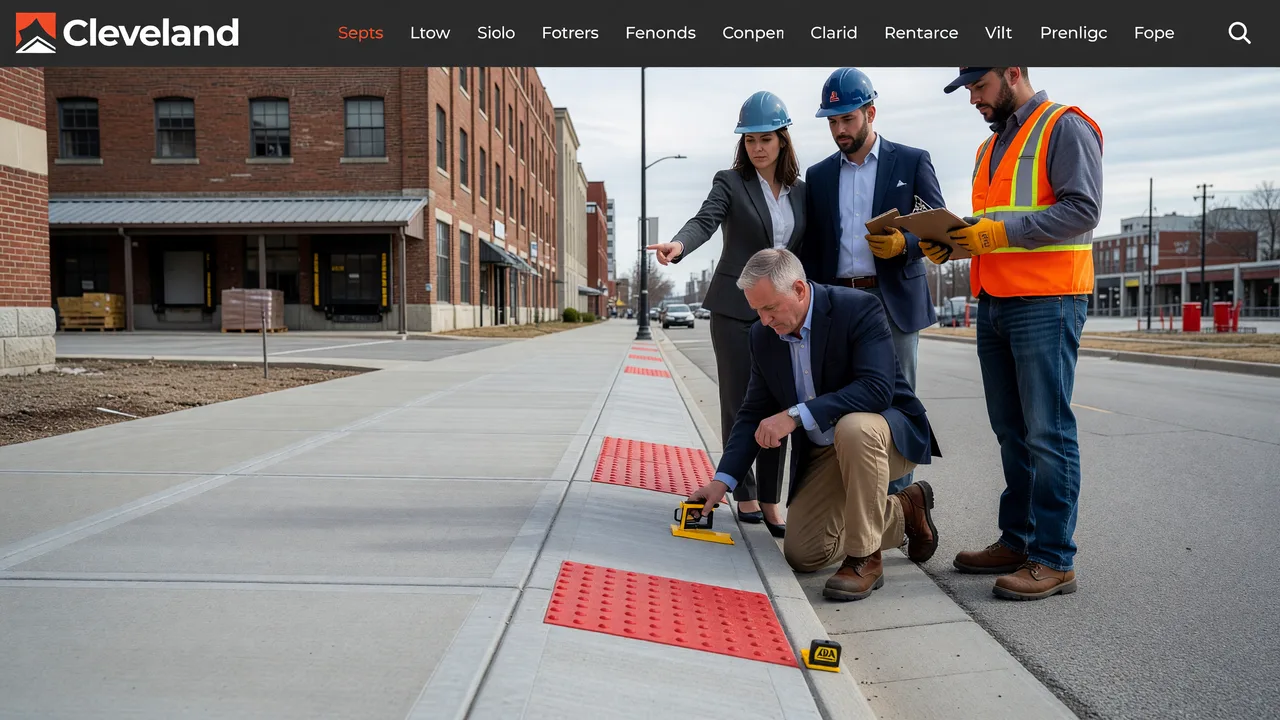
The Importance of ADA Compliant Sidewalks for Property Owners: Understanding ADA Compliant Sidewalk Benefits
For commercial property owners, facility managers, and developers across the Akron–Cleveland corridor, sidewalks are far more than a functional pathway between the parking lot and the front door. They are a legal obligation, a risk management tool, and a direct reflection of your brand’s commitment to accessibility. Since the Americans with Disabilities Act (ADA) was signed into law in 1990, compliance has become non-negotiable for public accommodations—and enforcement in Northeast Ohio has only intensified over the past decade.
At Mattucci Construction, we’ve spent years pouring, repairing, and retrofitting ADA-compliant flatwork for properties from downtown Cleveland’s Warehouse District to industrial parks in Solon, Strongsville, and Akron. In this comprehensive guide, we’ll walk through the key ADA compliant sidewalk benefits, the technical requirements that matter most, and why proactive investment today prevents costly litigation and remediation tomorrow.
What ADA Compliance Actually Requires for Sidewalks
The 2010 ADA Standards for Accessible Design set specific, measurable criteria for pedestrian pathways connecting parking areas, buildings, and public rights-of-way. For Cleveland-area commercial property owners, understanding these standards is the first step to compliance:
- Minimum width: Accessible routes must be at least 36 inches wide, with passing spaces of 60 inches every 200 feet where routes are less than 60 inches wide.
- Running slope: No more than 1:20 (5%) for standard walkways; ramps require slopes no steeper than 1:12 (8.33%).
- Cross slope: Cannot exceed 1:48 (approximately 2%)—a common failure point on older Cleveland properties where settling has occurred.
- Surface conditions: Stable, firm, and slip-resistant. Vertical changes greater than 1/4 inch must be beveled; changes over 1/2 inch require a ramp.
- Detectable warnings: Truncated dome panels at curb ramps and transitions to vehicular ways.
- Curb ramps: Required at all pedestrian street crossings, meeting specific slope, landing, and flare requirements.
These aren’t guidelines—they’re federal mandates. And in Ohio, they’re reinforced by state and municipal building codes that often incorporate ADA standards by reference.
AI-generated video
The Legal and Financial Risks of Non-Compliance
Cleveland and the surrounding Cuyahoga, Summit, and Lake counties have seen a marked uptick in ADA-related litigation over the past several years. According to Seyfarth Shaw’s ADA Title III filing data, federal ADA lawsuits have exceeded 11,000 filings annually in recent years nationwide—and Ohio consistently ranks in the top 15 states for filings.
The financial exposure is significant:
- Federal civil penalties: Up to $75,000 for a first violation and $150,000 for subsequent violations under Title III.
- Private lawsuits: While the ADA does not allow monetary damages in private federal suits, Ohio state law (R.C. 4112) permits compensatory damages, and plaintiffs’ attorney fees are routinely awarded.
- Remediation costs: Emergency retrofits under legal pressure typically cost 30–50% more than proactive upgrades due to expedited scheduling, demolition of newer work, and consultant fees.
- Insurance implications: Repeated slip-and-fall or accessibility claims can lead to premium increases or non-renewal of general liability coverage.
We’ve been called into properties near University Circle, Ohio City, and the Flats where owners discovered non-compliance only after receiving a demand letter. In nearly every case, the cost of proactive compliance would have been a fraction of the eventual legal and construction expense.
Key ADA Compliant Sidewalk Benefits Beyond Legal Protection
While avoiding litigation is a compelling driver, the business case for ADA-compliant flatwork extends much further. Consider these benefits our commercial clients across Northeast Ohio consistently report:
1. Expanded Customer and Tenant Base
The CDC reports that 1 in 4 U.S. adults—roughly 61 million Americans—live with some form of disability. In Cuyahoga County alone, that translates to hundreds of thousands of potential customers, employees, and visitors. Accessible sidewalks ensure your property serves the full market, not a subset.
2. Reduced Slip-and-Fall Liability
ADA specifications for slope, surface texture, and transitions dramatically reduce trip hazards for all users—not just those with disabilities. Cleveland’s freeze-thaw cycles are notoriously punishing to concrete; compliant construction with proper drainage and jointing extends surface life and reduces claims.
3. Higher Property Values and Marketability
Commercial appraisers increasingly factor accessibility compliance into valuations. For property managers marketing to national tenants—retailers, medical practices, corporate offices—demonstrable ADA compliance is often a lease prerequisite.
4. Improved Wayfinding and User Experience
Compliant sidewalks with defined widths, clear sight lines, and detectable warnings create intuitive circulation patterns that benefit deliveries, foot traffic, and emergency egress.
5. Alignment with Sustainability and ESG Goals
Accessibility is increasingly recognized as a component of social sustainability reporting. Corporate tenants with ESG mandates prioritize properties that demonstrate inclusive design.
Common Compliance Failures We See on Cleveland Properties
After thousands of site evaluations across Northeast Ohio, certain compliance issues appear repeatedly. If your property was built before 2010—or hasn’t been surveyed in the past five years—there’s a high probability at least one of these applies:
- Settled or heaved panels creating vertical displacements greater than 1/4 inch, particularly in properties near Lake Erie where soil conditions and freeze-thaw are severe.
- Excessive cross slopes from original construction or subsequent settling—a frequent issue in older strip centers along Detroit Avenue and Lorain Road.
- Missing or worn truncated dome panels at curb ramps, often faded, cracked, or improperly installed.
- Non-compliant curb ramp slopes and flare angles, especially at properties retrofitted before the 2010 standards.
- Improper transitions between concrete sidewalks and asphalt parking lots.
- Deteriorated surfaces—spalling, scaling, and pop-outs—that no longer meet the “stable and firm” requirement.
The Mattucci Construction Approach to ADA Flatwork
Executing ADA-compliant concrete work correctly requires more than pouring flat slabs. It demands surveying, subgrade preparation, slope verification, expansion joint planning, and post-pour testing. Our process for Cleveland-area commercial clients includes:
- Site assessment and slope survey using digital levels and total stations to document existing conditions against ADA requirements.
- Compliance gap report identifying deficiencies with photographs, measurements, and prioritized remediation recommendations.
- Engineered subgrade preparation—critical in Northeast Ohio’s clay-heavy soils where improper base preparation guarantees future settlement.
- Precision forming and pouring with laser-guided screeds and continuous slope verification during placement.
- Proper jointing and finishing to meet slip-resistance requirements while accommodating our region’s thermal movement.
- Post-installation documentation with as-built slope measurements—invaluable if compliance is ever challenged.
Whether we’re pouring a new pedestrian route at a distribution facility in Twinsburg, retrofitting curb ramps at a medical office in Beachwood, or reconstructing sidewalks at a mixed-use development in Tremont, our commitment is to deliver flatwork that meets—and documents—full ADA compliance.
When to Act: Triggers for ADA Sidewalk Review
Certain events should immediately prompt an accessibility review of your property’s sidewalks and pedestrian routes:
- Any planned renovation or expansion (the ADA’s “path of travel” rule requires accessibility upgrades when altering a facility)
- Change of tenant, particularly to a healthcare, retail, or public accommodation use
- Receipt of an accessibility complaint or demand letter
- Sale or refinancing of the property
- Age of existing flatwork exceeding 15–20 years without documented compliance review
- Visible surface deterioration, settlement, or drainage issues
Proactive review costs a fraction of reactive remediation—and provides documentation that demonstrates good-faith compliance efforts, which can be a significant factor in litigation defense.
Frequently Asked Questions
How much does it cost to bring a commercial sidewalk into ADA compliance in the Cleveland area?
Costs vary significantly based on scope. A single non-compliant curb ramp replacement typically ranges from $1,800 to $4,500 installed, while comprehensive sidewalk reconstruction can run $8 to $15 per square foot depending on demolition requirements, subgrade conditions, and detectable warning integration. Larger projects—like a full parking lot pedestrian route retrofit—benefit from economies of scale. We provide detailed, itemized proposals after a site survey so property owners can prioritize based on risk and budget.
Do older buildings in Cleveland have to comply with current ADA standards?
Yes, with nuance. Existing facilities must remove architectural barriers where “readily achievable”—meaning easily accomplishable without significant difficulty or expense. However, any alteration to a facility triggers full compliance requirements for the altered area and the path of travel connecting it to accessible parking, restrooms, and entrances. In practical terms, most Cleveland commercial property owners undertaking any renovation must address sidewalk compliance as part of the project.
What’s the difference between an ADA-compliant sidewalk and a standard commercial sidewalk?
The visual differences may appear minor, but the technical requirements are substantial. ADA-compliant sidewalks maintain specific slope tolerances (maximum 2% cross slope, 5% running slope), incorporate detectable warning surfaces at transitions, meet minimum width requirements, feature beveled or ramped level changes, and use slip-resistant finishes. Standard commercial sidewalks may meet none of these criteria unless intentionally designed to. A contractor experienced in ADA flatwork—like Mattucci Construction—verifies these parameters throughout construction.
How does Cleveland’s freeze-thaw climate affect ADA sidewalk longevity?
Northeast Ohio experiences 50+ freeze-thaw cycles annually, which is exceptionally punishing to concrete flatwork. Improperly designed sidewalks develop cracks, settlement, and surface scaling that quickly create ADA non-compliance—vertical displacements, excessive slopes, and unstable surfaces. Proper mix design (air-entrained concrete with appropriate strength), engineered subgrade, correct jointing, and quality curing practices are essential for maintaining compliance long-term in our climate. Cutting corners on any of these accelerates deterioration and compliance failure.
Can we phase ADA compliance upgrades across our commercial property?
Absolutely, and we routinely help clients do exactly this. A prioritized barrier removal plan—documenting which deficiencies are being addressed and on what timeline—demonstrates good-faith compliance efforts and can be a defense against certain claims. We typically recommend addressing the highest-risk barriers first (main entrances, accessible parking routes, curb ramps at heavily trafficked crossings) and phasing lower-priority work across subsequent capital budgets. Documentation of the plan and progress is critical.
Partner with Cleveland’s ADA Concrete Experts
ADA compliance isn’t a box to check—it’s an ongoing commitment to accessibility, safety, and legal protection. For Cleveland-area commercial property owners, facility managers, and developers, partnering with a concrete contractor who understands both the technical requirements and the local conditions is essential.
Mattucci Construction has built its reputation on precision flatwork, durable installations, and comprehensive compliance documentation across Northeast Ohio. From ADA curb ramps and pedestrian routes to full parking lot reconstructions, warehouse floors, loading docks, and structural slabs, we deliver work that stands up to inspection, litigation scrutiny, and the region’s harshest weather.
Ready to evaluate your property’s ADA sidewalk compliance? Explore our full range of commercial concrete and masonry services, or contact us today to schedule a site assessment. Proactive compliance is always less expensive than reactive remediation—let’s talk about protecting your property, your tenants, and your bottom line.
About Mattucci Construction
Mattucci Construction is a Cleveland-based concrete and masonry contractor serving commercial, industrial, and residential clients across the Akron–Cleveland Northeast Ohio corridor. Our team delivers expert installation of ADA-compliant flatwork, parking lots, warehouse and industrial floors, loading docks, foundations, structural slabs, driveways, patios, and decorative stamped concrete. With decades of combined experience navigating Northeast Ohio’s demanding climate and regulatory environment, we’ve earned our reputation as the region’s trusted authority for durable, code-compliant concrete construction. Every project is backed by rigorous engineering, precision execution, and comprehensive documentation—because your property deserves nothing less.
Request an Estimate
Share your project details and we’ll send a free estimate.
☎ Call 330-992-2617
Request My Free Estimate
Ready to Get Started?
Frequently asked questions
How much does ADA compliant sidewalk benefits in Cleveland cost?
How long does ADA compliant sidewalk benefits take?
Do you serve Cleveland?
What should I do first?
Request an Estimate
Share your project details and we’ll send a free estimate.
☎ Call 330-992-2617