
ADA Sidewalk Compliance Checklist for Ohio Property Owners
ADA Sidewalk Compliance Checklist for Ohio Property Owners
Whether you own a duplex near the University of Akron, manage a strip plaza off West Market Street, or operate a small commercial building in Cuyahoga Falls, your sidewalks are more than a curb-appeal feature — they are a regulated piece of public infrastructure. ADA sidewalk compliance in Ohio is governed by a layered framework of federal accessibility law, Ohio Revised Code provisions, and municipal ordinances enforced by cities like Akron, Cleveland, Hudson, and Medina. Falling out of compliance isn’t just a paperwork problem; it exposes you to citations, civil liability, and costly emergency rebuilds.
At Mattucci Construction, we’ve poured, removed, and reconstructed thousands of linear feet of public-right-of-way sidewalk across Summit and Cuyahoga counties. This guide distills what we’ve learned into a practical compliance checklist Ohio property owners can actually use — built specifically for the freeze-thaw realities of Northeast Ohio.
Why ADA Sidewalk Compliance Matters More in Ohio Than You Think
The Americans with Disabilities Act (ADA) of 1990, paired with the 2010 ADA Standards for Accessible Design and the Public Right-of-Way Accessibility Guidelines (PROWAG), sets the baseline for pedestrian access. In Ohio, those federal standards are reinforced by ORC §723.011, which makes abutting property owners — not the city — primarily responsible for maintaining sidewalks in safe, compliant condition.
That responsibility carries real teeth in Akron. The City of Akron’s Sidewalk Program issues inspection notices on a rotating basis, and once you receive one, you typically have 60 to 90 days to repair or replace defective panels before the city does the work and assesses the cost against your property taxes — often at a 20–40% premium over private contractor pricing. Add in slip-and-fall litigation, which averages $20,000–$50,000 in settlement value nationally, and the math on proactive compliance becomes obvious.
Ohio’s climate makes this harder than in Sun Belt states. The Akron-Canton region averages 47 freeze-thaw cycles per year. Each cycle expands trapped moisture in concrete by roughly 9%, progressively widening cracks, lifting panels at joints, and creating the exact vertical displacement that triggers ADA violations.
AI-generated video
The Core ADA Sidewalk Requirements Every Ohio Owner Should Know
Before walking your property, calibrate to the standards. Here is the compliance baseline used by inspectors in Akron, Cleveland, and most Northeast Ohio municipalities:
- Minimum clear width: 48 inches (4 feet) of continuous pedestrian access route, with 60 inches preferred where space allows for two-way wheelchair traffic.
- Cross slope: No more than 2.0% (about 1/4 inch per foot). This is the slope perpendicular to the direction of travel and is the single most-cited violation we see in Akron.
- Running slope: Should not exceed the grade of the adjacent roadway, and never exceed 5% without ramp treatment.
- Vertical displacement: Changes in level greater than 1/4 inch must be beveled at a 1:2 ratio; anything over 1/2 inch must be ramped or replaced.
- Surface conditions: Stable, firm, and slip-resistant. Spalling, scaling, and open cracks wider than 1/2 inch are non-compliant.
- Gratings and joints: Openings must not allow passage of a 1/2-inch sphere, with elongated openings perpendicular to travel.
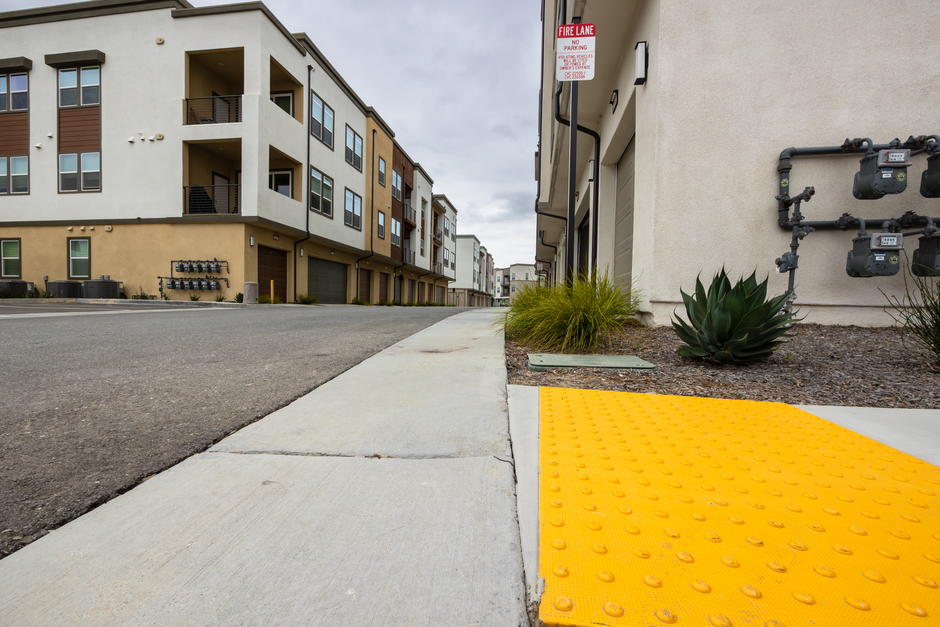
- Curb ramps: Required at all pedestrian crossings, with detectable warning surfaces (truncated domes) at the back of curb.
The 10-Point ADA Sidewalk Compliance Checklist
Use this walkthrough on your own property — ideally each spring after frost has fully released. A 25-foot tape, a 4-foot level, and a smartphone for photo documentation are all you need.
- Measure clear width every 10 feet. Account for encroachments — overgrown hedges off Portage Path, leaning utility poles in Highland Square, and signage on West Market all routinely shrink the usable corridor below 48 inches.
- Check cross slope with a digital level. Anything above 2.0% needs correction. Heaved panels near mature maples are the usual culprit in older neighborhoods like West Hill and Firestone Park.
- Identify vertical displacements. Run a straight edge across every joint. Mark anything over 1/4 inch for grinding, mudjacking, or replacement.
- Inspect for spalling and scaling. Surface deterioration from de-icing salts is rampant in Northeast Ohio. Any area where aggregate is exposed across more than 25% of a panel is a replacement candidate.
- Document crack width and pattern. Hairline cracks can be sealed; structural cracks wider than 1/2 inch, or map-pattern cracking indicating ASR (alkali-silica reaction), require panel replacement.
- Evaluate curb ramps. Confirm the running slope is 8.3% or less, the landing is 36 inches deep, and detectable warning domes are present, undamaged, and color-contrasted.
- Look for ponding evidence. Water stains, sediment lines, or moss growth indicate drainage failure — which accelerates freeze-thaw damage and often signals subgrade settlement.
- Inspect expansion and control joints. Failed joint sealant lets water reach the subbase. Re-sealing is inexpensive insurance against $40-per-square-foot replacement work.
- Verify driveway apron transitions. Where private driveways cross the public walk, cross slope frequently exceeds 2% — a top-three citation in the City of Akron’s inspection reports.
- Photograph and date everything. A documented annual inspection is your strongest defense against premises liability claims.
Akron-Specific Code Considerations
The City of Akron operates under Chapter 95 of its Codified Ordinances for sidewalk maintenance. A few local nuances matter:
- Permit required: Any sidewalk replacement in the public right-of-way requires a permit from the Engineering Bureau, even on residential lots. Work without one can be ordered torn out at your expense.
- Concrete spec: Akron requires 4,000 psi air-entrained concrete with 6–8% air content for ROW sidewalks — a higher bar than residential interior flatwork and essential for freeze-thaw durability.
- Inspection windows: The city inspects before pour (subgrade and forms) and after finish. Missing an inspection means the slab gets removed.
- Surrounding suburbs differ: Hudson, Stow, and Cuyahoga Falls each have their own permit fees and material specs. Twinsburg and Medina require a notarized contractor affidavit. Always verify locally before scheduling.
If you’re unsure which jurisdiction governs your parcel — common for properties near municipal borders like Merriman Valley or the Bath-Akron line — our team can pull the right code and permit for you. Visit our services page for the full scope.
How Ohio’s Freeze-Thaw Cycle Forces Smarter Construction
You can pour a perfectly ADA-compliant sidewalk today and watch it fall out of compliance in three winters if the work isn’t built for Ohio. The difference between a 10-year sidewalk and a 30-year sidewalk comes down to five construction details:
- Compacted granular subbase of 4–6 inches of #57 limestone, mechanically tamped — not just leveled sand.
- Air-entrained concrete at 6.5% target air content, verified at the truck with a pressure meter.
- Proper jointing — control joints every 4–5 feet (matching slab thickness in feet), tooled or saw-cut to 1/4 the slab depth within 12 hours of pour.
- Curing compound applied within 30 minutes of finishing, not just plastic sheeting that blows off overnight.
- Penetrating sealer applied 28 days post-pour and reapplied every 3–5 years, especially on south-facing exposures that see the most freeze-thaw cycles.
Skip any of these and you’ll be looking at premature cracking, scaling, and panel heave — and a new ADA violation notice — well before you expect.
When to Repair vs. Replace
Not every defect requires a tear-out. A practical rule of thumb our crews use across Northeast Ohio:
- Repair (grinding, mudjacking, joint sealing): Single-defect panels, vertical displacement under 1 inch, intact surface, no structural cracking. Typical cost: $150–$600 per panel.
- Replace: Multiple defects per panel, structural cracking, scaling beyond 25% of surface area, sub-base failure, or panels older than 40 years. Typical cost in the Akron market: $12–$18 per square foot for ROW-spec work.
- Full system reconstruction: Recommended when more than 50% of panels show defects, since matching new work to deteriorating adjacent slabs creates differential settlement within a few seasons.
A qualified contractor should be willing to walk the property with you, mark each panel’s recommended action with spray chalk, and provide a panel-by-panel quote. If you’re getting flat per-foot pricing with no inspection, you’re getting a guess, not a bid.
Frequently Asked Questions
Who is legally responsible for sidewalk repairs in Akron — the city or the property owner?
Under Ohio Revised Code §723.011 and Akron Codified Ordinance Chapter 95, the abutting property owner is responsible for the maintenance, repair, and ADA compliance of sidewalks in the public right-of-way fronting their property. The city owns the right-of-way but transfers maintenance liability to the owner. If the city repairs a defective walk after notice, the cost is assessed back to the property — typically at a 20–40% markup over private contractor pricing — and attached as a lien.
What’s the maximum cross slope allowed on an ADA-compliant sidewalk?
2.0%, or approximately 1/4 inch of fall per foot of width. This is measured perpendicular to the direction of pedestrian travel. Cross slope is the most commonly cited ADA violation in Northeast Ohio, typically caused by frost heave, tree root pressure, or original construction error. Running slope (parallel to travel) has different limits — generally up to 5% without ramp treatment.
How much does ADA-compliant sidewalk replacement cost in the Akron area?
Right-of-way sidewalk replacement using Akron-spec 4,000 psi air-entrained concrete typically runs $12–$18 per square foot in 2024. A standard 5-foot-wide panel section (5×5) therefore costs roughly $300–$450 installed. Curb ramps with detectable warning domes run $1,500–$3,500 each depending on geometry. Repair options like mudjacking or grinding can extend service life at 25–50% of replacement cost when the panel is structurally sound.
How long should a properly installed concrete sidewalk last in Ohio’s climate?
A sidewalk built to municipal spec — compacted granular base, 4,000 psi air-entrained concrete, properly jointed, cured, and sealed — should deliver 30 to 50 years of service life in Northeast Ohio. Cheaper installations skipping the granular base, air entrainment, or curing compound often show significant deterioration in 8–15 years. Penetrating sealer reapplied every 3–5 years can add a decade or more to that lifespan.
Do I need a permit to replace my own sidewalk in front of my Akron house?
Yes. Any work in the public right-of-way — which includes virtually all sidewalks fronting Akron properties — requires a permit from the City of Akron Engineering Bureau, regardless of whether you’re a homeowner or a contractor. The city also requires pre-pour and post-finish inspections. Working without a permit can result in mandatory removal of completed work at the owner’s expense. Most surrounding suburbs (Cuyahoga Falls, Stow, Hudson, Twinsburg, Medina) have similar requirements with their own fee schedules.
Schedule Your ADA Sidewalk Assessment with a Trusted Akron Contractor
ADA compliance isn’t a one-time project — it’s an ongoing standard that Ohio’s climate is constantly working against. Whether you’ve received an inspection notice from the City of Akron, you’re prepping a commercial property for sale, or you want to get ahead of next winter’s freeze-thaw damage, Mattucci Construction can walk your property, document every defect, pull the right permits, and deliver concrete built to outlast 30 Ohio winters.
Contact our Akron office today to schedule a property assessment, or explore our full range of concrete and sidewalk services.
About Mattucci Construction
Mattucci Construction is a family-owned concrete and home services contractor serving Akron, Cleveland, and the Northeast Ohio suburbs including Cuyahoga Falls, Stow, Hudson, Twinsburg, Medina, and Strongsville. We specialize in ADA-compliant sidewalk construction, driveway replacement, and structural concrete work engineered specifically for Ohio’s freeze-thaw climate. Every project is built to municipal right-of-way specifications, with the documentation and permit compliance owners need to protect their property and their liability exposure.
Get a Free Quote
Send us a message and we’ll get right back to you.
☎ Call 330-992-2617
Request a Free Bid Package
Ready to Get Started?
Mattucci Construction provides expert Home Services in Akron and surrounding areas.
Contact Us Today
Call 330-992-2617
Frequently asked questions
How much does our service cost?
Mattucci Construction offers transparent pricing and a free initial consultation. Final cost depends on your specific situation — contact us for a no-obligation quote.
How long does our service take?
Timelines vary by case, but Mattucci Construction provides a clear estimate up front and same-day scheduling where possible.
Do you serve my area?
Yes — Mattucci Construction actively serves the local area and surrounding communities.
What should I do first?
Reach out to Mattucci Construction for a free consultation; we’ll review your situation and outline the best next step.
Contact our Akron office today
Request an Estimate
Share your project details and we’ll send a free estimate.
☎ Call 330-992-2617
Frequently asked questions
How much does concrete cost?
How long does concrete take?
Do you serve my area?
What should I do first?
Request an Estimate
Share your project details and we’ll send a free estimate.
☎ Call 330-992-2617