
Machine-Formed vs Hand-Formed Curb and Gutter OH
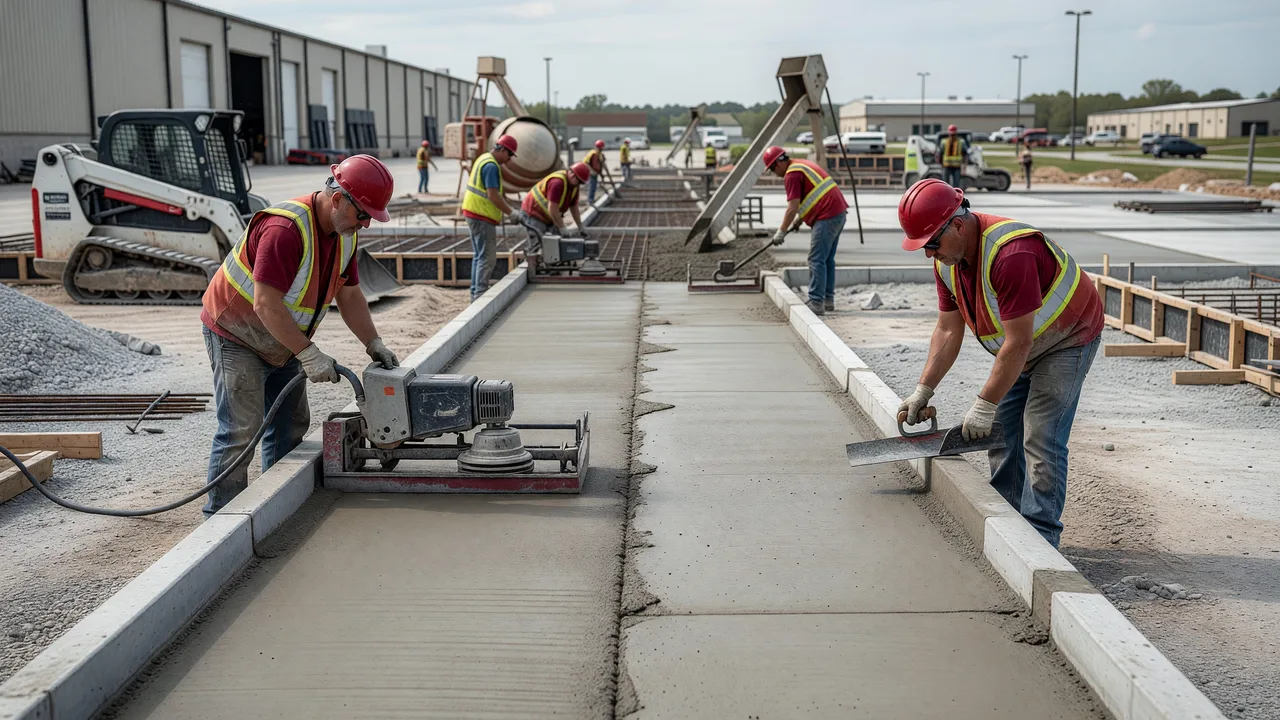
Direct comparison for commercial property owners, facility managers, and general contractors planning parking lots, warehouse sites, and ADA-compliant flatwork.
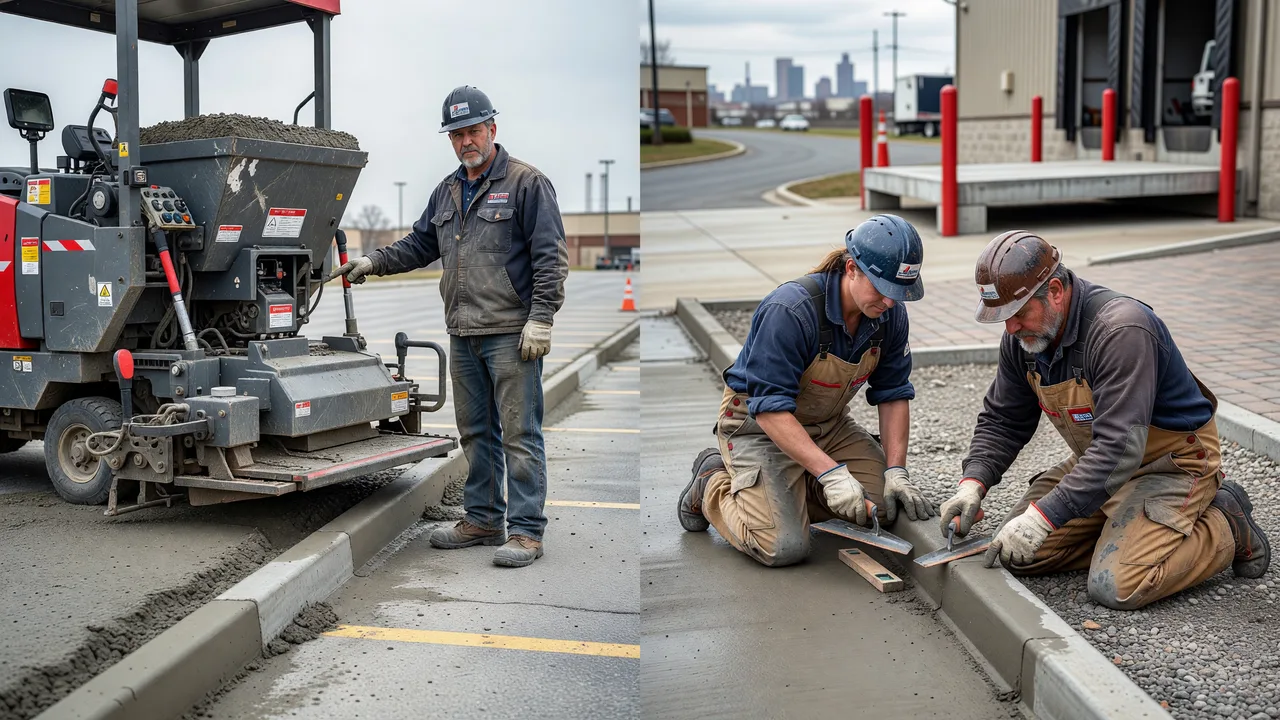
Machine-formed curb and gutter uses an extruder for straight, high-volume runs with consistent cross-sections and faster placement, while hand-formed work allows custom radii, transitions, and tight commercial layouts. In Ohio commercial applications, machine methods reduce labor hours on long parking-lot perimeters, yet hand forming remains necessary around loading docks, ADA. Call (330) 992-2617 to discuss your needs and next steps.
Direct Answer: Machine-Formed vs Hand-Formed Curb and Gutter OH
Machine-formed curb and gutter is produced by a slip-form extruder that places and shapes concrete in one continuous pass, delivering uniform sections over long straight distances typical of commercial parking lots. Hand-formed curb and gutter is built using wood or metal forms that are set and stripped by crews, allowing precise adjustments for curves, transitions, and connections to existing structures. Commercial projects in Ohio often combine both methods: machines handle perimeter runs while hand forming addresses loading-dock radii, ADA sidewalk tie-ins, and drainage inlets where tolerances affect inspection approval and long-term drainage performance.

How Machine-Formed Curb and Gutter Is Installed on Commercial Sites
A self-performing crew positions the extruder on a prepared subbase, maintains consistent slump, and advances the machine while monitoring edge slump and joint spacing. The process produces a monolithic section with integral gutter that resists Ohio freeze-thaw cycles when air entrainment and proper curing are maintained. Because no separate forming crew follows behind, the method reduces the number of workers on site and shortens the window when the area remains inaccessible to deliveries or tenant traffic.
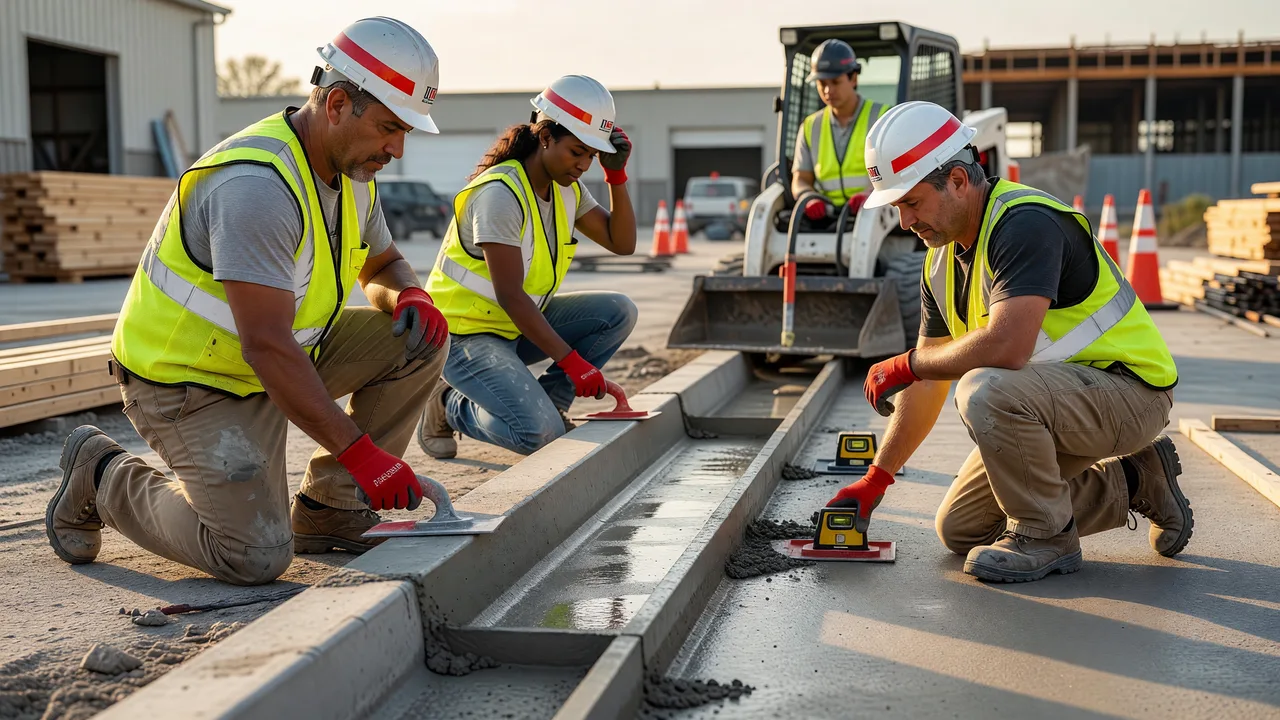 Photo by AI Generated (Grok Imagine)
How Hand-Formed Curb and Gutter Supports Complex Commercial Layouts
Hand forming begins with layout of radii, transitions, and inlet locations using stakes and string lines. Crews build forms that match the exact profile required by site plans, then place concrete in smaller pours that allow vibration around reinforcement and embedded anchors. This approach is required where machine access is blocked by existing structures, underground utilities, or the need for variable curb heights at warehouse door aprons. The additional labor hours are offset by fewer callbacks when drainage and ADA cross-slopes meet inspection on the first attempt.
Machine-Formed vs Hand-Formed Curb and Gutter OH Comparison
| Factor | Machine-Formed | Hand-Formed |
|---|---|---|
| Production speed | 300–500 linear feet per day on straight runs | 80–150 linear feet per day depending on complexity |
| Profile consistency | High; governed by machine mold | Dependent on form accuracy and crew skill |
| Best applications | Long parking-lot perimeters, warehouse site boundaries | Loading-dock radii, ADA transitions, inlet connections |
| Ohio winter durability | Excellent when air entrainment and joint spacing are controlled | Excellent when reinforcement and curing follow specifications |
| Subcontractor involvement | None; self-perform crews handle entire operation | None; self-perform crews handle entire operation |
Cost and Schedule Implications for Commercial Projects
Machine-formed curb and gutter typically lowers total labor cost on large straight sections because one operator and a small crew replace multiple form carpenters. Hand-formed sections carry higher unit pricing yet prevent costly rework when the layout includes multiple radii or must match existing elevations at tenant entrances. Facility managers evaluating best Machine-Formed vs Hand-Formed Curb and Gutter services in OH weigh these trade-offs against downtime for deliveries and the risk of failed inspections that delay certificate of occupancy.
Choosing the Right Method for Parking Lots and Warehouse Sites
Commercial parking-lot perimeters longer than 400 feet with consistent curb height favor machine forming because the extruder maintains alignment and slope without repeated form setting. Warehouse aprons that require depressed curb at dock doors or ADA-compliant sidewalk connections require hand forming to achieve the exact dimensions shown on civil drawings. Professional Machine-Formed vs Hand-Formed Curb and Gutter contractors review the civil plan early to allocate the correct crews and equipment, avoiding change orders that arise when the wrong method is bid.
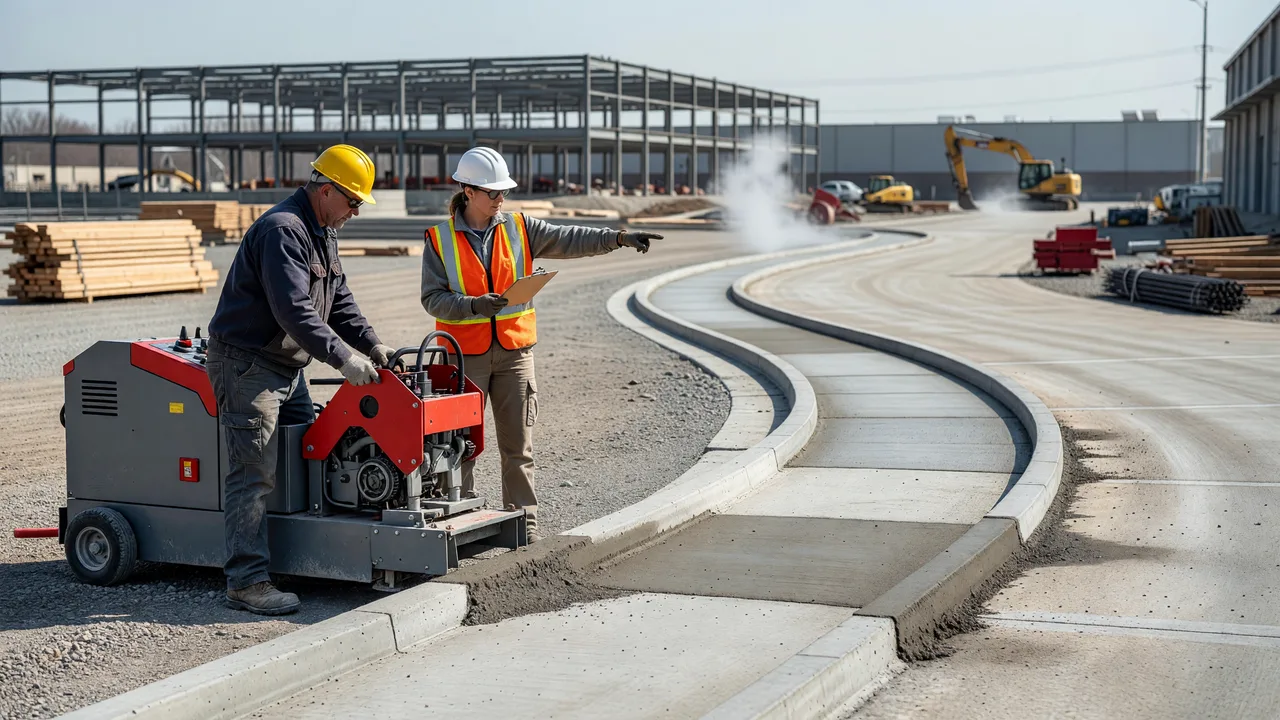 Photo by AI Generated (Grok Imagine)
Durability Considerations in Northeast Ohio Freeze-Thaw Cycles
Both methods can produce curb and gutter that survives repeated freeze-thaw cycles when concrete is specified with 5–7 % air entrainment, proper joint spacing, and adequate subbase compaction. Machine-formed sections benefit from continuous placement that reduces cold joints, while hand-formed sections allow additional reinforcement at stress points such as radius returns and inlet throats. Property owners concerned about recurring cracking after a few winters should verify that the crew placing the concrete also controls the mix design and curing procedures rather than relying on separate subcontractors.
Practical Recommendations Before Awarding Work
- Request a site walk with the concrete superintendent to identify straight runs versus complex transitions so the bid accurately reflects machine versus hand labor.
- Confirm the contractor self-performs all forming and placement rather than subcontracting the curb and gutter scope.
- Ask for the specific air-entrainment range and joint-sealant product planned for Ohio winter exposure.
- Verify current bonding capacity, insurance certificates, and OSHA 30-hour credentials for the crew that will be on site.
- Review a recent project photo set showing both machine and hand-formed details on a comparable commercial site.
ADA and Drainage Compliance Factors
ADA sidewalk cross-slopes and curb-ramp transitions are almost always hand formed because the required dimensions and detectable-warning placements vary at each location. Machine-formed curb can be placed adjacent to these details, but the interface must be detailed so water does not pond at the junction. Commercial projects that fail initial inspection often trace the issue to mismatched elevations between machine and hand work; a single accountable crew that performs both operations reduces that coordination risk.
Frequently Asked Questions About Machine-Formed vs Hand-Formed Curb and Gutter
How much does machine-formed vs hand-formed curb and gutter cost in OH?
What is the best machine-formed vs hand-formed curb and gutter company in OH?
How do I choose a machine-formed vs hand-formed curb and gutter provider in OH?
What should I look for in machine-formed vs hand-formed curb and gutter services?
How long does machine-formed vs hand-formed curb and gutter take?
Is machine-formed vs hand-formed curb and gutter worth the investment?
Request a Site-Specific Comparison for Your Project
Submit your civil drawings or site address for a detailed breakdown of machine-formed versus hand-formed sections, including production rates and compliance notes. Call Mattucci Construction to speak directly with the superintendent who will oversee the work.