
Commercial Concrete vs Residential Concrete — Key Differences Explained OH
A practical buyer guide for owners, facility managers, developers, and contractors evaluating concrete work by load, compliance, durability, cost drivers, and execution risk.
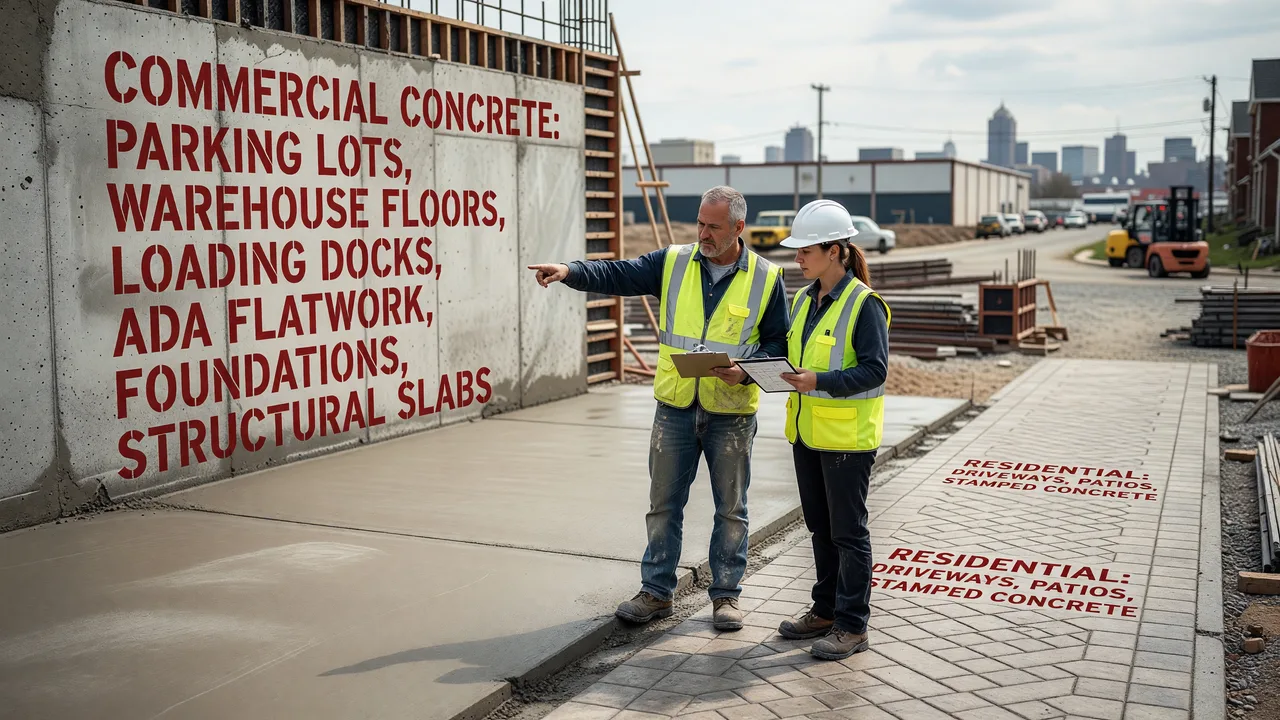
Commercial concrete and residential concrete use many of the same base materials, but they differ sharply in load demands, slab design, reinforcement, drainage, compliance, scheduling, and failure risk. Commercial work is built for heavier traffic, stricter inspections, and operational uptime, while residential concrete is. Call Call the visible office number listed on https://mattucciconstruction.net to discuss your needs and next steps.
Commercial Concrete vs Residential Concrete — the direct answer
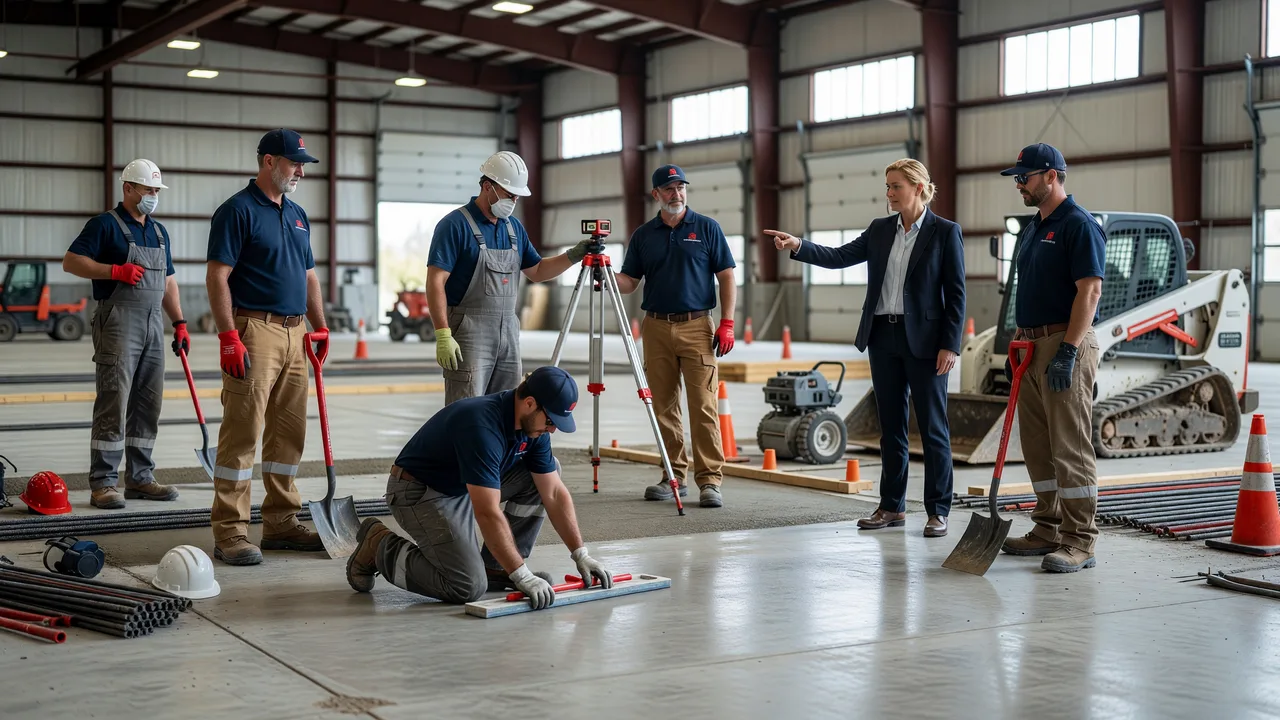 Photo by AI Generated (Grok Imagine)
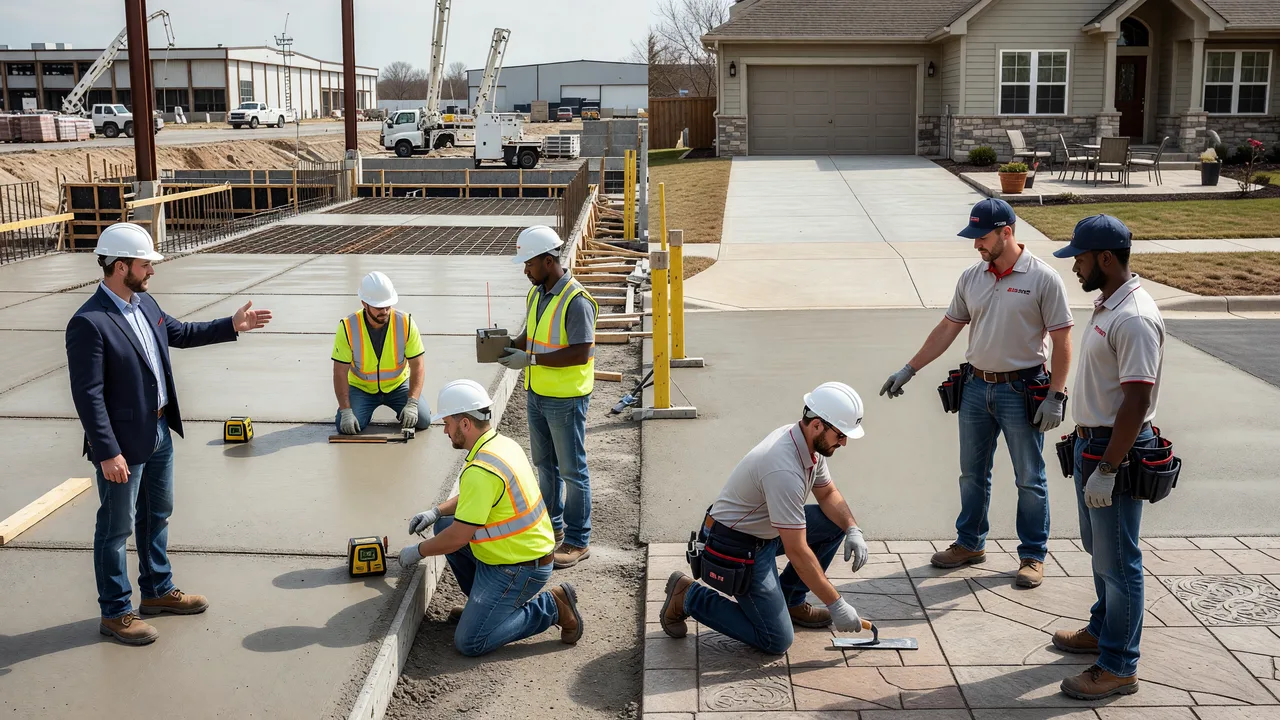
Commercial Concrete vs Residential Concrete — Key Differences Explained OH comes down to performance requirements. Commercial concrete is engineered and installed to handle heavier loads, tighter tolerances, stricter ADA and inspection standards, more complex site logistics, and higher consequences if it fails. Residential concrete usually serves lighter-duty applications such as driveways, patios, and walkways, where aesthetics matter but operational shutdowns, forklift traffic, and compliance exposure are typically lower.
For a buyer, the most important distinction is not simply strength. It is the total system: subgrade preparation, reinforcement, drainage strategy, jointing, finishing tolerances, curing, access planning, and accountability on the job. That is why a contractor experienced in warehouse floors, loading docks, parking lots, foundations, and ADA flatwork is often the right fit for commercial work, even if both project types are technically “concrete.”
Why the difference matters to buyers
Many property owners and project teams underestimate the gap between commercial and residential concrete because both involve forms, placement, finishing, and curing. In practice, the risk profile is entirely different. A residential driveway crack may be frustrating. A failed loading dock apron, ponding parking lot, out-of-tolerance warehouse slab, or noncompliant ADA route can interrupt operations, create liability, trigger rework, or fail inspection.
Commercial buyers are usually balancing multiple constraints at once: tenant access, delivery routes, pedestrian safety, drainage, sequencing with other trades, and schedule pressure. They also need to know who is actually responsible when problems appear. That accountability issue matters. Mattucci Construction’s position in the market is built around self-performing commercial concrete and masonry work rather than selling a project and turning it over to unknown subcontractors. For procurement teams, that changes communication, schedule control, and quality oversight in meaningful ways.
On the residential side, buyers often prioritize curb appeal, usable outdoor space, and cost containment. The slab still needs to last, especially in freeze-thaw climates, but it usually does not have to support repeated truck loading, industrial traffic, or commercial code scrutiny to the same degree. Understanding that difference helps buyers compare bids more intelligently and avoid using the wrong scope assumptions.
Side-by-side comparison: commercial concrete vs residential concrete
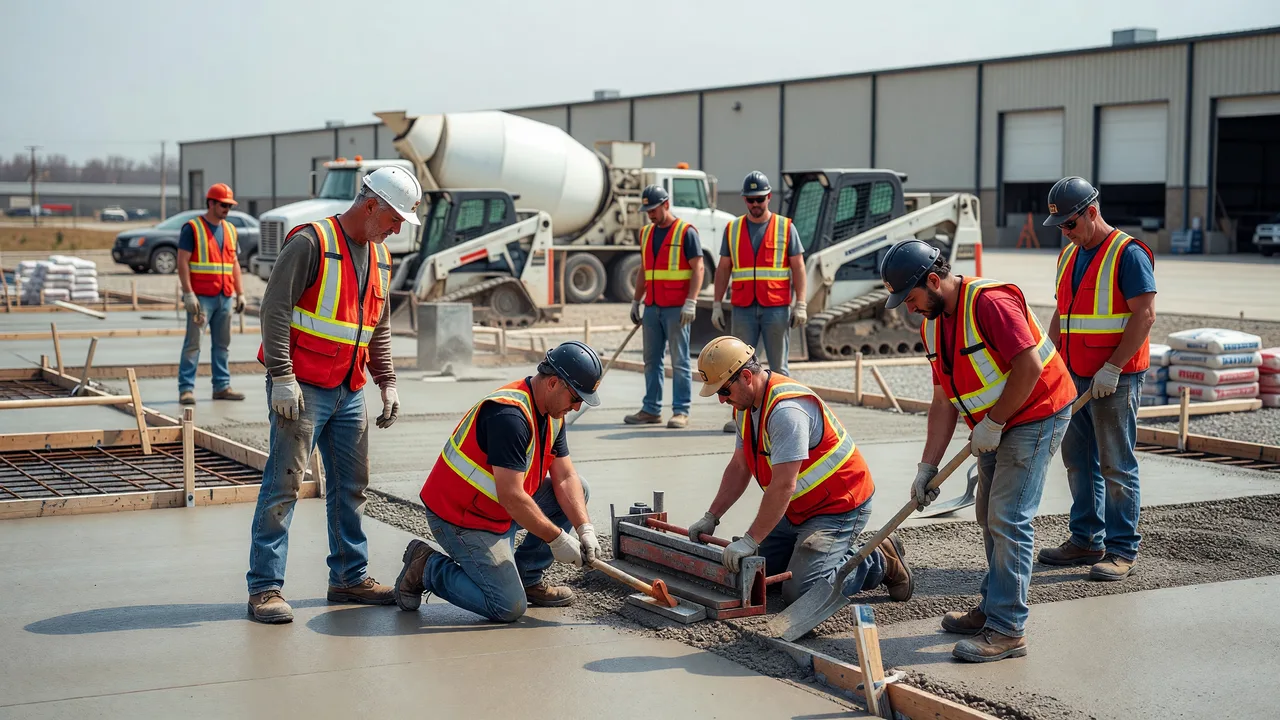 Photo by AI Generated (Grok Imagine)
| Category | Commercial Concrete | Residential Concrete |
|---|---|---|
| Typical use | Parking lots, warehouse floors, loading docks, ADA sidewalks, foundations, structural slabs, tenant build-outs | Driveways, patios, walkways, garage slabs, decorative flatwork |
| Load requirements | Designed for cars, trucks, forklifts, equipment, delivery traffic, or structural demands | Usually designed for passenger vehicles and foot traffic |
| Design complexity | Higher; often includes drainage planning, access sequencing, reinforcement strategy, and tolerance control | Moderate; often focused on function plus appearance |
| Compliance exposure | Frequently involves ADA, inspection, safety, and site management requirements | Typically lower regulatory complexity, depending on project type |
| Subgrade and base demands | More critical because settlement, rutting, and cracking can disrupt business operations | Important, but usually under lighter service conditions |
| Finishing priorities | Performance, drainage, slip resistance, elevation control, joint layout, traffic readiness | Appearance, texture, slope, decorative options, homeowner use |
| Failure consequences | Downtime, liability, tenant complaints, inspection issues, delivery disruption, costly repair | Reduced curb appeal, nuisance cracking, trip hazards, water runoff issues |
| Scheduling | Often phased around operations, tenants, deliveries, and other trades | Usually simpler access and coordination |
| Best contractor fit | Commercial-focused, bonded and insured, OSHA-compliant, self-performing crews | Residential or mixed-use contractor with strong flatwork experience |
The table shows why buyers should avoid comparing commercial and residential concrete as if they were interchangeable products. The material may look similar once cured, but the design assumptions and execution requirements are not the same. In commercial settings, the slab or paved area has to work under repeated stress, meet accessibility needs, and keep people and vehicles moving safely.
The biggest technical differences
The most practical way to understand Commercial Concrete vs Residential Concrete — Key Differences Explained OH is to break the comparison into the field conditions that drive success or failure.
Load capacity and intended traffic
Commercial concrete is commonly asked to handle far more than passenger cars. Think delivery trucks crossing a parking lot entrance, forklifts circulating in a warehouse, repeated impact near loading docks, or structural loads transferred through foundations and slabs. Those conditions influence thickness, reinforcement, base preparation, and joint layout.
Residential concrete usually sees lighter duty cycles. A driveway may carry family vehicles, and a patio may carry furniture and foot traffic. That does not mean residential work is simple; it means the slab is not usually designed for the same concentrated or repetitive loads seen in industrial or retail environments. If a contractor prices commercial work as if it were a basic residential slab, the underdesign risk is real.
Subgrade preparation and base stability
Concrete performance starts below the slab. Commercial projects typically require more rigorous subgrade evaluation and base preparation because settlement affects drainage, safety, and equipment performance. A slight low spot in a patio is annoying. A low spot in a parking lot can create ponding, ice, accelerated deterioration, and customer complaints. Settlement in a warehouse floor can affect traffic flow and maintenance.
For buyers, this is one of the easiest places for low-bid proposals to hide risk. Surface finish is visible on day one. Inadequate base work shows up later as cracking, rocking slabs, broken edges, and chronic patching. If the project must survive years of heavy use and repeated freeze-thaw cycles, the base and drainage plan deserve as much attention as the mix itself.
Reinforcement, slab design, and structural role
Not all concrete is performing the same structural function. Commercial work may include foundations and footers, structural slabs, tilt-up concrete construction, retaining walls, and other assemblies where reinforcement strategy and geometry are central to the project. Even flatwork such as loading areas or industrial floors can require tighter design discipline because edge conditions and repeated loading are more severe.
Residential flatwork is often simpler in structural terms, especially for patios and standard walkways. Decorative considerations like stamped concrete may become more prominent. In contrast, commercial buyers usually care more about serviceability: whether the slab drains correctly, carries traffic, meets slope and accessibility requirements, and holds up through years of use.
Drainage and water management
Drainage is one of the most underestimated differences between project types. Commercial concrete often has to move water away from storefronts, dock doors, equipment pads, access aisles, and pedestrian routes while maintaining usable grades. Improper slope can create slip hazards, freeze-thaw damage, and accessibility issues. In parking lots and site concrete, drainage is not a cosmetic detail; it is part of the asset’s performance.
Residential work still needs proper pitch and runoff control, but the stakes are usually lower. Water standing on a patio is inconvenient. Water standing at a dock, accessible route, or business entrance is a liability and maintenance problem. That is why experienced commercial crews spend more time on elevations, transitions, and tie-ins.
Tolerances, finish, and usability
A smooth-looking slab is not necessarily a usable commercial slab. Warehouse and industrial floors often demand flatter, more consistent surfaces than typical residential work. Loading docks need reliable elevations. ADA sidewalks and flatwork need compliant transitions and slopes. Parking lots need drainage without creating abrupt grade changes that hold water or damage vehicles.
Residential buyers may focus on appearance first, especially with stamped or decorative concrete. Commercial buyers should focus on serviceability first. The right finish is the one that supports the intended use, traffic type, and maintenance plan while reducing long-term failure points.
Compliance, inspection, and jobsite risk
Commercial projects often involve greater oversight. ADA routes, sidewalk cross-slope, transitions at ramps, safety during phased work, and documentation expectations can all matter. Procurement teams also care whether the contractor is bonded and insured and whether crews are OSHA-compliant, because that affects site risk and prequalification confidence.
Residential concrete can still require permits and good practice, but the compliance environment is generally less demanding. For commercial owners and general contractors, choosing a contractor who routinely works under inspection and safety expectations reduces the likelihood of rework and dispute. Mattucci Construction’s commercial focus, self-perform model, bonded and insured status, and OSHA-compliant crews align directly with those concerns.
How costs differ between commercial and residential concrete
When buyers ask, “How much does commercial concrete vs residential concrete — key differences explained cost in null?” the honest answer is that cost depends less on the label and more on the load demands, access constraints, drainage complexity, reinforcement, demolition requirements, phasing, and finish tolerances. The word “null” in some keyword phrases is clearly a search-data artifact, but the buying question itself is legitimate: commercial work usually costs more because it is built to do more and because failure costs more.
Commercial concrete pricing is commonly driven by scope conditions such as heavy-duty slab sections, larger excavations, more involved base prep, traffic control, demolition and haul-off, coordination with operating businesses, and compliance-sensitive flatwork. A parking lot replacement, ADA sidewalk upgrade, or loading dock repair often includes prep and sequencing costs that do not exist on a simple patio pour.
Residential work can still become expensive if decorative finishes, difficult access, poor soil conditions, or drainage correction are involved. But in general, a standard residential driveway or patio has fewer operational constraints than a commercial slab or site-concrete package. The better buying approach is to compare scope assumptions line by line rather than chase a low square-foot number with no context.
Some related search terms, such as “how much does ada-sidewalk cost in Macedonia OH,” “how much does parking-lot cost in Twinsburg OH,” “how much does parking-lot cost in Macedonia OH,” and “best parking-lot near me,” all point to the same underlying issue: buyers want clarity on what drives price. The main drivers are not just square footage. They are thickness, reinforcement, drainage, demolition, accessibility requirements, tie-ins, site access, curing windows, and whether the work must be phased to keep operations moving.
How timelines differ
Commercial concrete usually takes longer to plan and coordinate, even when placement itself happens quickly. A warehouse floor, parking lot section, foundation package, or ADA flatwork project may require demolition, grading, inspection coordination, traffic rerouting, weather sequencing, curing protection, and staged access for tenants or deliveries. The schedule is not only about pour day; it is about keeping the site functional before, during, and after the work.
Residential projects often move faster because access is simpler and fewer stakeholders are involved. That said, timeline depends on project size, weather, complexity, and curing requirements. Buyers should ask for a realistic sequence of work rather than a vague start-and-finish promise. A credible contractor should explain what happens in prep, placement, protection, and return-to-service stages.
For commercial owners, the best timeline question is not “How many days is the crew on site?” It is “How will this affect operations, deliveries, customer access, and inspection milestones?” That framing separates experienced commercial contractors from companies that mainly think in residential terms.
What to look for in commercial concrete vs residential concrete services
If you are evaluating Commercial Concrete vs Residential Concrete — Key Differences Explained contractor options, focus on fit, not just availability. The right provider for a decorative backyard patio may not be the right provider for an active commercial property with loading activity, ADA concerns, and inspection exposure.
- Relevant project mix: Look for proven commercial capabilities such as parking lots and site concrete, warehouse and industrial floors, loading docks, ADA sidewalks and flatwork, foundations and footers, tilt-up concrete construction, tenant build-outs, and concrete repair and restoration.
- Self-performed work: Ask who will actually be on the job. A self-performing contractor gives owners and GCs a clearer accountability chain than a sales-led company relying on subcontractor rotation.
- Risk controls: Bonded and insured status matters. OSHA-compliant crews matter. These are not marketing extras; they are procurement and site-risk considerations.
- Scope clarity: A useful Commercial Concrete vs Residential Concrete — Key Differences Explained estimate should spell out demolition, subgrade prep, reinforcement assumptions, drainage, jointing, finish, and sequencing.
- Repair mindset: The contractor should understand common failure points, not just new placement. That is especially relevant for parking lots, dock approaches, and industrial floors that are being restored or tied into existing slabs.
Buyers searching phrases like “commercial-concrete in Twinsburg OH” or “concrete masonry construction in Macedonia OH” are usually trying to find a contractor with true commercial depth rather than a generic concrete company. That distinction matters nationally as well: commercial scope knowledge is a specialization, not just a larger version of residential flatwork.
Mattucci Construction fits that commercial buyer profile closely. The company is family-owned, has been in business more than 20 years, self-performs commercial concrete and masonry work, and operates with bonded and insured, OSHA-compliant crews. Its commercial scope includes parking lots and site concrete, warehouse and industrial floors, loading docks, ADA flatwork, foundations and footers, tilt-up concrete construction, masonry, retaining walls, tenant build-outs, and repair and restoration. For secondary residential needs, the company also handles driveways, patios, and stamped concrete, but its differentiation is strongest where commercial durability and accountability matter most.
Practical recommendations before you request bids
If you need concrete work and are deciding whether commercial or residential experience is sufficient, take these steps before sending the project out.
- Define the traffic: List whether the surface will carry passenger vehicles, heavy trucks, forklifts, pallet jacks, or repeated impact at doors and dock areas.
- Identify compliance-sensitive areas: Note accessible routes, sidewalk transitions, entrances, loading zones, and tenant circulation paths.
- Document drainage problems: Record where water ponds, freezes, back-pitches, or runs toward doors. These issues should shape the scope, not be treated as punch-list items.
- Ask who performs the work: Do not assume the company you hire is the crew that shows up. Accountability should be explicit.
- Compare schedule approaches: Review how each bidder plans demolition, access, protection, phasing, and cure time.
- Request a usable consultation: A strong Commercial Concrete vs Residential Concrete — Key Differences Explained consultation should surface site constraints, not just measure square footage.
For buyers comparing “best Commercial Concrete vs Residential Concrete — Key Differences Explained null,” “top Commercial Concrete vs Residential Concrete — Key Differences Explained null,” “professional Commercial Concrete vs Residential Concrete — Key Differences Explained null OH,” “affordable Commercial Concrete vs Residential Concrete — Key Differences Explained null,” and similar searches, the real differentiator is not a keyword superlative. It is whether the contractor understands the service environment of the slab and can explain how the design and installation choices reduce future failures.
The same principle applies to phrases like “Commercial Concrete vs Residential Concrete — Key Differences Explained near me,” “Commercial Concrete vs Residential Concrete — Key Differences Explained services null OH,” “Commercial Concrete vs Residential Concrete — Key Differences Explained best null OH,” “Commercial Concrete vs Residential Concrete — Key Differences Explained top null OH,” “Commercial Concrete vs Residential Concrete — Key Differences Explained affordable null OH,” “Commercial Concrete vs Residential Concrete — Key Differences Explained professional null OH,” “Commercial Concrete vs Residential Concrete — Key Differences Explained null near me,” and “services Commercial Concrete vs Residential Concrete — Key Differences Explained null.” Those search phrases may be awkward, but the decision criteria are consistent: match the contractor to the risk level of the project.
Is commercial concrete worth the added investment?
In the right application, yes. Commercial concrete is worth the investment when the slab or paved surface must handle heavy use, maintain safe access, pass inspection, and avoid recurring shutdowns or repairs. Paying for stronger preparation, better sequencing, and commercial-grade execution usually costs less than repeated patching, premature replacement, or operational disruption.
This is especially true for assets such as parking lots, industrial floors, loading docks, foundations, and ADA flatwork. These are not cosmetic-only surfaces. They affect access, logistics, liability, and the usable life of the property. For lighter-duty residential applications, the added complexity of a commercial approach may not always be necessary, but the discipline behind it can still be valuable when durability is the priority.
In climates with repeated freeze-thaw exposure, durability planning matters even more. Buyers should not reduce the decision to appearance or initial price. The better question is whether the completed work is designed for the real-world stresses it will face over time.
A measured next step for buyers
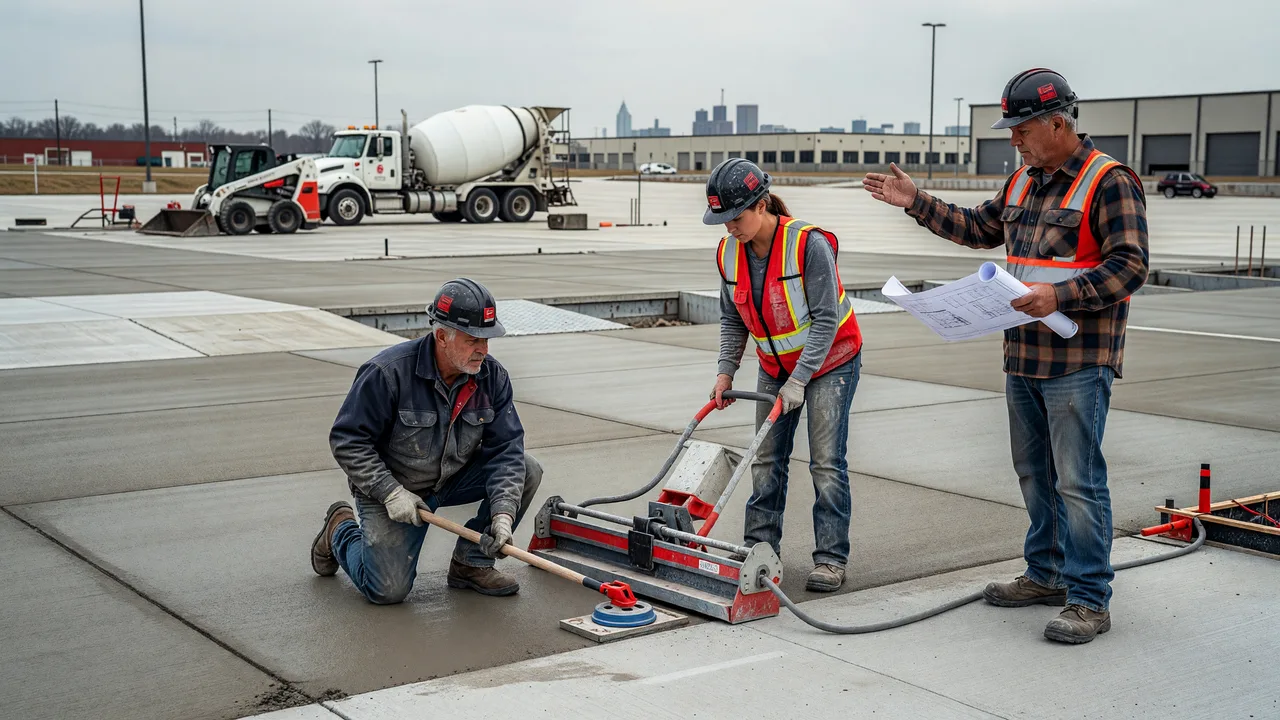 Photo by AI Generated (Grok Imagine)
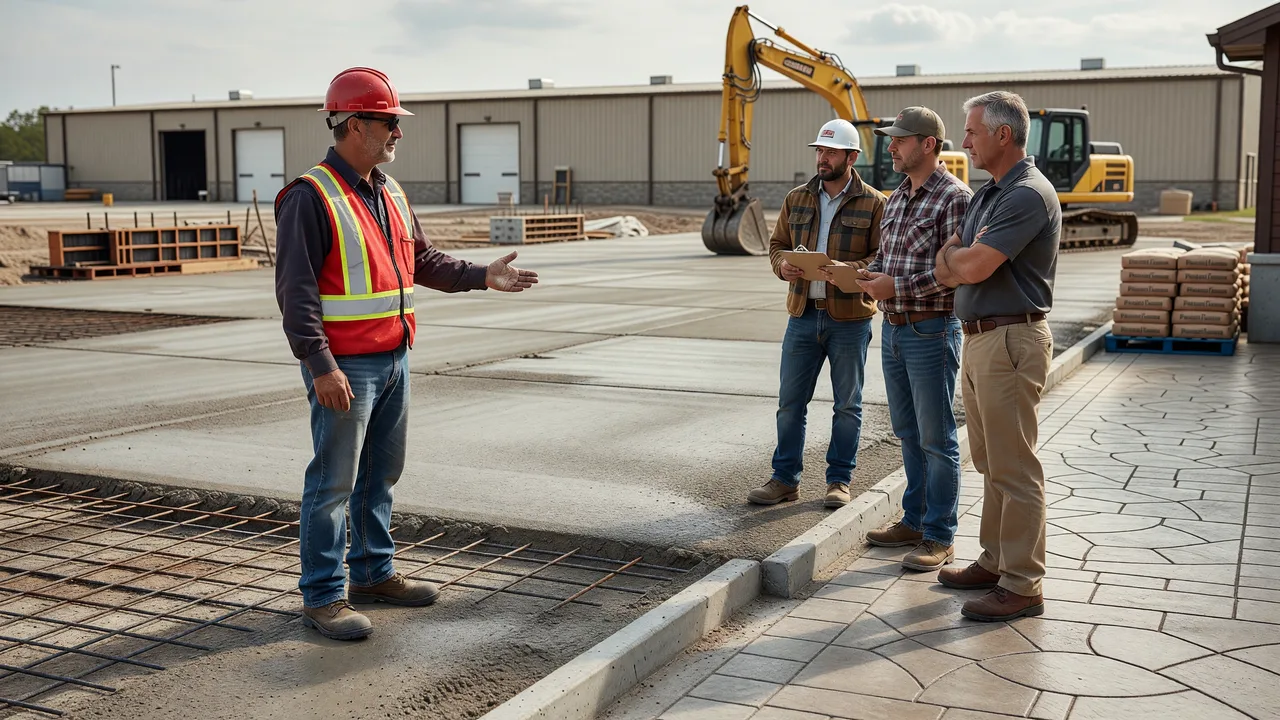
If your project involves commercial traffic, ADA requirements, site drainage, industrial use, foundations, or schedule-sensitive concrete work, it is worth getting a scope review from a contractor that works in those conditions routinely. Mattucci Construction is a family-owned commercial concrete and masonry contractor with more than 20 years in business, a current approximate 4.8 Google rating from 19 reviews, self-performing crews, and bonded, insured, OSHA-compliant operations.
For owners, facility managers, developers, and general contractors, that combination speaks to the issues that matter most: one accountable crew, commercial-specific scope knowledge, and execution built around heavy use and inspection reality rather than simple curb appeal. To discuss a project, use the quote request form at https://mattucciconstruction.net or call the visible office number on the website.
Frequently Asked Questions About Commercial Concrete vs Residential Concrete — Key Differences Explained
How much does commercial concrete vs residential concrete cost?
How much does commercial concrete vs residential concrete cost?
Commercial concrete usually costs more because the scope often includes heavier-duty slab design, more extensive subgrade prep, reinforcement, drainage control, demolition, access management, and phased scheduling. Residential concrete is often less complex, especially for patios or standard driveways. The most accurate way to compare cost is to review load requirements, site conditions, demolition, drainage, and finish expectations rather than rely on a generic square-foot price.
What is the best commercial concrete vs residential concrete company?
What is the best commercial concrete vs residential concrete company?
The best company is the one whose actual project mix matches your risk level. For commercial work, look for a contractor with direct experience in parking lots, warehouse floors, loading docks, ADA flatwork, foundations, and repair work; a self-perform model; and bonded, insured, OSHA-compliant crews. Mattucci Construction is particularly well-positioned for commercial concrete and masonry buyers because it self-performs and focuses on high-consequence commercial applications.
How do I choose a commercial concrete vs residential concrete provider?
How do I choose a commercial concrete vs residential concrete provider?
Start by matching the contractor to the service conditions of the slab. Ask what similar work they do most often, who will perform the work, how they handle drainage and base prep, whether they are bonded and insured, and how they coordinate around active operations. If the project includes ADA concerns, heavy traffic, or structural scope, choose a commercial-focused provider rather than a contractor centered on residential decorative flatwork.
What should I look for in commercial concrete vs residential concrete services?
What should I look for in commercial concrete vs residential concrete services?
Look for scope clarity, not broad promises. A strong proposal should address demolition, grading, subgrade prep, reinforcement assumptions, slopes and drainage, jointing, finish type, access constraints, phasing, and cure protection. Also verify whether the work is self-performed and whether the crews are OSHA-compliant. Those factors are especially important on commercial properties where safety, access, and accountability are major concerns.
How long does commercial concrete vs residential concrete take?
How long does commercial concrete vs residential concrete take?
Commercial projects often take longer to plan and sequence because they may involve larger footprints, demolition, inspections, traffic control, tenant access, and phased operations. Residential projects are often faster because there are fewer stakeholders and simpler logistics. The right question is not just duration, but how the work will affect access, deliveries, and return-to-service timing.
Is commercial concrete vs residential concrete worth the investment?
Is commercial concrete vs residential concrete worth the investment?
Yes, when the application demands it. Commercial-grade concrete work is worth the investment for properties that need durability under heavy traffic, dependable drainage, safer access, and fewer shutdowns or callbacks. If the slab supports operations or public access, underbuilding the scope can be far more expensive than getting it right the first time.
Does commercial concrete use different concrete than residential concrete?
Does commercial concrete use different concrete than residential concrete?
Sometimes, but not always in a simple one-material-versus-another sense. The bigger difference is how the system is designed and installed: slab thickness, reinforcement, base prep, joint layout, finishing tolerances, and drainage. Two projects may both use concrete, but one may require a much more demanding build because of traffic loads, structural function, or compliance needs.
Can a residential concrete contractor do commercial work?
Can a residential concrete contractor do commercial work?
Some can, but buyers should not assume that residential experience automatically translates to commercial competence. Commercial projects involve different failure points: heavier use, stricter tolerances, ADA requirements, phased access, and inspection exposure. If the project affects operations, safety, or logistics, a contractor with established commercial experience is usually the safer choice.
Why does self-performing matter on commercial concrete projects?
Why does self-performing matter on commercial concrete projects?
Self-performing matters because it creates a single accountability chain. Owners and general contractors know who is staffing the project, who is sequencing the work, and who is responsible if problems arise. On schedule-sensitive commercial jobs, that reduces the confusion that can happen when a company sells the job and hands field execution to outside crews.
Does masonry experience matter when evaluating a commercial concrete contractor?
Does masonry experience matter when evaluating a commercial concrete contractor?
Yes, especially on projects where site structures, retaining walls, tenant build-outs, or broader exterior scope are involved. A contractor with both commercial concrete and masonry capability can often coordinate related scopes more cleanly, which simplifies scheduling and responsibility. Mattucci Construction’s combined commercial concrete and masonry focus is relevant for buyers managing integrated site and building work.
Need a commercial concrete scope reviewed by an accountable crew?
If you are comparing commercial and residential concrete options for a parking lot, warehouse floor, loading dock, ADA flatwork, foundation, or repair project, request a quote through the form at mattucciconstruction.net. Mattucci Construction is family-owned, self-performing, bonded and insured, and operates with OSHA-compliant crews.