
Commercial Concrete Construction Guide (Akron) | Mattucci Co
The Ultimate Guide to Commercial Concrete Construction for Property Managers in Akron, Ohio
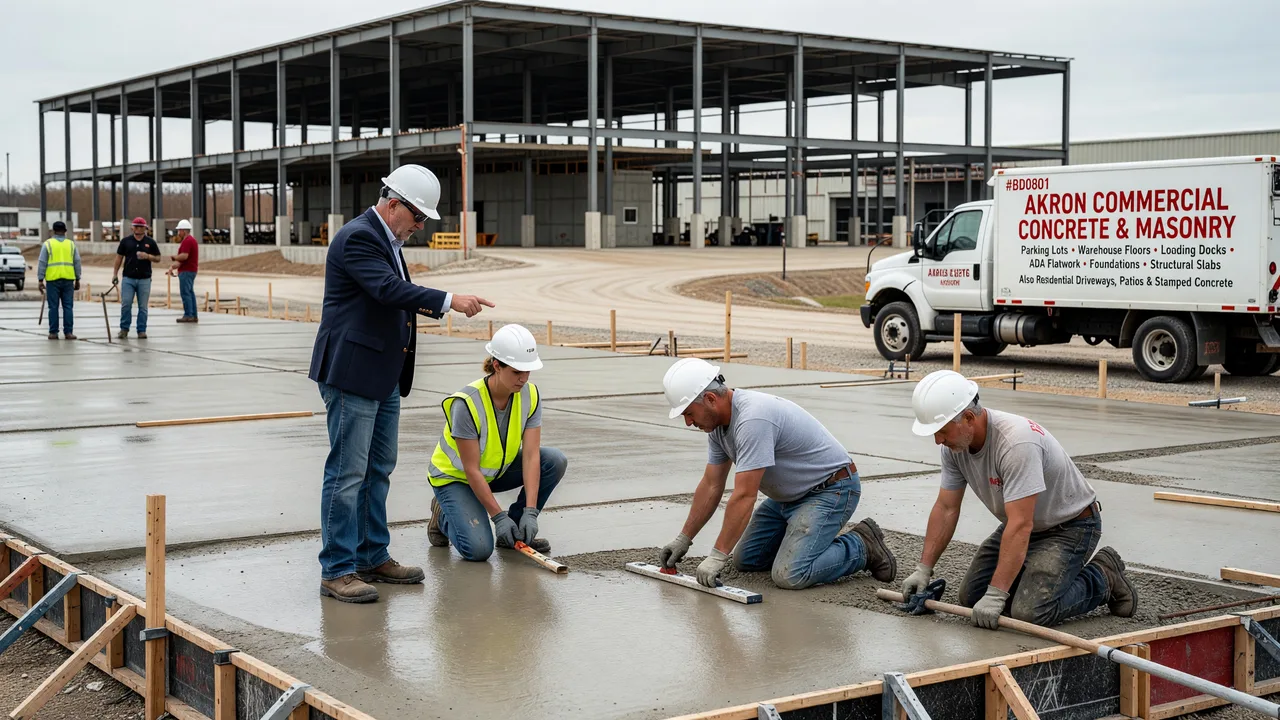
Managing commercial property in Northeast Ohio comes with a unique set of challenges — freeze-thaw cycles that can push 60+ per year, aggressive winter road salt, heavy industrial loading, and ever-tightening ADA and stormwater regulations. Concrete is the single most important building material on nearly every commercial site, yet it is often the most misunderstood. This commercial concrete construction guide was written specifically for property owners, facility managers, and general contractors across the Akron–Cleveland corridor who need to make smart, defensible decisions about concrete and masonry investments.
At Mattucci Construction, we have poured, formed, and finished commercial concrete across Summit County for decades — from warehouse slabs in Copley and Norton to parking lots in downtown Akron, loading docks along the Route 8 corridor, and ADA flatwork at retail centers near Chapel Hill and Montrose. What follows is the practical, expert-level knowledge we wish every property manager had before requesting a bid.
1. Understanding the Major Categories of Commercial Concrete Work
Not all concrete is created equal, and the mix design, reinforcement, and finishing techniques vary dramatically based on the application. A property manager overseeing a mixed-use portfolio in Akron will typically encounter six major categories:
- Parking lots and drive lanes — typically 6″ to 8″ reinforced slabs over a compacted aggregate base, engineered for repeated axle loads and freeze-thaw durability.
- Warehouse and industrial floors — high-tolerance slabs (often FF/FL floor-flatness rated) ranging from 6″ to 10″ thick, sometimes with fiber reinforcement or post-tensioning.
- Loading docks and approach aprons — heavily reinforced 8″+ slabs with hardened edges, expansion joints, and dock levelers integrated into the pour.
- ADA-compliant flatwork — sidewalks, ramps, curb cuts, and detectable warning surfaces meeting ADA 2010 Standards and Ohio Building Code Chapter 11.
- Foundations and structural slabs — footings, stem walls, grade beams, and elevated slabs designed by a licensed structural engineer.
- Masonry and decorative work — CMU walls, retaining walls, stamped concrete entryways, and architectural finishes.
Each category has its own code requirements, industry standards (ACI 318, ACI 302, ASTM C94), and long-term maintenance profile. Confusing them — or hiring a contractor who does — is the fastest way to end up with premature failure.
Video by
Site Engine
2. Why Northeast Ohio’s Climate Demands a Different Standard
Akron sits in ASHRAE Climate Zone 5A and experiences an average of 60–70 freeze-thaw cycles annually, according to NOAA data. Combined with heavy application of deicing salts on commercial parking areas, this creates one of the most aggressive concrete environments in the United States.
What this means practically:
- Air-entrained mixes are non-negotiable. ODOT and ACI recommend 5–8% entrained air for exterior flatwork. We specify 6.5% ± 1.5% on virtually every exterior pour.
- Minimum 4,000 psi compressive strength for exterior commercial concrete, with 4,500 psi being our standard for parking areas and 5,000 psi for loading docks.
- Proper curing is critical. A cure of at least 7 days using curing compound or wet curing dramatically extends service life.
- Sealing every 2–3 years with a penetrating silane/siloxane sealer can extend the life of exterior concrete by 40% or more.
Cheap concrete is expensive concrete. A parking lot that fails in 8 years instead of lasting 25+ costs the owner three times as much over the building lifecycle.
3. Commercial Concrete Costs, Timelines, and What Drives Them
Every property manager wants to know two things up front: what will it cost and how long will it take. While every project is unique, these Akron-area benchmarks reflect typical 2024–2025 pricing for quality commercial work:
- Commercial parking lots: $8–$14 per square foot installed (including base prep, reinforcement, jointing, and sealing)
- Warehouse floors: $7–$12 per square foot for standard-tolerance slabs; $14–$20+ for superflat FF50+ specifications
- ADA sidewalks and ramps: $10–$16 per square foot, with detectable warning panels adding $200–$400 each
- Loading docks: $15–$25 per square foot including formwork, embeds, and heavy reinforcement
- Structural foundations: Highly variable — typically $12–$30+ per square foot depending on depth, soil conditions, and engineering
Timelines are driven more by weather windows and cure time than by pour speed. A 20,000 SF parking lot typically requires 2–3 weeks from mobilization to open-for-traffic. Structural slabs need 28 days to reach design strength, though they can accept construction loads much sooner. Cold-weather pours (below 40°F) require heated enclosures, blankets, and Type III cement — adding 15–25% to project cost. This is why we always recommend scheduling major exterior concrete work between April and mid-October in the Akron area.
4. ADA Compliance and Stormwater — The Two Areas That Get Owners Sued
Two categories account for the majority of concrete-related liability we see in Summit County: ADA violations and stormwater management failures. Both are enforceable, both are inspected, and both can be avoided with proper planning.
ADA requirements every property manager must verify:
- Accessible routes with maximum 1:20 running slope (5%) and 1:48 cross slope (2.08%)
- Ramps at maximum 1:12 slope with landings at top, bottom, and every 30″ of rise
- Detectable warning surfaces (truncated domes) at all curb cuts and transit boarding areas
- Accessible parking spaces sized per Ohio Building Code with van-accessible spaces at 132″ wide including access aisle
- Maximum 1/4″ vertical change in surface, or up to 1/2″ if beveled at 1:2
Stormwater considerations in Akron include compliance with the City of Akron’s post-construction stormwater standards and, for larger sites, EPA NPDES permits. Pervious concrete, proper drainage slopes (minimum 1% for asphalt-adjacent, 1.5%+ for standalone), and integrated trench drains can transform a compliance headache into a competitive advantage.
5. How to Vet a Commercial Concrete Contractor in the Akron Market
The Akron–Cleveland corridor has no shortage of contractors advertising “commercial concrete” services. Very few actually have the equipment, crews, and experience to deliver on projects over 10,000 SF. When soliciting bids, we recommend property managers require the following:
- Proof of $2M+ general liability and workers’ comp coverage with your entity listed as additional insured
- Bonding capacity appropriate for the project size (typically 1.5x contract value)
- ACI-certified finishers on the crew, not just the estimator
- References from three projects of similar scope completed in the last 24 months in Northeast Ohio
- A detailed mix design specification with compressive strength, air content, slump, and w/c ratio — not just “6-inch concrete”
- Joint layout drawings before the pour, showing control joints, construction joints, and isolation joints
- A written warranty — at minimum 1 year on workmanship, with clear language on what is and isn’t covered
Beware of bids that are 20%+ below the average. In our experience, that gap almost always represents cut corners on base preparation, rebar, or mix quality — problems that won’t surface until well after the contractor is gone.
6. Preventive Maintenance: Protecting the Investment
A well-installed commercial concrete surface should last 25–40 years in the Akron climate. Getting there requires a modest but consistent maintenance program:
- Annual inspection in spring after freeze-thaw season — document any new cracks, spalls, or joint failures
- Joint sealant replacement every 5–7 years to prevent water intrusion under the slab
- Penetrating sealer application every 2–3 years on exterior surfaces
- Prompt crack repair using appropriate materials — hairline cracks with epoxy injection, larger cracks with routed and sealed repair
- Snow removal best practices — plastic or rubber-edged plows, calcium chloride instead of rock salt when possible, no deicers during the first winter after installation
A parking lot that receives $0.15/SF/year in preventive maintenance will typically outlast an unmaintained lot by 10–15 years — an ROI that is difficult to beat anywhere in a commercial facilities budget.
Frequently Asked Questions
How long does commercial concrete take to cure before it can handle traffic?
Commercial concrete reaches roughly 70% of design strength at 7 days and 100% at 28 days. Pedestrian traffic can typically resume after 24–48 hours, standard vehicle traffic after 7 days, and full truck/loading dock traffic after 28 days. Cold weather extends these windows, while accelerating admixtures can shorten them. For time-sensitive Akron projects like retail reopens, we can specify high-early-strength mixes that reach traffic-ready strength in 3–5 days.
What’s the difference between concrete and asphalt for a commercial parking lot?
Asphalt has a lower upfront cost ($4–$7/SF vs. $8–$14/SF for concrete) but a service life of only 15–20 years with regular sealcoating and resurfacing. Concrete typically lasts 25–40 years with minimal maintenance and handles heavy truck loads far better. For Akron properties with significant truck traffic — distribution centers, industrial parks, medical facilities with ambulance traffic — concrete’s lifecycle cost is almost always lower. For low-traffic retail lots, asphalt can be more economical.
Do I need a permit for commercial concrete work in Akron?
Yes, most commercial concrete work in the City of Akron requires permitting through the Department of Planning and Urban Development. Parking lot construction, structural foundations, retaining walls over 4 feet, and any ADA modifications all require permits and typically plan review. Surrounding communities like Cuyahoga Falls, Stow, Fairlawn, and Hudson each have their own requirements. A qualified contractor will handle permitting as part of the scope — always confirm this in writing before signing.
Why does concrete crack, and when should I be concerned?
All concrete cracks — it’s a matter of controlling where. Hairline shrinkage cracks appearing within the first year are normal and cosmetic. Concerning cracks are those that: exceed 1/4″ in width, show vertical displacement (one side higher than the other), run through the full depth of the slab, or appear in structural elements. Control joints (the tooled lines you see every 10–15 feet) are engineered to force cracks to occur in hidden, predictable locations. If your slab lacks proper joint spacing, random cracking is inevitable.
Can commercial concrete be poured in the winter in Northeast Ohio?
Yes, but with significant precautions and additional cost. Cold-weather concreting per ACI 306 requires ambient temperatures above 40°F during placement, protection blankets or heated enclosures to maintain concrete temperature above 50°F for at least 3 days, and often the use of Type III (high-early-strength) cement or accelerating admixtures. Expect a 15–25% cost premium and longer schedules. For non-emergency work, we always recommend scheduling between April and mid-October in the Akron area for best quality and value.
Partner With Akron’s Commercial Concrete Experts
Whether you’re planning a new warehouse floor in Copley, replacing a failing parking lot near downtown Akron, upgrading ADA access at a Fairlawn medical building, or specifying a loading dock for a distribution facility along I-77, the concrete decisions you make today will affect your property’s performance, liability exposure, and net operating income for decades.
Mattucci Construction has been the trusted commercial concrete and masonry partner for property managers, general contractors, and developers across Summit County and the greater Akron–Cleveland corridor. We bring ACI-certified finishers, fully insured crews, transparent bidding, and a warranty we stand behind — because our reputation was built one pour at a time.
Ready to get a professional assessment of your project? Explore our full range of commercial concrete and masonry services or contact our estimating team today for a no-obligation site visit and detailed proposal.
About the Author
Mattucci Construction is a family-operated concrete and masonry contractor serving the Akron–Cleveland Northeast Ohio corridor. Specializing in commercial parking lots, industrial warehouse floors, loading docks, ADA flatwork, structural foundations, and decorative masonry, our team combines decades of hands-on field experience with modern engineering standards. We are fully licensed, insured, and bonded in the State of Ohio, and we are proud members of the local construction community — the same community we live, work, and raise our families in. When property managers across Summit County need concrete done right the first time, they call Mattucci.
Request an Estimate
Share your project details and we’ll send a free estimate.
☎ Call 330-992-2617
Request My Free Estimate
Ready to Get Started?
Mattucci Construction provides expert Concrete & Masonry Contractor in Akron and surrounding areas.
Contact Us Today
Call 330-992-2617
Frequently asked questions
How much does our service in Akron cost?
Mattucci Construction offers transparent pricing and a free initial consultation. Final cost depends on your specific situation — contact us for a no-obligation quote.
How long does our service take?
Timelines vary by case, but Mattucci Construction provides a clear estimate up front and same-day scheduling where possible.
Frequently asked questions
How much does commercial concrete construction guide in Akron cost?
How long does commercial concrete construction guide take?
Do you serve Akron?
What should I do first?
Request an Estimate
Share your project details and we’ll send a free estimate.
☎ Call 330-992-2617