
What PSI Concrete Do Commercial Parking Lots Need?
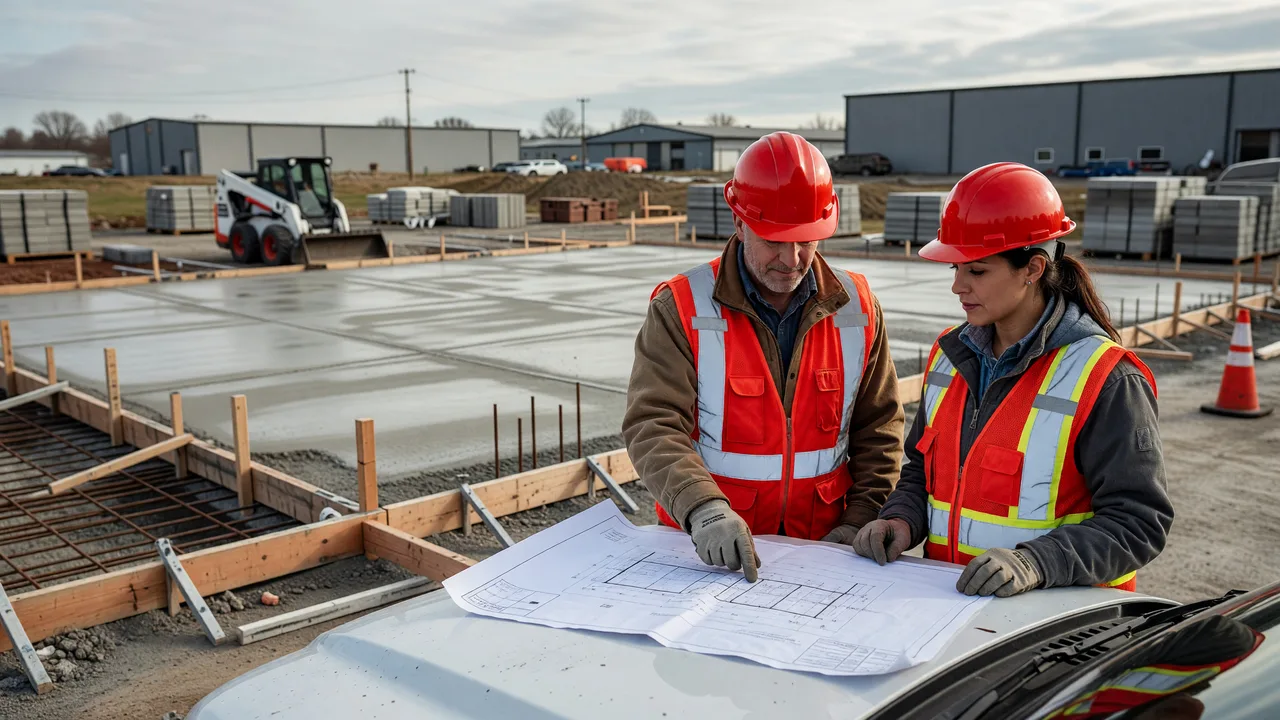
A practical guide for owners, facility managers, developers, and GCs evaluating parking lot concrete strength, durability, and long-term performance.
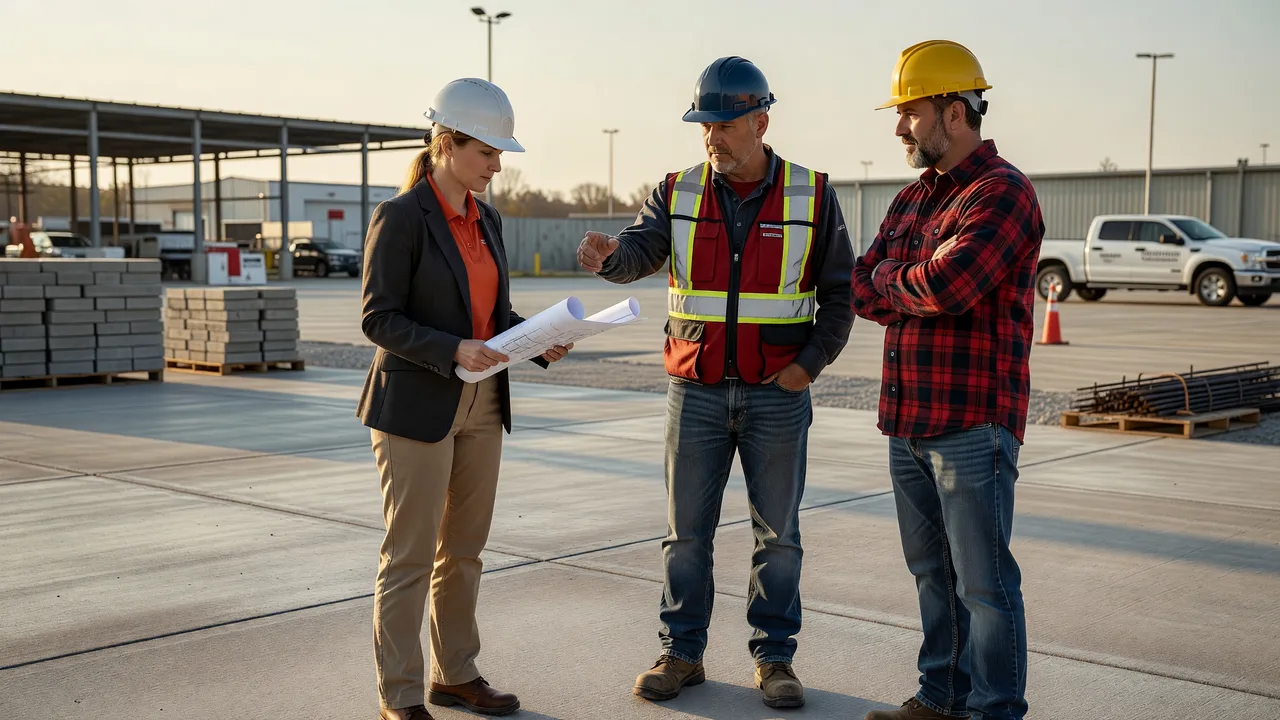
Most commercial parking lots are specified in the 4,000 to 5,000 PSI range, but the right answer depends on traffic loads, slab thickness, subgrade preparation, drainage, jointing, and freeze-thaw exposure. For lots that serve delivery traffic, heavier vehicles, or harsh winter conditions, stronger mixes and tighter construction standards are often warranted. Call (330) 992-2617 to discuss your needs and next steps.
Direct Answer: What PSI Concrete Do Commercial Parking Lots Need? OH
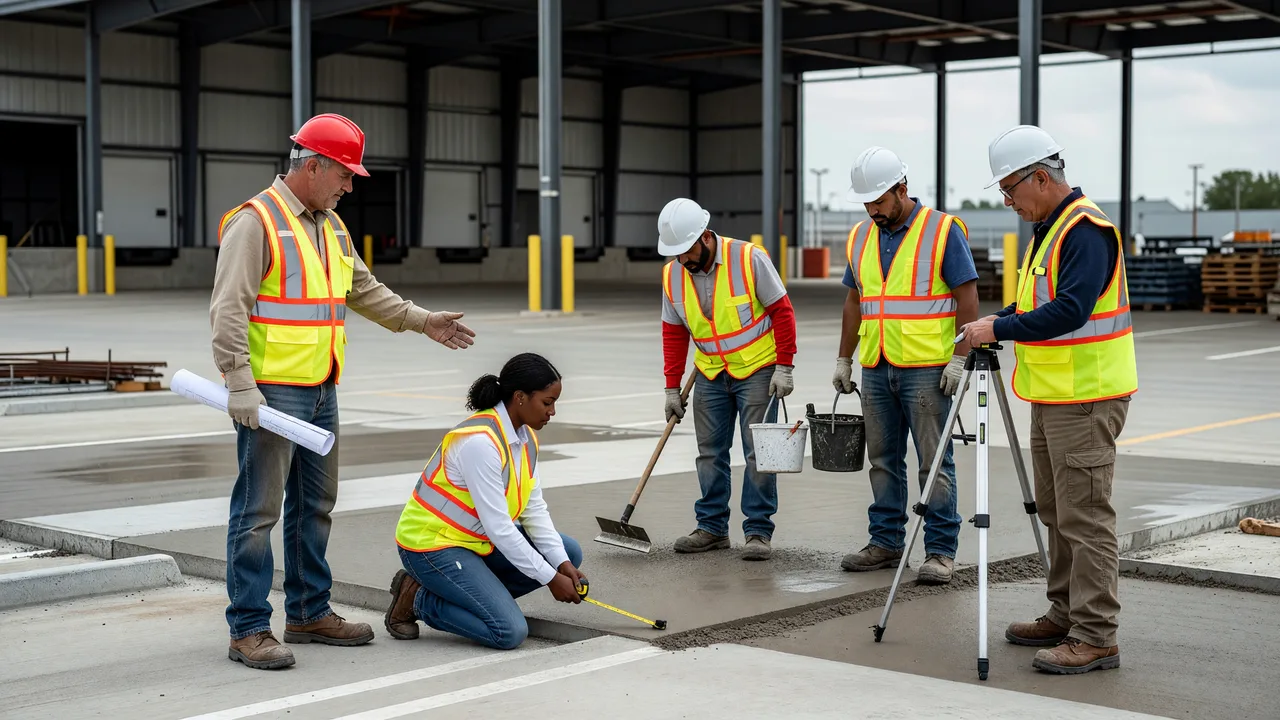 Photo by AI Generated (Grok Imagine)
For most commercial parking lots, concrete in the 4,000 to 5,000 PSI range is common, with the final specification based on expected vehicle loads, climate exposure, slab design, and site conditions. Passenger-car lots may perform well at the lower end, while parking areas with delivery traffic, dumpster pads, drive lanes, or freeze-thaw exposure often justify a more robust mix and detailing package.
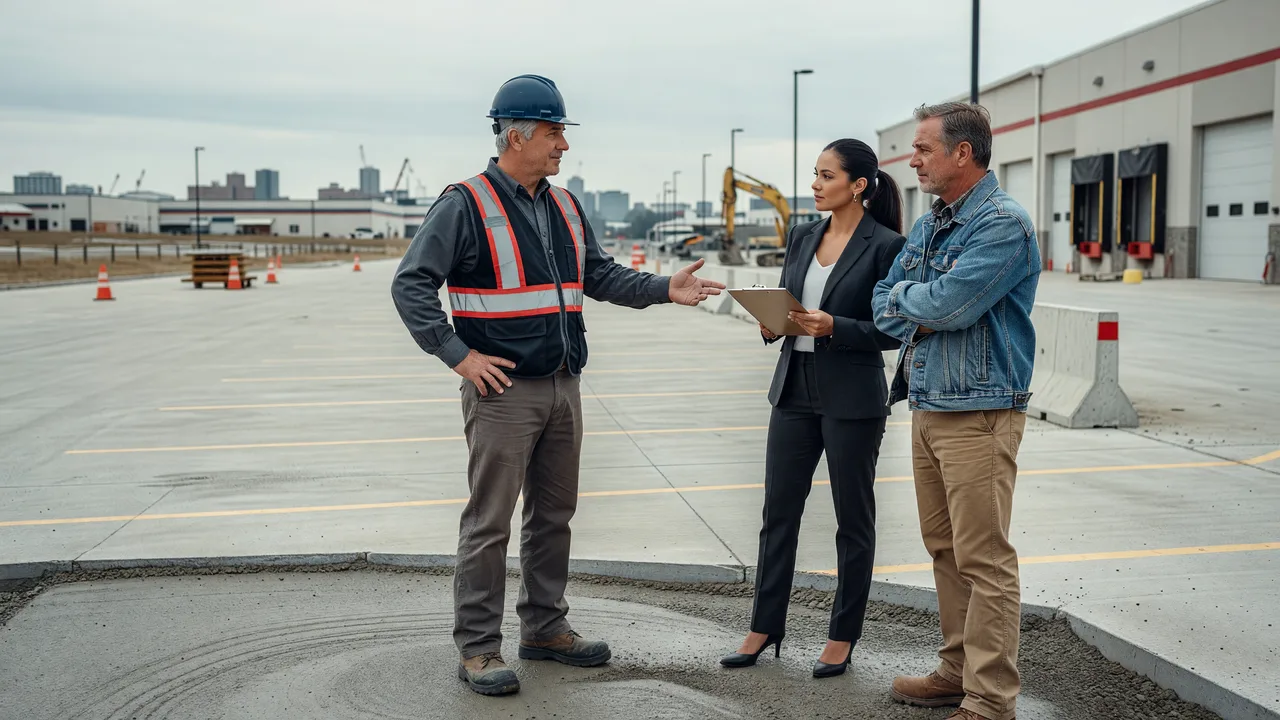
Why PSI Matters in Commercial Parking Lots
When buyers ask What PSI Concrete Do Commercial Parking Lots Need? OH, they are really asking how strong the slab must be to resist cracking, surface wear, scaling, rutting at wheel paths, and premature replacement. PSI, or pounds per square inch, measures compressive strength. It matters because a commercial parking lot is not just a flat surface. It is a working asset expected to carry traffic, shed water, tolerate deicing chemicals, and hold up through years of weather cycling.
That said, compressive strength alone does not guarantee performance. A 5,000 PSI mix placed over poor subgrade or with weak drainage can still fail early. Likewise, a lower-strength mix paired with solid base preparation, proper joint spacing, controlled finishing, and disciplined curing may outperform a stronger mix installed carelessly. Commercial owners should view PSI as one part of a system, not the only quality marker.
This is where experienced commercial crews matter. Mattucci Construction is a family-owned, self-performing commercial concrete and masonry contractor with more than 20 years in business. For commercial buyers, the value is accountability: no subcontractor handoff, bonded and insured coverage, and OSHA-compliant crews that understand parking lots, warehouse floors, loading docks, ADA flatwork, foundations, and structural slabs where failure creates real operational and liability exposure.
Typical PSI Ranges by Parking Lot Use
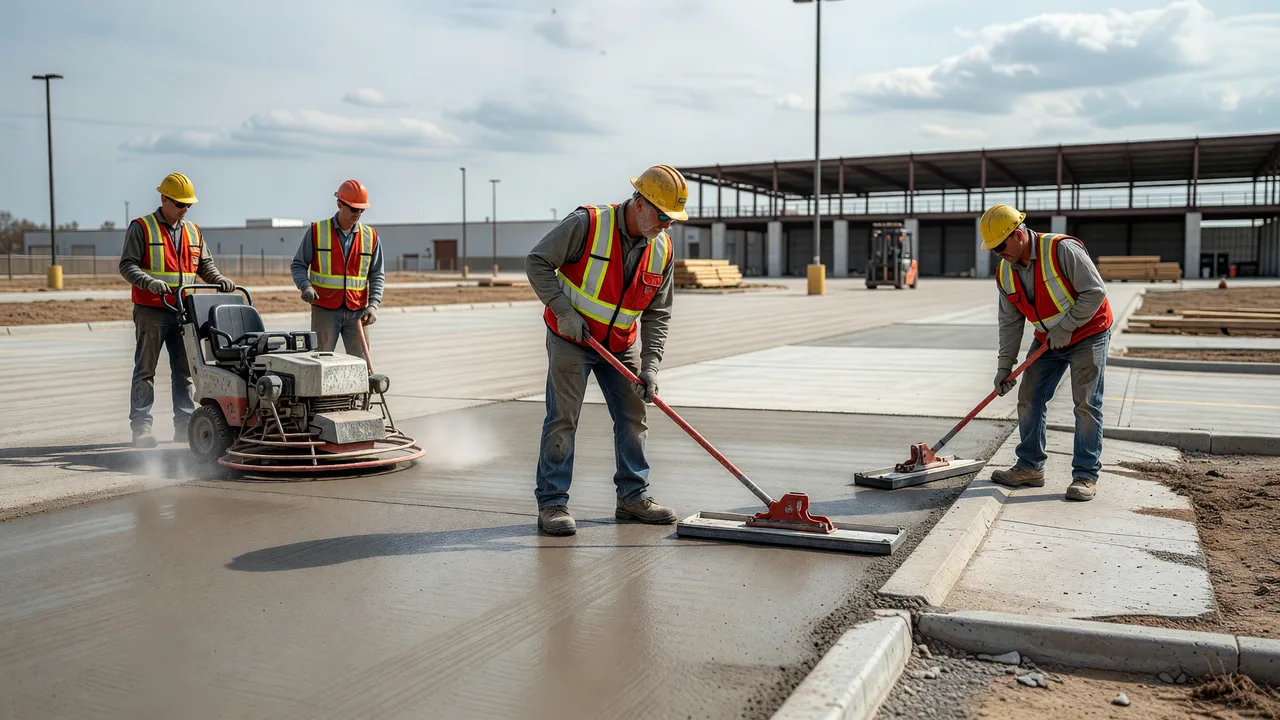 Photo by AI Generated (Grok Imagine)
The best answer to What PSI Concrete Do Commercial Parking Lots Need? OH starts with use case. A small office lot carrying mainly passenger vehicles is different from a retail site with delivery windows, a medical facility with service access, or an industrial property where heavier vehicles cross the pavement daily. Strength should align with actual loading conditions, not just a generic default.
| Parking Lot Area | Typical PSI Consideration | Why It Changes |
|---|---|---|
| Standard passenger vehicle stalls | Often around 4,000 PSI | Lower wheel loads and less concentrated stress |
| Main drive lanes and circulation routes | Often 4,000 to 4,500 PSI | More braking, turning, and repeated traffic passes |
| Entrances, aprons, and service access | Often 4,500 to 5,000 PSI | Higher impact loading and concentrated movement |
| Dumpster pads and loading zones | Often 5,000 PSI or engineered higher-performance design | Heavier axle loads and stationary stress points |
| Industrial and frequent truck traffic areas | Project-specific design, commonly at or above the upper end of standard lot mixes | Weight, repetition, and turning forces increase failure risk |
These ranges are directional, not a substitute for a project specification. The right design also depends on slab thickness, reinforcement approach where specified, subbase condition, and drainage. If a lot has mixed-use zones, one PSI across the whole project may not be the most durable or cost-effective answer.
What Actually Determines the Right PSI Specification
Owners often focus on mix strength because it is easy to compare on paper. In practice, the right answer to What PSI Concrete Do Commercial Parking Lots Need? OH comes from multiple jobsite variables working together. A well-built parking lot is designed around traffic, water, soil behavior, and climate—not just a number in a proposal.
Traffic Type and Frequency
Passenger cars create different stresses than delivery vans, box trucks, refuse haulers, or service vehicles. Even occasional heavy-vehicle access can dictate stronger concrete or thicker sections in selected zones. Main circulation lanes and turning areas usually see more punishment than individual stalls because they combine repeated loading with steering forces.
Freeze-Thaw Exposure
In cold-weather markets, freeze-thaw cycles can be as important as compressive strength. Water that enters the concrete or saturates the slab edge expands when frozen. Over time, that can cause scaling, spalling, pop-outs, and joint deterioration. For commercial buyers, this is why durability details matter just as much as mix strength. A parking lot built for winter exposure should be approached as a long-life asset, not a lowest-bid pour.
Subgrade and Base Preparation
Concrete does not perform independently of what is underneath it. Weak, wet, or uneven subgrade leads to differential settlement, rocking slabs, and cracks that have little to do with whether the mix tested at 4,000 or 5,000 PSI. Proper grading, compaction, and base support are foundational to parking lot service life.
Drainage and Slope
Standing water accelerates surface wear and increases freeze-related damage. It can also create nuisance icing and customer safety issues. Lots should be designed to move water efficiently to inlets or drainage points rather than allowing ponding in wheel paths or at entrances.
Joint Layout and Curing
Concrete shrinks as it cures. Control joints help direct cracking into planned locations. If joints are poorly spaced, cut too late, or ignored in layout, random cracking becomes more likely. Curing also matters because strength gain and surface durability depend on moisture retention during the early phase after placement.
PSI Is Important, But It Is Not the Whole Parking Lot Spec
A buyer comparing bids should not assume the proposal with the highest PSI is automatically the best value. Ask what is included in subgrade prep, slab thickness, drainage correction, jointing, finishing, curing, and traffic staging. Those items often determine whether a lot lasts or becomes a recurring repair line item.
This is also where a What PSI Concrete Do Commercial Parking Lots Need? contractor should be able to explain the difference between a decorative residential mindset and a commercial durability mindset. Commercial flatwork has to survive vehicle loading, code requirements, tenant use, and maintenance operations. That is different from pouring a patio and calling it done.
4,000 PSI vs. 5,000 PSI: Which Is Better?
The practical comparison is not whether one number is universally better. It is whether the project conditions justify the additional performance target. For many standard commercial parking fields, 4,000 PSI may be appropriate when paired with solid design and workmanship. For more demanding use, 5,000 PSI may provide a stronger margin against wear and environmental stress.
| Factor | 4,000 PSI Mix | 5,000 PSI Mix |
|---|---|---|
| Typical application | Standard commercial parking stalls and lighter-use areas | Heavier-use zones, service drives, entrances, and demanding conditions |
| Surface durability potential | Good when properly placed and cured | Typically stronger margin for wear resistance |
| Heavy vehicle tolerance | May be suitable in limited-access situations depending on design | Often preferred where heavier or repeated loading exists |
| Freeze-thaw performance | Depends heavily on air entrainment, drainage, and curing | Also depends on those factors, but strength can support overall durability goals |
| Cost impact | Generally lower material cost | Generally higher material cost, potentially lower long-term risk in harsher use cases |
If you are managing a property with loading activity, snow operations, or recurring repairs in wheel paths and joints, upgrading the design may be worth the investment. If the lot is light-duty and the drainage, base, and joint plan are sound, a lower PSI specification may still be entirely appropriate. The point is to fit the slab to the exposure—not to overspend blindly or underbuild because the low bid looks attractive.
Common Failure Points in Commercial Parking Lots
Buyers asking What PSI Concrete Do Commercial Parking Lots Need? best null OH or top What PSI Concrete Do Commercial Parking Lots Need? null are often trying to avoid the same few failures seen over and over in commercial sites. These failures usually trace back to design shortcuts, poor site prep, or weak execution.
- Random cracking: Often caused by poor joint spacing, delayed saw cutting, inadequate base support, or uncontrolled shrinkage.
- Scaling and surface flaking: Common where freeze-thaw durability, finishing practices, or curing were not handled correctly.
- Ponding water: Usually a grading or drainage problem, not a PSI problem.
- Joint breakdown: A major issue in drive lanes and service areas where edges take repeated wheel loads.
- Settlement or rocking slabs: Tied to weak or inconsistent support below the concrete.
- Premature repairs in high-load zones: Often seen at dumpster pads, loading approaches, or areas where site traffic exceeded the original design assumptions.
Commercial concrete should be built around these failure points from day one. Mattucci Construction’s commercial focus matters here because the company regularly works in environments where flatwork is tied to operations, deliveries, ADA access, and inspection expectations—not just appearance.
How Commercial Buyers Should Evaluate a Parking Lot Concrete Specification
If you are comparing proposals or reviewing a What PSI Concrete Do Commercial Parking Lots Need? estimate, ask disciplined questions beyond compressive strength. A complete parking lot scope should explain how the contractor is reducing risk, not just what number appears on the mix ticket.
- What traffic was the lot designed for? Passenger-only traffic is different from regular service access or heavy delivery patterns.
- Are stronger zones called out separately? Entrances, aprons, dumpster pads, and loading paths often need different treatment.
- How will the base be prepared? Compaction and support consistency directly affect crack control and settlement.
- How will drainage be handled? Ask how the slope prevents ponding and protects the slab through winter weather.
- What is the joint plan? Joint layout should be intentional, not an afterthought.
- What curing approach will be used? Early strength development and surface durability depend on it.
- Who is actually performing the work? Self-perform crews offer clearer accountability than subcontractor chains.
For procurement-minded owners and GCs, the contractor’s operating model matters. Mattucci Construction self-performs commercial concrete and masonry work rather than selling the job and handing it to unknown labor. That is especially relevant where schedule coordination, site safety, and inspection readiness are critical. The company is bonded and insured, uses OSHA-compliant crews, and maintains an approximate 4.8 average Google rating from 19 reviews, which gives buyers an additional trust signal without overclaiming volume.
Cost, Schedule, and ROI: What Owners Usually Want to Know
Searches like How much does what psi concrete do commercial parking lots need? cost in null?, how much does parking-lot cost in Twinsburg OH, and how much does parking-lot cost in Macedonia OH reflect a fair concern, even when project conditions vary too much for a universal price. Higher PSI concrete can increase material cost, but total parking lot cost is also shaped by demolition, excavation, base correction, drainage work, thickness, reinforcing requirements where specified, access constraints, phasing, and traffic control.
Schedule is similar. When people ask How long does what psi concrete do commercial parking lots need? take?, the answer depends on square footage, weather, removals, site logistics, and whether the lot must remain partially open during construction. For active properties, staged work can be more important than raw speed because tenants, customers, and deliveries still need to function. The strongest project outcome is usually a controlled sequence that protects operations while still maintaining quality standards.
On return on investment, Is what psi concrete do commercial parking lots need? worth the investment? is usually answered by lifecycle cost. A stronger and better-detailed lot may reduce recurring patching, complaint calls, ADA trip-hazard exposure, winter damage, and early replacement. Cheap concrete work often becomes expensive concrete work once repairs, downtime, and reputation damage enter the picture.
What to Look for in a Commercial Concrete Provider
Questions like How do I choose a what psi concrete do commercial parking lots need? provider in null?, What should I look for in what psi concrete do commercial parking lots need? services?, and What is the best what psi concrete do commercial parking lots need? company in null? should be answered with operational criteria, not slogans.
- Commercial specialization: Look for a contractor that regularly handles parking lots, warehouse and industrial floors, loading docks, ADA sidewalks and flatwork, foundations, and structural slabs.
- Self-perform accountability: One crew, one chain of responsibility, and fewer surprises than subcontractor roulette.
- Safety and procurement readiness: Bonded and insured status plus OSHA-compliant crews matter on commercial sites.
- Real durability mindset: The contractor should talk about drainage, freeze-thaw performance, joints, and operations—not just finish appearance.
- Broader site capability: Concrete repair and restoration, retaining walls, tenant build-outs, tilt-up concrete construction, and commercial masonry can be valuable when the scope expands.
If you are comparing commercial-concrete in Twinsburg OH, concrete masonry construction in Macedonia OH, or even broad searches such as best parking-lot near me, the decision standard should still be the same: choose a contractor that understands commercial consequences. Parking lots are tied to safety, access, traffic flow, inspections, and the image of the property. They should be built by people who treat them that way.
This also applies when adjacent work is part of the package. A parking lot project may intersect with how much does ada-sidewalk cost in Macedonia OH concerns, loading dock approaches, site retaining walls, or repair transitions into existing flatwork. Buyers benefit when one commercial contractor can evaluate those interfaces coherently instead of fragmenting responsibility across multiple subs.
Practical Recommendations Before You Approve the Pour
For owners, facility managers, developers, and GCs, the best path forward is not guessing at a universal answer to What PSI Concrete Do Commercial Parking Lots Need? professional null OH. It is validating the design assumptions before placement begins.
- Match the spec to actual traffic. Document whether the lot will see only passenger vehicles or repeated delivery, service, waste, or truck traffic.
- Separate heavy-load areas from standard parking areas. Do not let dumpster pads, aprons, or service access be treated like normal stalls.
- Verify drainage before discussing finish details. Water management has major consequences for winter durability and liability.
- Review base preparation in writing. Good concrete over bad support is still bad work.
- Confirm joint layout and curing procedures. These are central to crack control and long-term surface performance.
- Ask who will be on the site. A self-performing contractor provides clearer accountability.
- Think in lifecycle cost, not only installed cost. Repairs, tenant disruption, and early replacement can erase any low-bid savings.
Whether you are searching for What PSI Concrete Do Commercial Parking Lots Need? near me, What PSI Concrete Do Commercial Parking Lots Need? null near me, services What PSI Concrete Do Commercial Parking Lots Need? null, or What PSI Concrete Do Commercial Parking Lots Need? services null OH, the underlying requirement is the same: the slab has to survive use, weather, and inspection scrutiny. PSI matters, but parking lot success comes from the full construction system being executed correctly.
For many commercial projects, the most useful next step is a project-specific What PSI Concrete Do Commercial Parking Lots Need? consultation that reviews traffic patterns, failure history, drainage, and any ADA or service-access concerns before the scope is finalized.
Soft Next Step: Get a Project-Specific Recommendation
 Photo by AI Generated (Grok Imagine)
If you are planning a new commercial parking lot, replacing failed pavement, or evaluating recurring cracks and surface breakdown, a project-specific review is more useful than relying on a generic PSI rule. Mattucci Construction self-performs commercial concrete and masonry work for owners, facility managers, developers, and GCs who need parking lots, industrial floors, loading docks, ADA flatwork, foundations, and related site concrete built to hold up under real use.
To discuss your scope, use the quote-request form at https://mattucciconstruction.net or call (330) 992-2617. This page is informational by design, but when you need a contractor who can evaluate strength requirements alongside drainage, schedule, safety, and accountability, that conversation is worth having early.
Frequently Asked Questions About What PSI Concrete Do Commercial Parking Lots Need?
Is 4,000 PSI enough for a commercial parking lot?
Is 4,000 PSI enough for a commercial parking lot?
Often, yes—especially for standard passenger-vehicle parking areas with good subgrade support, proper drainage, disciplined jointing, and correct curing. It may not be the right choice for every zone on the site, though. Entrances, service drives, dumpster pads, and areas with heavier or repeated truck traffic often justify a stronger mix or a different slab design.
When should a parking lot use 5,000 PSI concrete?
When should a parking lot use 5,000 PSI concrete?
5,000 PSI concrete is commonly considered when the lot includes heavier loading, high-traffic circulation lanes, delivery access, or demanding winter exposure. It can also make sense where owners want a stronger durability margin in areas that historically crack, scale, or break down faster. The final decision should still be tied to overall slab design and site conditions, not PSI alone.
Does higher PSI automatically mean a longer-lasting parking lot?
Does higher PSI automatically mean a longer-lasting parking lot?
No. Higher compressive strength helps, but it does not overcome poor drainage, weak subgrade, improper joint spacing, over-finishing, or inadequate curing. Many early failures blamed on “bad concrete” are actually base, water-management, or workmanship problems. Long service life comes from the total system being designed and installed correctly.
How long does a commercial parking lot concrete project take?
How long does a commercial parking lot concrete project take?
Duration depends on square footage, demolition needs, drainage corrections, weather, access, and whether the site must stay operational during construction. A phased schedule is common on occupied commercial properties because tenant access, deliveries, and customer traffic can be just as important as pour speed. A credible contractor should outline staging, not just a generic completion promise.
What should I look for in commercial parking lot concrete services?
What should I look for in commercial parking lot concrete services?
Look for a contractor that understands commercial traffic loads, drainage, ADA implications, winter durability, and schedule coordination. Self-perform capability is a major advantage because it creates direct accountability. Bonded and insured status, OSHA-compliant crews, and relevant experience with parking lots, loading docks, industrial floors, and repair work are all meaningful screening factors.
Is a higher-PSI parking lot worth the investment?
Is a higher-PSI parking lot worth the investment?
It can be, especially if your site sees delivery traffic, heavy turning movements, repeated winter stress, or costly annual repairs. The right upgrade can reduce lifecycle costs by limiting patching, downtime, and early replacement. The key is targeting stronger design where it materially improves performance rather than overspecifying every square foot without a reason.
Need a Project-Specific Parking Lot Concrete Recommendation?
If you are evaluating a commercial parking lot replacement, service-access slab, ADA flatwork, or related site concrete scope, Mattucci Construction can review the loading conditions, durability requirements, and construction considerations that affect the right PSI and overall design. Submit a quote request through the website or call the office to start the conversation.