
Tilt-Up Concrete Construction Cost vs Steel or CMU — What to Expect OH
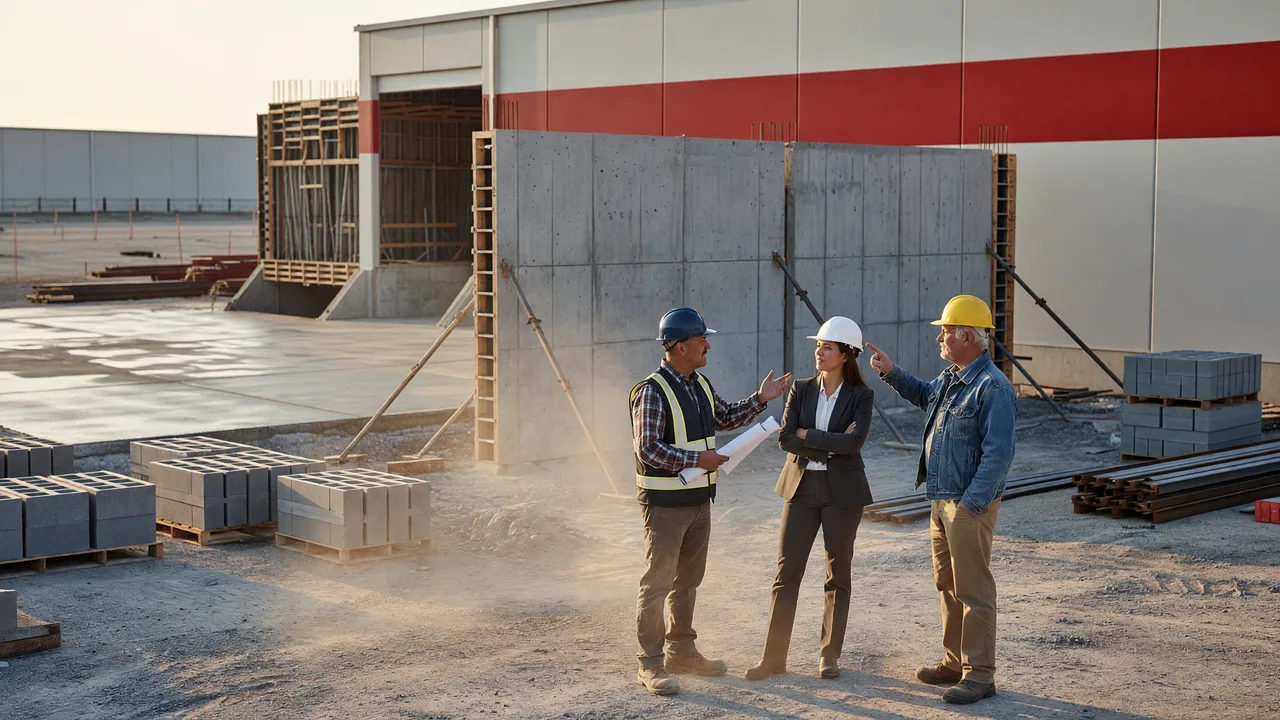
A practical cost guide for owners, developers, facility managers, and general contractors comparing tilt-up concrete, structural steel, and CMU wall systems for commercial buildings.

Tilt-up concrete construction often becomes cost-competitive with steel or CMU on larger commercial buildings because it can reduce exterior wall labor, shorten enclosure time, and improve durability. Actual cost depends on panel size, crane access, reinforcement, openings, finishes, site logistics, and schedule risk—not just material price per square foot. Call (330) 992-2617 to discuss your needs and next steps.
Direct answer: Is tilt-up concrete construction cheaper than steel or CMU?
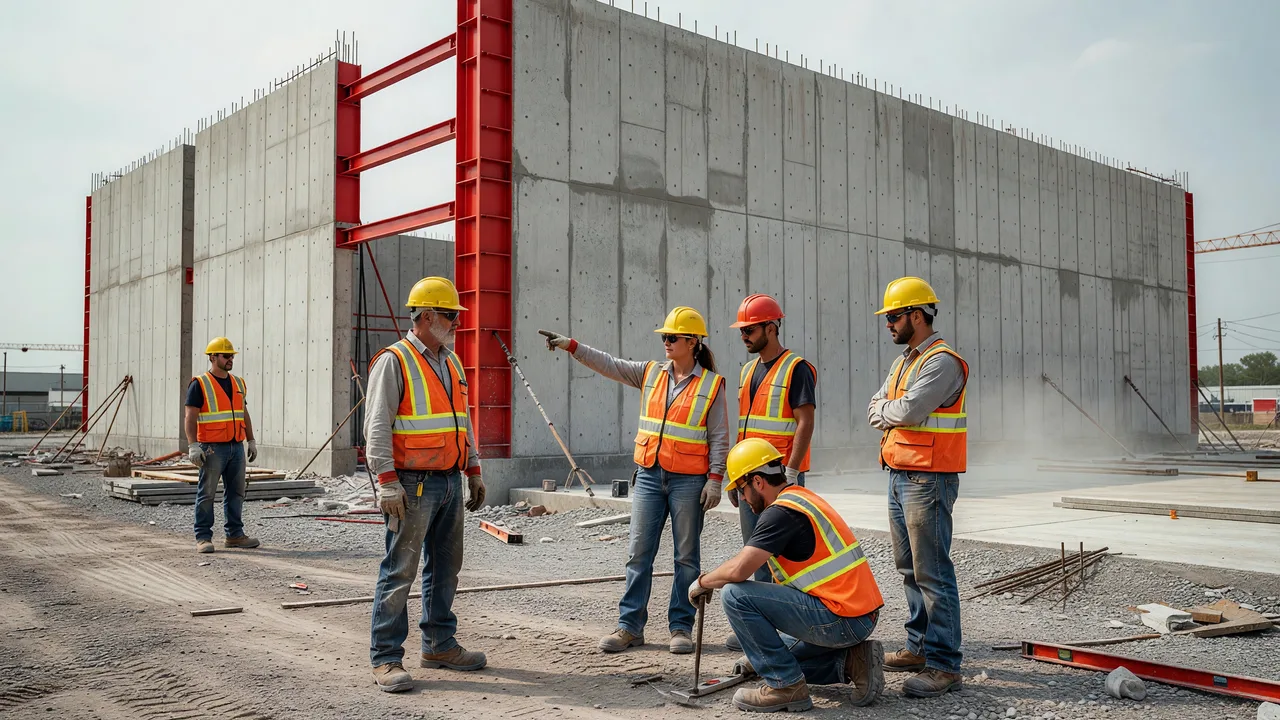 Photo by AI Generated (Grok Imagine)
Tilt-Up Concrete Construction Cost vs Steel or CMU — What to Expect OH comes down to building size, wall height, repetition, site access, and schedule demands. In many commercial projects, tilt-up is most economical when the footprint is large enough to justify forming and lifting panels. Steel can be faster for certain structural layouts, while CMU can pencil out on smaller or heavily segmented buildings. The lowest bid on paper is not always the lowest total project cost once labor, weather exposure, maintenance, and schedule risk are included.

How to compare Tilt-Up Concrete Construction Cost vs Steel or CMU — What to Expect OH
Owners often start the comparison with a simple question: which wall system costs less per square foot? That is useful, but incomplete. A better procurement approach is to compare the installed building shell cost, the time to dry-in, and the risk of downstream problems. A shell that saves money on day one but creates coordination delays, water intrusion details, or recurring repair work is not actually the low-cost option.
For a fair evaluation of Tilt-Up Concrete Construction Cost vs Steel or CMU — What to Expect OH, compare the same scope across systems: foundations, embeds, reinforcing, crane picks, insulation strategy, structural frame coordination, exterior finish, openings, waterproofing, and the labor required to complete the enclosure. On many warehouse, industrial, and distribution buildings, tilt-up can gain efficiency because the slab and wall work are tightly coordinated and the exterior wall becomes a structural, durable enclosure in one system.
This is also why experienced commercial buyers ask about site logistics early. Tilt-up needs room for casting beds, material staging, and crane movement. If the site is constrained, the economics can shift. By contrast, CMU may fit tighter sites but usually adds labor duration and more field joints. Steel can support flexible building geometry, but material pricing volatility and fireproofing or enclosure coordination can change the total cost picture quickly.
The real cost categories owners should review
- Preconstruction and design coordination: panel engineering, connection detailing, opening layout, and sequencing.
- Site preparation and foundations: footers, slab readiness, and embed accuracy.
- Material package: concrete, reinforcing steel, structural steel components, CMU units, grout, and accessories.
- Labor intensity: field crew size, placement complexity, masonry production rates, and crane day requirements.
- Schedule exposure: weather windows, cure time, enclosure sequence, and trade stacking.
- Long-term ownership cost: crack management, joint maintenance, impact resistance, moisture resistance, and finish durability.
That broader lens is what makes a Tilt-Up Concrete Construction Cost vs Steel or CMU — What to Expect estimate more useful than a line-item wall price pulled from a conceptual budget.
Where tilt-up usually wins on cost
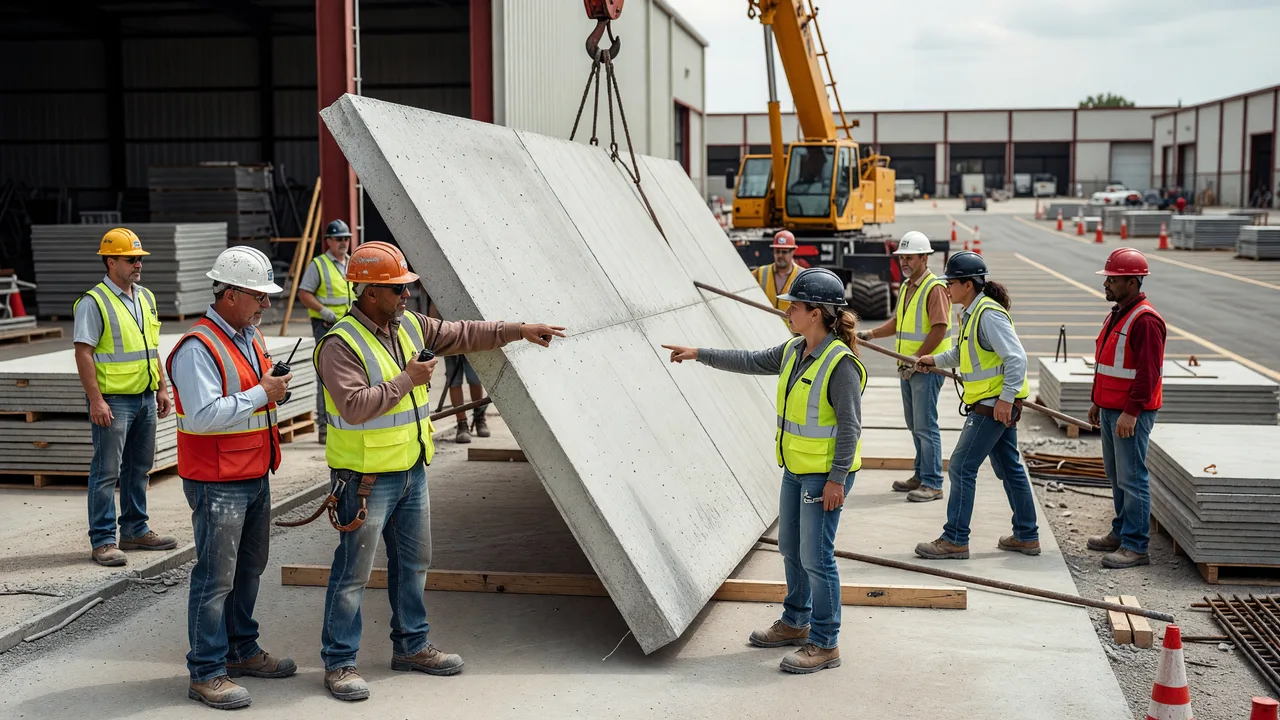 Photo by AI Generated (Grok Imagine)
Tilt-up tends to perform best economically on low-rise commercial and industrial buildings with broad footprints, repeated wall geometry, and enough site area to cast and lift panels efficiently. Warehouses, manufacturing facilities, distribution buildings, and certain retail boxes are common examples. In these cases, panel repetition improves production, and the wall system can move from concept to enclosure with fewer hand-laid operations than CMU.
Another advantage is durability. Concrete wall panels can tolerate hard use, incidental impacts, and exposure conditions that matter to commercial owners. When a building needs to survive loading activity, tenant turnover, weather cycling, and years of use without cosmetic attention every season, a durable envelope can lower lifecycle cost. That is especially relevant for buyers who are comparing not just first cost but ownership cost over ten to twenty years.
There is also a schedule argument. A compressed schedule has a real dollar value. If tilt-up accelerates enclosure enough to support interior trades sooner, the owner may gain occupancy or operational use earlier. That is not universal, but it is a recurring reason tilt-up remains attractive on time-sensitive commercial projects.
Typical building conditions that support tilt-up value
Tilt-up generally becomes more favorable when the building has long wall runs, moderate-to-tall single-story wall heights, repeated openings, straightforward panel shapes, and clear crane access. If the structural and architectural team can simplify reveals, penetrations, and embedded items, the forming and lifting process becomes more efficient. The more repetition in the panel package, the stronger the cost case usually becomes.
This is why a Tilt-Up Concrete Construction Cost vs Steel or CMU — What to Expect consultation should happen early in design development. Waiting until construction documents are nearly complete can lock the owner into details that undermine the system’s natural advantages.
Where steel may be the better value
Steel is not just a competitor to tilt-up; in many buildings it is part of the same solution. Structural steel excels when spans are long, building geometry is irregular, or future flexibility matters more than shell mass. If the project has significant cantilevers, unusual loading criteria, mezzanine complexity, or architectural forms that do not repeat well, steel may deliver a cleaner path.
From a cost standpoint, steel can also reduce dependence on large casting areas and may simplify logistics on constrained sites. If there is little room for panel casting or crane staging, the carrying cost of working around those limitations can erode tilt-up savings. Owners should also evaluate the local market for fabrication lead times. Material and fabrication availability can shift the budget and schedule balance either way.
When reviewing professional Tilt-Up Concrete Construction Cost vs Steel or CMU — What to Expect null comparisons, the important point is not to force one system onto every building. It is to match the system to the operating requirements, site constraints, and risk tolerance of the project.
Where CMU may be the better value
CMU can remain a practical choice on smaller commercial buildings, compartmentalized layouts, utility structures, or buildings where the wall system includes many short segments, control joints, and frequent changes in elevation. Masonry also offers familiarity for certain building types and can be phased in areas where full panel casting operations are less practical.
That said, CMU is labor-driven. On projects with large expanses of wall, field productivity and weather exposure can affect both budget and schedule. More hand-laid work usually means more opportunities for variation in production rates. When decision-makers ask whether affordable Tilt-Up Concrete Construction Cost vs Steel or CMU — What to Expect null means the lowest initial wall cost, the answer is no. Affordability should account for labor certainty, enclosure timing, maintenance expectations, and the consequences of schedule slip.
CMU may also require additional detailing or finish systems depending on performance goals. Those costs should be included in the comparison rather than assumed away during conceptual budgeting.
Comparison table: tilt-up vs steel vs CMU
| Factor | Tilt-Up Concrete | Steel-Framed Shell | CMU |
|---|---|---|---|
| Best fit | Large, low-rise commercial and industrial buildings with repetition | Complex geometry, long spans, constrained casting areas, flexible layouts | Smaller buildings, segmented walls, utility structures, phased masonry work |
| Primary cost driver | Panel forming, reinforcement, crane picks, site logistics | Material market volatility, fabrication, erection, coordination with enclosure | Labor production rate, grout/reinforcement, weather exposure, finish scope |
| Schedule profile | Can accelerate enclosure when sequencing is planned well | Often efficient for frame erection; enclosure depends on wall system coordination | Usually slower on large wall areas due to hand-laid installation |
| Site requirements | Needs casting bed area and crane access | Less casting area required; staging still important | Can work on tighter sites but with more field labor duration |
| Durability | High impact resistance and robust envelope performance | Depends on enclosure package and protective systems | Durable, but joints and moisture detailing require attention |
| Design flexibility | Strong for repeated panelized layouts | High flexibility for spans and irregular forms | Moderate; adaptable but labor-intensive for large repetitive walls |
| Lifecycle considerations | Lower maintenance potential on many heavy-use facilities | Varies by cladding and coating systems | Can be durable but often more joint and finish maintenance over time |
This table is not a substitute for a project-specific budget, but it shows why top Tilt-Up Concrete Construction Cost vs Steel or CMU — What to Expect null comparisons are really about fit, not slogans.
What changes the price the most
Several variables have an outsized effect on the final number. First is panel complexity. Large, repetitive panels are usually more efficient than highly customized panels with many reveals, recesses, odd geometries, and penetrations. Second is site logistics. The farther materials have to move, the tighter the crane work area, and the more congested the site, the less efficient production becomes.
Third is opening density. Doors, storefront areas, louvers, and utility penetrations all add coordination and reinforcement demands. Fourth is engineering and structural interface. Connection details between wall panels, roof diaphragm, and foundations must be precise. If those details are late or poorly coordinated, field delays can erase expected savings.
Fifth is finish expectation. Architectural finishes, insulated panel strategies, and specialty coatings all influence cost. Finally, schedule pressure matters. Overtime, resequencing, and winter work conditions can all affect the installed cost of tilt-up, steel, or CMU.
Anyone searching Tilt-Up Concrete Construction Cost vs Steel or CMU — What to Expect services null OH should understand that no reputable contractor can give a serious number without reviewing these drivers.
Why the cheapest conceptual price can be misleading
A conceptual square-foot figure can be useful for early feasibility, but it often ignores project friction. If access is poor, if drawings are incomplete, or if the wall package is being used to solve too many late design changes, the installed cost rises. That is why sophisticated owners request alternates with defined assumptions rather than chasing a single low number.
The best Tilt-Up Concrete Construction Cost vs Steel or CMU — What to Expect null analysis is transparent about assumptions, exclusions, and sequencing responsibilities. That clarity prevents costly change orders and finger-pointing later.
Schedule, downtime, and risk matter as much as material cost
Commercial buyers are rarely purchasing walls in isolation. They are protecting an opening date, a tenant improvement sequence, a logistics schedule, or an operating facility. That makes schedule certainty a financial issue. A wall system that helps the building dry in sooner may reduce general conditions, protect interior work, and limit disruption to operations.
Risk also shows up in inspection exposure and accountability. On concrete and masonry scopes, inaccurate layouts, drainage mistakes, improper slopes, or poor sequencing can create expensive downstream corrections. Mattucci Construction’s market position is relevant here because the company self-performs commercial concrete and masonry work rather than selling the job and handing it to unknown crews. For buyers managing warehouse floors, loading docks, ADA flatwork, foundations, or site concrete, that single-source accountability can reduce coordination failure points.
Mattucci Construction is family-owned, has been in business more than 20 years, and operates with bonded and insured, OSHA-compliant crews. For commercial procurement teams, those are not marketing extras. They are risk controls. The company also maintains an approximately 4.8 average Google rating from 19 reviews, which is a modest but credible public trust signal rather than an inflated review claim.
For readers looking for Tilt-Up Concrete Construction Cost vs Steel or CMU — What to Expect contractor insight, the lesson is simple: compare the contractor’s execution model as carefully as the wall system.
How long does each system usually take?
There is no universal duration because schedules depend on design completion, permitting, weather, site readiness, labor availability, and building complexity. Still, the sequence differences are predictable. Tilt-up requires planning, forming, reinforcement placement, casting, curing, and crane lifting. Once those pieces are coordinated, panel erection can move quickly. CMU spreads labor across a longer field duration because units are laid in place course by course. Steel frame erection can be fast, but full enclosure depends on the cladding and wall package that follows.
In practical terms, owners should ask when each option gets the building to weather-tight status, not just when the primary structure is standing. That is usually the better measure of schedule value. If occupancy, equipment installation, or tenant turnover is driving the job, speed to dry-in may matter more than isolated labor productivity.
That is why people asking How long does tilt-up concrete construction cost vs steel or cmu — what to expect take? should expect a phased answer: preconstruction duration, field production duration, and time to dry-in.
Practical recommendations before you request pricing
- Define your performance priorities first. Decide whether first cost, speed to occupancy, durability, future flexibility, or appearance carries the most weight.
- Ask for apples-to-apples assumptions. Require each budget to state what is included for foundations, reinforcement, crane work, insulation, connections, finishes, and openings.
- Review site logistics early. Confirm whether there is enough room for casting beds, material staging, truck access, and crane operations.
- Evaluate the building geometry honestly. Repetitive wall runs support tilt-up efficiency; highly segmented layouts may favor another system.
- Do not ignore lifecycle cost. Heavy-use commercial buildings need envelope and site work that can handle traffic, impact, drainage, and weather exposure with less recurring repair.
- Vet accountability. Ask who will self-perform the work, who owns schedule coordination, and how safety and insurance requirements are handled.
These same buying principles apply when owners search adjacent topics like parking lot replacement, ADA sidewalk work, site concrete, or concrete masonry construction. Whether the query is best parking-lot near me, how much does ada-sidewalk cost in Macedonia OH, commercial-concrete in Twinsburg OH, concrete masonry construction in Macedonia OH, or how much does parking-lot cost in Twinsburg OH, the reliable answer always depends on scope definition, drainage, subgrade conditions, access, and who is actually responsible for performing the work.
That broader context also helps answer Is tilt-up concrete construction cost vs steel or cmu — what to expect worth the investment? On the right building, yes—especially when durability, schedule performance, and reduced coordination risk matter to the owner.
How to choose a provider for tilt-up, site concrete, and commercial masonry work
If your project includes tilt-up along with foundations, structural slabs, loading docks, warehouse floors, parking lots, or ADA flatwork, choose a contractor that understands how those scopes interact. Problems usually do not start with the wall itself; they start where layouts, elevations, drainage, embeds, and operational requirements meet. A contractor with commercial field experience will ask practical questions about truck circulation, dock elevations, slab performance, and inspection sequencing before offering a neat-looking budget.
For buyers comparing Tilt-Up Concrete Construction Cost vs Steel or CMU — What to Expect near me or Tilt-Up Concrete Construction Cost vs Steel or CMU — What to Expect null near me, the most important screening questions are straightforward: Does the company self-perform? Is it bonded and insured? Are crews OSHA-compliant? Does the company regularly handle commercial slabs, site concrete, docks, foundations, and masonry—not just residential decorative work? Can it explain what drives cost and schedule risk without hiding behind vague allowances?
Those questions align with Mattucci Construction’s operating model. The company self-performs commercial concrete and masonry work, is bonded and insured, uses OSHA-compliant crews, and has more than 20 years in business. Its core capabilities include parking lots and site concrete, warehouse and industrial floors, loading docks, ADA sidewalks and flatwork, foundations and footers, tilt-up concrete construction, commercial masonry, concrete repair and restoration, retaining walls, and tenant build-outs. For owners and GCs, that breadth matters because it reduces handoff risk between related scopes.
That is the difference between generic services Tilt-Up Concrete Construction Cost vs Steel or CMU — What to Expect null content and an actionable procurement standard.
Soft next step: get a project-specific comparison
 Photo by AI Generated (Grok Imagine)
If you are evaluating tilt-up against steel or CMU, the most useful next step is a project-specific review of the building footprint, wall geometry, site constraints, schedule, and related concrete scope. A real comparison should show what each system includes, what assumptions it relies on, and where risk is likely to surface during construction.
Mattucci Construction provides commercial concrete and masonry expertise grounded in self-performed field execution. If your project involves tilt-up, foundations, slabs, loading docks, ADA flatwork, parking lots, or repair work, use the quote request form at https://mattucciconstruction.net and call (330) 992-2617 to discuss scope, schedule, and constructability. This page is informational, but a disciplined preconstruction conversation can save significant time and rework later.
Frequently Asked Questions About Tilt-Up Concrete Construction Cost vs Steel or CMU — What to Expect
How much does tilt-up concrete construction cost vs steel or cmu — what to expect cost in null?
There is no credible one-size-fits-all number because the cost depends on footprint, panel repetition, building height, opening density, crane access, structural coordination, insulation strategy, and finish level. On larger low-rise commercial buildings, tilt-up often becomes highly competitive because the wall system can combine structural performance, enclosure speed, and durability. On smaller or more segmented buildings, CMU or steel-based solutions may budget better. A useful estimate compares total shell cost and schedule impact, not just unit price.
What is the best tilt-up concrete construction cost vs steel or cmu — what to expect company in null?
The best provider is the one that can explain system tradeoffs clearly, define assumptions, and take accountability for execution. For commercial buyers, look for a contractor that self-performs relevant concrete and masonry scopes, carries proper insurance, works with OSHA-compliant crews, and understands operational issues like drainage, access, slab performance, dock elevations, and inspection requirements. Mattucci Construction is notable in that context because it is family-owned, has more than 20 years in business, self-performs work, and is bonded and insured.
How do I choose a tilt-up concrete construction cost vs steel or cmu — what to expect provider in null?
Start by asking whether the company regularly handles commercial foundations, slabs, loading docks, ADA flatwork, site concrete, masonry, and tilt-up coordination. Then ask who actually performs the work. A self-perform contractor can usually provide better accountability than a firm that outsources critical scopes. Finally, request a comparison with clearly stated inclusions, exclusions, schedule assumptions, and site logistics notes. That will tell you more than a low budget number by itself.
What should I look for in tilt-up concrete construction cost vs steel or cmu — what to expect services?
Look for scope clarity, constructability input, schedule realism, and operational awareness. Good services include preconstruction review, foundations and slab coordination, attention to crane and casting logistics, and realistic discussion of openings, embeds, reinforcement, and finish expectations. If the same contractor can also self-perform related concrete or masonry work, that can reduce handoff risk and improve schedule control.
How long does tilt-up concrete construction cost vs steel or cmu — what to expect take?
The timeline varies by design completion, weather, permitting, and site readiness. Tilt-up includes planning, casting, curing, and erection phases; CMU typically requires a longer field installation period; steel can erect quickly but still depends on the enclosure package for dry-in. Owners should compare time to weather-tight status rather than looking only at when the frame or wall begins. That is the milestone that usually affects occupancy and downstream trade work the most.
Is tilt-up concrete construction cost vs steel or cmu — what to expect worth the investment?
It often is on the right building type. Tilt-up can deliver value through enclosure efficiency, durability, and reduced lifecycle maintenance on heavy-use commercial facilities. It is especially attractive where large wall areas, repeated geometry, and operating demands favor a robust concrete envelope. The investment case weakens if the site is too constrained for efficient panel casting and lifting or if the building geometry does not support panel repetition.
Does a tilt-up comparison also help with other commercial concrete budgeting decisions?
Yes. The same discipline used to compare tilt-up, steel, and CMU also improves budgeting for parking lots, ADA sidewalks, foundations, loading docks, warehouse slabs, and masonry repairs. In every case, drainage, subgrade conditions, traffic loads, access, inspection requirements, and contractor accountability are bigger budget drivers than generic online averages. That is why experienced buyers request scope-specific pricing rather than relying on broad national ranges.
Need a project-specific tilt-up vs steel or CMU comparison?
If you are planning a commercial building and need a grounded cost discussion around tilt-up concrete, site work, foundations, slabs, docks, or masonry, request a quote through the form at https://mattucciconstruction.net and call (330) 992-2617. Mattucci Construction self-performs commercial concrete and masonry work with bonded, insured, OSHA-compliant crews.