
Rebar vs Wire Mesh Reinforcement — Which Is Right for Your Commercial Slab?
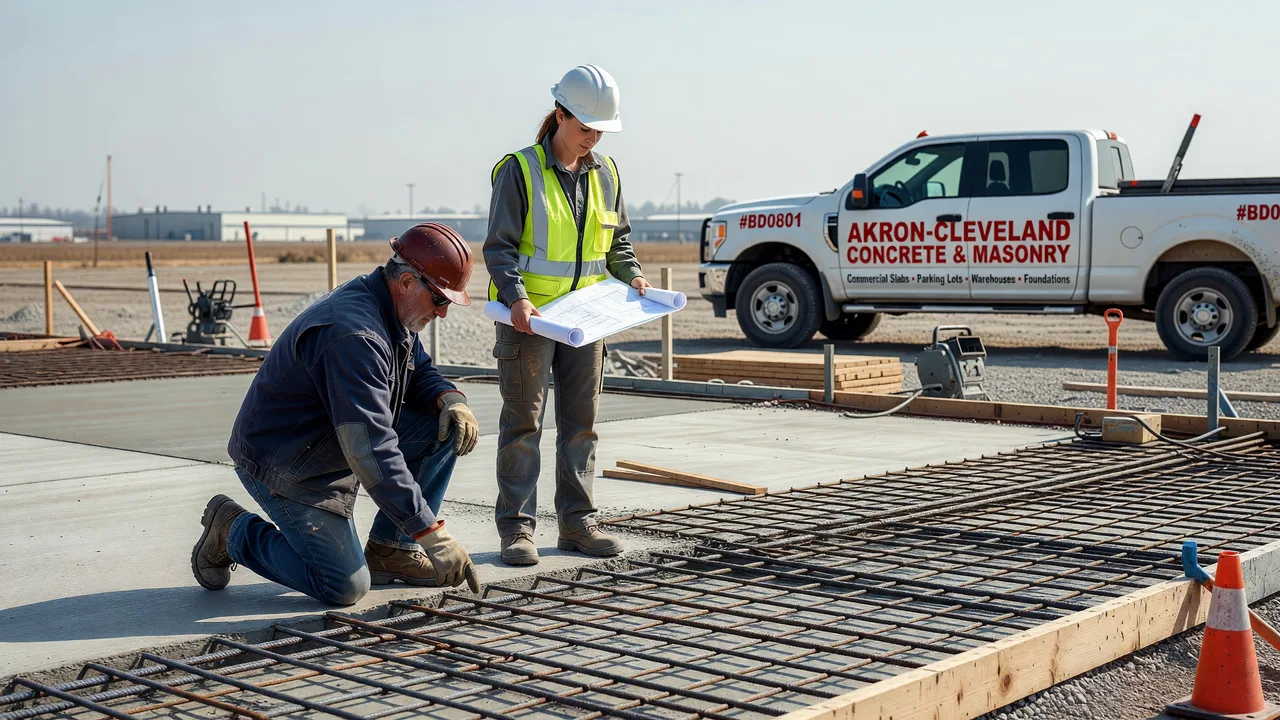
A practical guide for owners, facility managers, developers, and GCs comparing slab reinforcement for warehouses, loading docks, parking lots, foundations, and other commercial concrete applications.
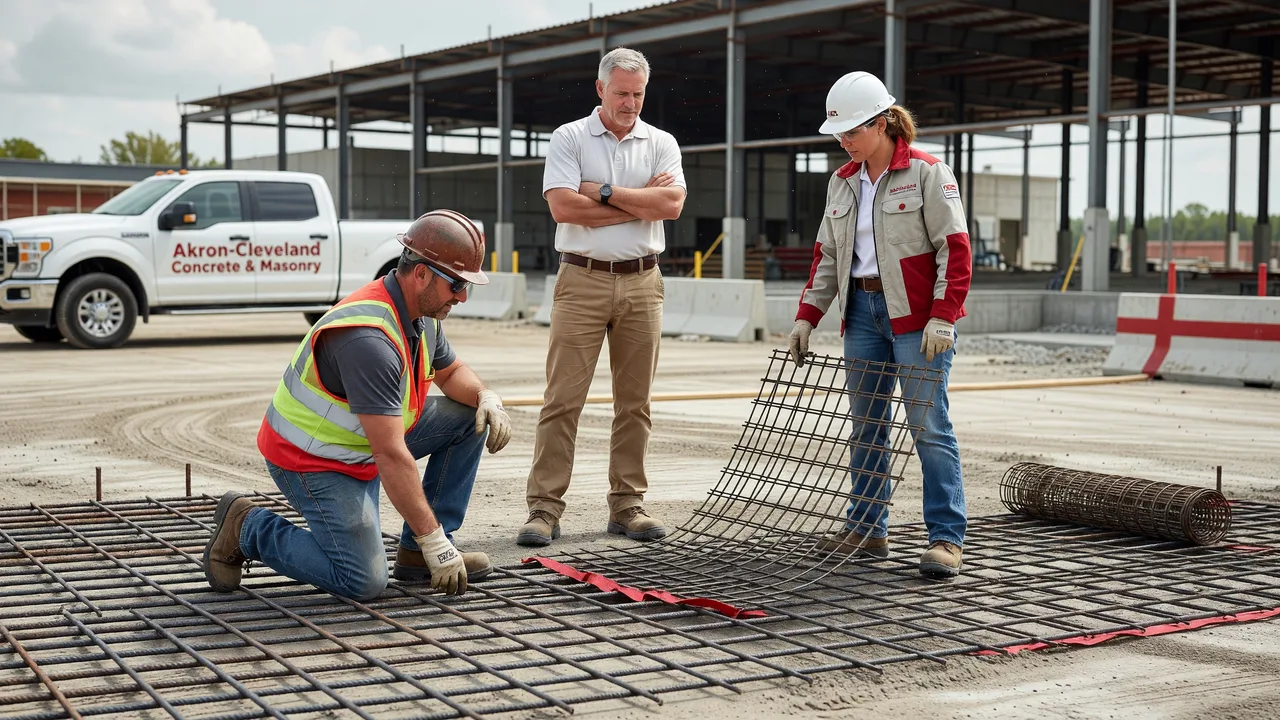
For most commercial slabs, rebar is the better choice when loads are heavy, spans are larger, or long-term durability matters most. Wire mesh can help with shrinkage crack control in lighter-duty slabs, but it is easier to misplace during the pour. The right reinforcement depends on slab thickness, joint layout. Call (330) 992-2617 to discuss your needs and next steps.
Direct Answer: Rebar vs Wire Mesh Reinforcement — Which Is Right for Your Commercial Slab? OH
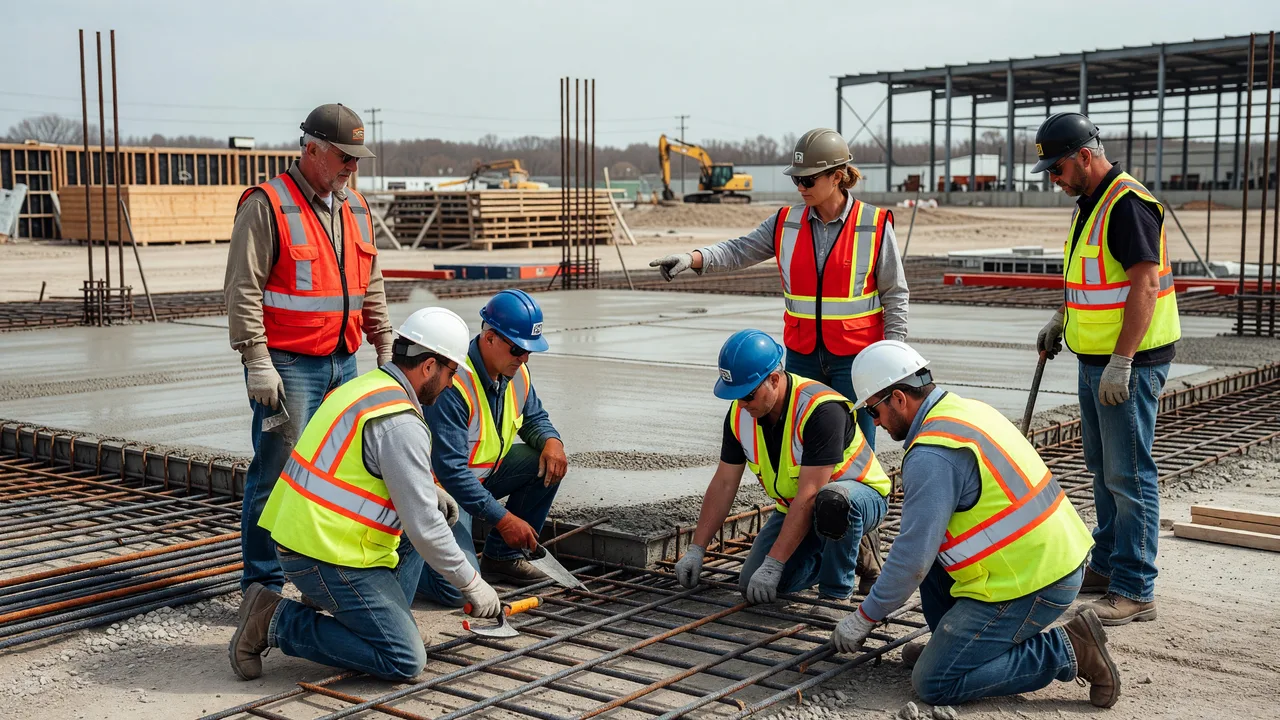 Photo by AI Generated (Grok Imagine)
Rebar is usually the right choice for commercial slabs that carry forklifts, trucks, storage racks, dock traffic, or other concentrated loads. Wire mesh is more often used for lighter-duty crack control, but only if it is properly supported and stays in the correct position during placement. For a commercial slab, the real decision should be based on structural demand, slab thickness, subgrade conditions, jointing, and the engineer of record’s design.
This is the core issue behind Rebar vs Wire Mesh Reinforcement — Which Is Right for Your Commercial Slab? OH: reinforcement is not a cosmetic add-on. It is part of how a slab manages tensile stress, controls cracking behavior, and performs under service conditions over time.
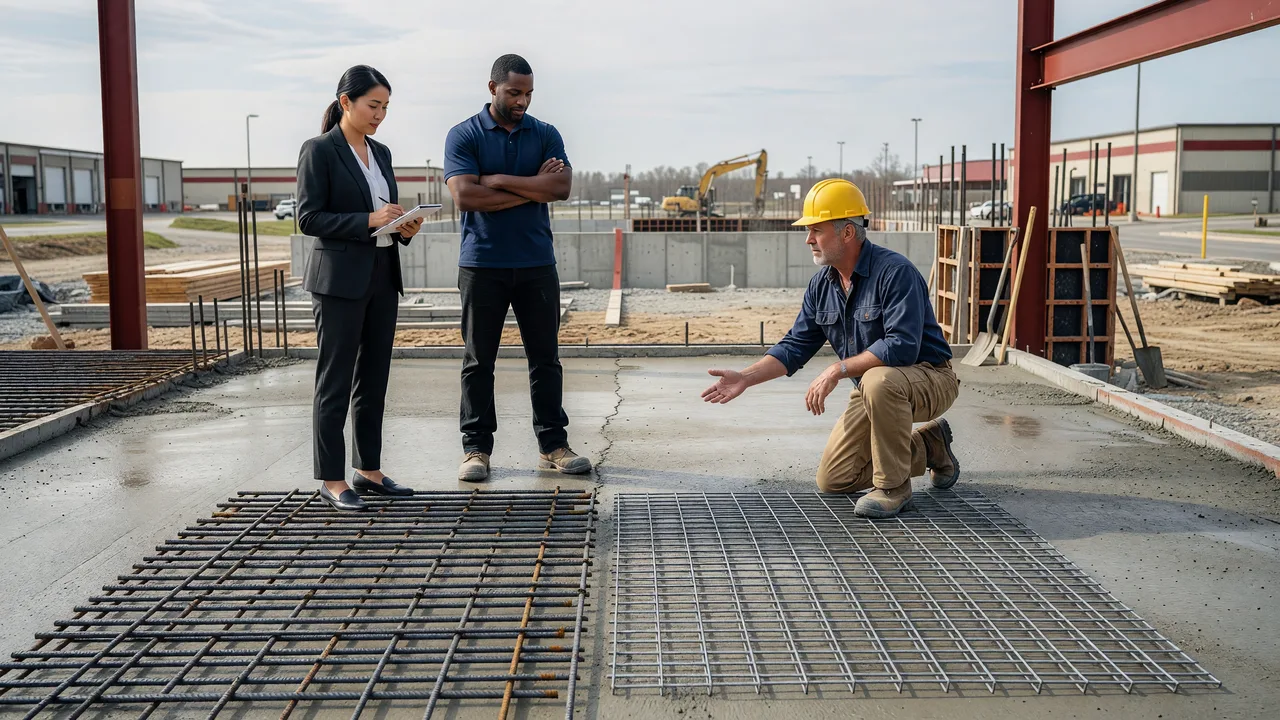
What rebar and wire mesh actually do in a concrete slab
Concrete is strong in compression and comparatively weak in tension. That matters because commercial slabs do not fail only from downward weight. They also experience bending stresses, temperature movement, drying shrinkage, edge loading, joint stress, and localized impact from traffic or equipment. Reinforcement helps the slab hold together when cracks form and, depending on the design, helps it resist tensile forces more effectively.
Rebar consists of steel bars placed in a designed pattern and elevation within the slab. It is commonly specified when a slab needs stronger reinforcement continuity, better load transfer support across stressed areas, or more predictable structural performance. Wire mesh, often welded wire reinforcement, uses a grid of steel wires. It can improve crack distribution and restraint in certain slab designs, but its value depends heavily on placement quality. If mesh ends up on the bottom of the slab instead of the designed elevation, its performance drops substantially.
For commercial buyers, the question is not simply which material is cheaper per sheet or per stick. The better question is which reinforcement system best supports operational use, inspection requirements, and long-term maintenance risk.
When rebar is usually the better fit for a commercial slab
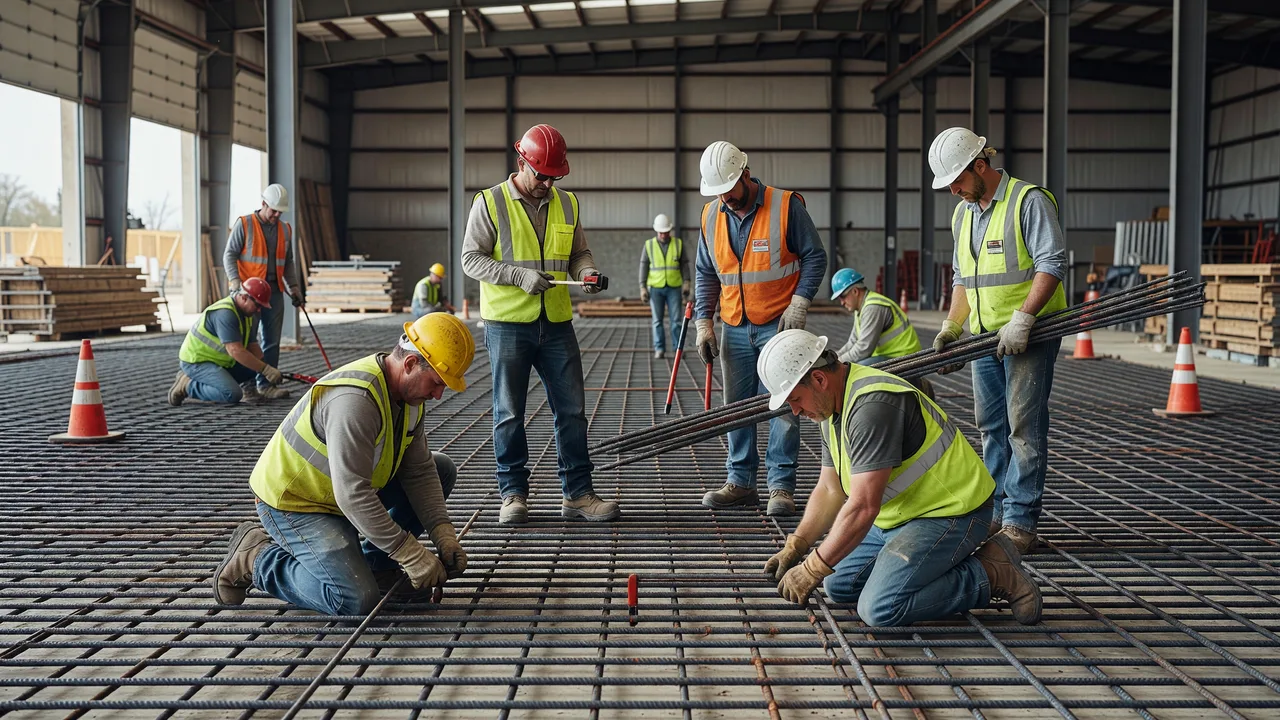 Photo by AI Generated (Grok Imagine)
In many commercial applications, rebar is the more appropriate reinforcement because the slab is expected to handle heavier service demands and tighter performance tolerances. That is especially true where failure carries real operational or liability consequences.
- Warehouse and industrial floors: Forklift traffic, pallet jacks, concentrated wheel loads, and storage systems create repeated stress cycles. Rebar is commonly favored where slab strength and continuity matter beyond basic shrinkage crack control.
- Loading docks: Dock slabs and aprons see impact, edge stress, truck interface movement, and heavy point loads. Rebar gives designers more control over reinforcement performance in these high-consequence zones.
- Foundations and structural slabs: Where the slab participates in structural behavior, rebar is typically integral to the engineered design rather than optional.
- Areas with uneven support risk: If subgrade conditions are variable or the slab spans small weak points, rebar generally provides more reliable reinforcement behavior than mesh.
- Thicker slabs or larger panels: As slab demands increase, rebar often becomes the practical specification because it can be detailed by size, spacing, lap, and cover with more precision.
For owners and GCs, rebar also tends to reduce ambiguity in the field. A self-performing contractor can place, tie, chair, and inspect the steel before the pour in a way that is easier to verify than loose mesh that may shift under foot traffic, pump hose movement, or concrete placement activity.
When wire mesh may make sense
Wire mesh can be appropriate in some commercial slab scenarios, especially where the goal is lighter-duty shrinkage and temperature reinforcement rather than higher structural demand. That may include certain sidewalks, light-use pads, or slabs with lower load expectations and straightforward geometry. It can also be specified as part of a broader reinforcement strategy depending on the engineer’s design.
The key limitation is installation discipline. Mesh has to be supported at the correct elevation to be effective. If crews pull it up during placement instead of setting it on chairs or other approved supports, the final position can be inconsistent. In real jobsite conditions, that inconsistency is one of the biggest reasons commercial buyers and designers prefer rebar for demanding slab work.
Wire mesh is not automatically wrong. It is simply more sensitive to execution. In a low-risk slab, that may be acceptable. In a mission-critical floor, loading area, or slab where shutdowns are expensive, many decision-makers want a more robust and more inspectable system.
Rebar vs wire mesh: side-by-side commercial slab comparison
The table below summarizes the practical differences commercial property owners, facility managers, developers, and general contractors should evaluate before approving a slab design.
| Factor | Rebar | Wire Mesh |
|---|---|---|
| Primary use | Higher-demand reinforcement, structural performance, heavier service conditions | Shrinkage and temperature crack control in lighter-duty slabs |
| Load handling | Generally better for heavy wheel loads, dock traffic, industrial use, and engineered slabs | Usually less suitable for high-load applications unless specifically engineered |
| Placement control | Easier to chair, tie, inspect, and verify before pour | More likely to end up out of position if not properly supported |
| Field reliability | Typically more reliable in demanding commercial conditions | Can perform adequately, but only with disciplined installation |
| Crack behavior | Helps hold cracks tight and support tensile demands where specified | Can help distribute shrinkage cracking if correctly placed |
| Complexity | More labor-intensive to place and tie | Can be faster to install in some simple layouts |
| Inspection confidence | Often preferred where accountability and verification matter | Can be harder to confirm after placement if mesh shifts during pour |
| Best fit | Warehouse floors, loading docks, structural slabs, foundations, industrial flatwork | Selected lighter-duty slabs, sidewalks, and applications with lower structural demand |
If you are comparing best Rebar vs Wire Mesh Reinforcement — Which Is Right for Your Commercial Slab? null guidance online, this is the distinction that matters most: commercial slabs should be reinforced based on service conditions, not on whichever material appears simpler at bid time.
The biggest mistake: assuming reinforcement can compensate for a poor slab build
Reinforcement matters, but it is only one part of slab performance. Many slab problems blamed on steel selection actually start below the concrete. Weak or inconsistent subgrade preparation, poor drainage, inadequate compaction, incorrect slab thickness, bad joint layout, or rushed curing can all create cracking, curling, settlement, or premature deterioration that reinforcement alone cannot fix.
That is why experienced commercial concrete contractors look at the full system. A warehouse floor that carries equipment all day has different demands than an ADA sidewalk. A parking lot slab-on-grade behaves differently than a loading dock apron. A foundation slab and a tilt-up concrete slab involve different structural assumptions. Reinforcement should be selected inside that larger design and construction framework.
For commercial buyers, this point is critical because long-term cost usually comes from downtime, repairs, and rework rather than from the initial steel line item. A cheaper reinforcement choice does not save money if the slab needs early patching, joint repairs, grinding, replacement sections, or operational workarounds.
How commercial slab use changes the right answer
The phrase Rebar vs Wire Mesh Reinforcement — Which Is Right for Your Commercial Slab? professional null OH only has a useful answer when the slab’s job is clearly defined. Commercial slabs are not interchangeable. The reinforcement strategy should reflect traffic, loading, tolerances, and risk.
Warehouse and industrial floors
These floors commonly justify rebar because the surface is exposed to repetitive wheel traffic, dynamic loading, abrasion, and potential rack or equipment loads. Cracks that open or differential movement at joints can interfere with operations, maintenance, and safety. In many industrial settings, durability and service continuity outweigh any small upfront material savings from lighter reinforcement.
Loading docks and aprons
These are among the most punishment-prone concrete areas on a commercial site. Impact loading, edge stress, truck braking and turning, and weather exposure combine to make reinforcement decisions more consequential. Rebar is often better suited where slab edges and transitions take abuse.
Parking lots and site concrete
Not every parking area uses the same slab design, but load class, turning movements, drainage, and subbase quality all matter. Delivery routes, dumpster pads, and drive lanes experience much harsher service than standard passenger-vehicle parking bays. Reinforcement must reflect those differences.
ADA sidewalks and flatwork
For ADA work, smoothness, slope compliance, drainage, and trip-hazard prevention are just as important as steel selection. Some walks may use mesh or other reinforcement as designed, but slabs in freeze-thaw conditions still depend on good base preparation, jointing, and finishing discipline.
Foundations, footers, and structural slabs
These are usually engineer-driven conditions where rebar is fundamental to the design. In these applications, the reinforcement decision is less about preference and more about meeting structural requirements and inspection standards.
Installation quality often matters more than the rebar-vs-mesh debate
On paper, a reinforcement design can look sound. In the field, performance depends on whether the crew actually installs it correctly. Bars need proper spacing, laps, supports, and cover. Mesh needs to be supported so it stays in the working zone of the slab. Concrete placement has to avoid displacing steel. Finishing has to proceed without compromising slab depth or reinforcement position. Cure practices must support strength gain and crack control.
This is where accountability matters. Commercial buyers frequently run into problems when the company they hired does not self-perform the work. The estimator sells one scope, another crew appears on pour day, and no one clearly owns the details that determine whether the slab passes inspection and lasts. Mattucci Construction’s positioning is important here because the company self-performs commercial concrete and masonry work rather than relying on subcontractor roulette. For property owners, facility managers, developers, and GCs, that means one accountable crew handling the work.
Mattucci Construction has been in business for more than 20 years, is family-owned, bonded and insured, and uses OSHA-compliant crews. Those facts do not decide whether rebar or mesh belongs in your slab design, but they do matter when the project depends on field execution rather than brochure promises.
What about cost? Rebar vs wire mesh is not just a material-price question
One of the most common buyer questions is effectively, How much does rebar vs wire mesh reinforcement — which is right for your commercial slab? cost in null? The honest answer is that there is no responsible flat national number because reinforcement cost is inseparable from slab design. Material type is only one variable among many.
Commercial slab pricing is influenced by slab thickness, steel size and spacing, mesh gauge, panel dimensions, subgrade preparation, edge conditions, sawcut pattern, access constraints, concrete volume, finishing requirements, pumping logistics, schedule, and inspection needs. A lightly reinforced housekeeping pad is not comparable to a warehouse floor or loading dock slab.
Wire mesh may appear less expensive on a narrow material comparison, and in some conditions it can be faster to place. But if the slab carries heavier use, the more relevant question is lifecycle cost. Rebar may be the more economical choice over time if it supports better long-term performance, reduces repair frequency, and lowers the risk of operational disruption.
When owners search terms like Rebar vs Wire Mesh Reinforcement — Which Is Right for Your Commercial Slab? estimate, Rebar vs Wire Mesh Reinforcement — Which Is Right for Your Commercial Slab? consultation, or affordable Rebar vs Wire Mesh Reinforcement — Which Is Right for Your Commercial Slab? null, the useful next step is not a generic online price. It is a scope-specific review of slab use, dimensions, design requirements, and site conditions.
How to choose the right reinforcement for your slab
If you are evaluating What should I look for in rebar vs wire mesh reinforcement — which is right for your commercial slab? services? or How do I choose a rebar vs wire mesh reinforcement — which is right for your commercial slab? provider in null?, use the checklist below.
- Start with actual service loads: Identify whether the slab will carry passenger vehicles, forklifts, trucks, racking, stored product, rolling equipment, or impact loading.
- Confirm whether the slab is structural or nonstructural: Structural slabs and foundations typically require engineered rebar layouts.
- Review the subgrade and drainage plan: Poor support conditions can overwhelm an otherwise reasonable reinforcement choice.
- Check slab thickness and panel/joint design: Reinforcement selection should align with joint spacing, crack control strategy, and expected movement.
- Ask how reinforcement will be supported and inspected: Mesh on the ground is not doing its job. Rebar without proper chairs, laps, or cover is also a problem.
- Consider the cost of failure, not just the cost of steel: On commercial properties, shutdowns, trip hazards, tenant complaints, and repeat repairs usually cost more than the reinforcement upgrade.
- Use a contractor who can execute the specification: Accountability, schedule control, and consistent crews matter on commercial slab work.
That decision framework is far more valuable than searching for Rebar vs Wire Mesh Reinforcement — Which Is Right for Your Commercial Slab? near me or top Rebar vs Wire Mesh Reinforcement — Which Is Right for Your Commercial Slab? null without evaluating the actual slab demands.
Practical recommendations by commercial application
Below are practical, non-generic recommendations commercial decision-makers can use when discussing reinforcement with their engineer or contractor.
Use rebar when downtime would be expensive
If slab cracking, settlement, or joint deterioration could interrupt warehouse operations, deliveries, tenant use, or safety compliance, rebar often offers the stronger risk-management position.
Use rebar where loads are concentrated or repetitive
Forklift aisles, dock approaches, industrial work zones, and heavy service pads generally justify a more robust reinforcement approach than light pedestrian slabs.
Consider mesh only when slab demand is clearly lighter and installation can be controlled
Wire mesh can make sense in lower-consequence slabs if it is part of the design and the installer can keep it in the proper position throughout the pour.
Do not separate reinforcement from the rest of the slab system
A good answer to Rebar vs Wire Mesh Reinforcement — Which Is Right for Your Commercial Slab? services null OH also includes subgrade preparation, drainage, thickness, joints, finishing, and curing. Those items are not secondary. They are performance drivers.
Document the scope before work starts
Commercial buyers should know what reinforcement is specified, how it will be supported, how laps and spacing will be handled, and who is responsible in the field. That level of clarity helps avoid change-order disputes and inspection surprises.
Why commercial buyers often prefer a self-performing concrete contractor
A slab can be perfectly detailed and still underperform if execution gets diluted across too many parties. That is why commercial owners and GCs often prefer a self-performing Rebar vs Wire Mesh Reinforcement — Which Is Right for Your Commercial Slab? contractor rather than a company that awards the fieldwork elsewhere after the sale. One accountable crew reduces handoff errors, communication gaps, and quality drift between estimate and installation.
Mattucci Construction’s commercial focus includes parking lots and site concrete, warehouse and industrial floors, loading docks, ADA sidewalks and flatwork, foundations and footers, tilt-up concrete construction, commercial masonry, concrete repair and restoration, retaining walls, and tenant build-outs. That scope matters because reinforcement decisions are not theoretical on these projects. They are tied directly to inspection, durability, drainage, schedule, and operational continuity.
For procurement teams asking What is the best rebar vs wire mesh reinforcement — which is right for your commercial slab? company in null?, the stronger evaluation criteria are usually straightforward: Does the contractor self-perform? Are they bonded and insured? Do they use OSHA-compliant crews? Do they have durable commercial experience rather than mostly residential marketing? Mattucci Construction checks those boxes and currently maintains an approximate 4.8-star Google rating from 19 reviews.
Some buyers also ask about Rebar vs Wire Mesh Reinforcement — Which Is Right for Your Commercial Slab? warranty or Rebar vs Wire Mesh Reinforcement — Which Is Right for Your Commercial Slab? financing. Those terms may appear in search behavior, but the more important issue on commercial concrete is whether the scope is designed and installed correctly the first time. Accountability upfront usually matters more than marketing language after the fact.
Bottom line for commercial slabs
There is no one-size-fits-all answer, but there is a clear pattern. If the slab is commercial, load-bearing, high-traffic, structurally significant, or costly to repair once in service, rebar is often the stronger choice. If the slab is lighter-duty and designed mainly for shrinkage crack control, wire mesh may be appropriate, provided placement quality is tightly controlled.
The smartest way to answer Rebar vs Wire Mesh Reinforcement — Which Is Right for Your Commercial Slab? top null OH is to begin with function, not preference: what the slab must support, how it will be used, what happens if it fails early, and whether the contractor can execute the reinforcement design as specified.
Talk through your slab scope before you bid it
 Photo by AI Generated (Grok Imagine)
If you are planning a warehouse floor, loading dock, parking area, foundation, ADA flatwork package, or another commercial concrete project, it is worth reviewing the reinforcement strategy before the bid gets locked in. The right decision depends on slab use, load, site conditions, and installation accountability as much as on material type. Mattucci Construction self-performs commercial concrete and masonry work, is bonded and insured, and uses OSHA-compliant crews. To discuss your project scope, use the quote-request form at mattucciconstruction.net or call (330) 992-2617.
Frequently Asked Questions About Rebar vs Wire Mesh Reinforcement — Which Is Right for Your Commercial Slab?
How long does rebar vs wire mesh reinforcement — which is right for your commercial slab? take?
How long does rebar vs wire mesh reinforcement — which is right for your commercial slab? take?
The reinforcement portion of a slab schedule depends on slab size, complexity, access, steel layout, and inspection sequencing. Mesh can be faster to deploy on simple, open slabs, while rebar usually requires more placing and tying time. On commercial work, however, schedule should be weighed against durability and inspection confidence. A faster installation is not automatically the better installation if the slab is high consequence.
Is rebar vs wire mesh reinforcement — which is right for your commercial slab? worth the investment?
Is rebar vs wire mesh reinforcement — which is right for your commercial slab? worth the investment?
Yes, selecting the right reinforcement is worth the investment because the cost of slab failure is usually much higher than the cost difference between reinforcement options. Repairs can disrupt deliveries, tenant access, equipment movement, and compliance. On commercial properties, the right slab system protects uptime as much as it protects concrete.
Can wire mesh replace rebar in a warehouse or loading dock slab?
Can wire mesh replace rebar in a warehouse or loading dock slab?
Not as a blanket rule. In demanding warehouse and loading dock environments, rebar is often preferred because these slabs face heavy wheel loads, impact, edge stress, and repetitive use. Whether mesh can be used depends on the engineered design and the slab’s actual service demands. It should never be substituted casually to cut cost.
Why does wire mesh sometimes underperform in commercial slabs?
Why does wire mesh sometimes underperform in commercial slabs?
The most common issue is placement. If the mesh is not properly supported and remains too low in the slab, it cannot perform as intended. Commercial pours involve foot traffic, hoses, buggies, and finishing operations that can displace unsupported mesh. That is why field discipline is essential.
Does reinforcement prevent concrete from cracking?
Does reinforcement prevent concrete from cracking?
No reinforcement completely eliminates cracking. Concrete naturally shrinks as it cures and can crack from movement, restraint, load, or subgrade issues. Reinforcement helps control how cracks behave, helps keep them tighter, and supports slab integrity. The broader slab system—including base prep, joints, drainage, and curing—still matters.
What matters besides rebar or wire mesh when building a commercial slab?
What matters besides rebar or wire mesh when building a commercial slab?
Subgrade preparation, compaction, drainage, slab thickness, joint layout, concrete mix, placement methods, finishing, and curing all affect performance. Many recurring slab failures trace back to poor support conditions or weak execution rather than to the reinforcement category alone. Reinforcement should be evaluated as one part of the full slab design.
Need a second set of eyes on your slab reinforcement plan?
If you are comparing reinforcement options for a commercial slab, Mattucci Construction can review the scope in practical jobsite terms—load demands, slab use, constructability, and long-term maintenance risk. Submit a quote request through the website or call the office to discuss your project.