
Laser-Screed Warehouse Floors — When Is It Worth the Premium?
Laser-Screed Warehouse Floors — When Is It Worth the Premium?
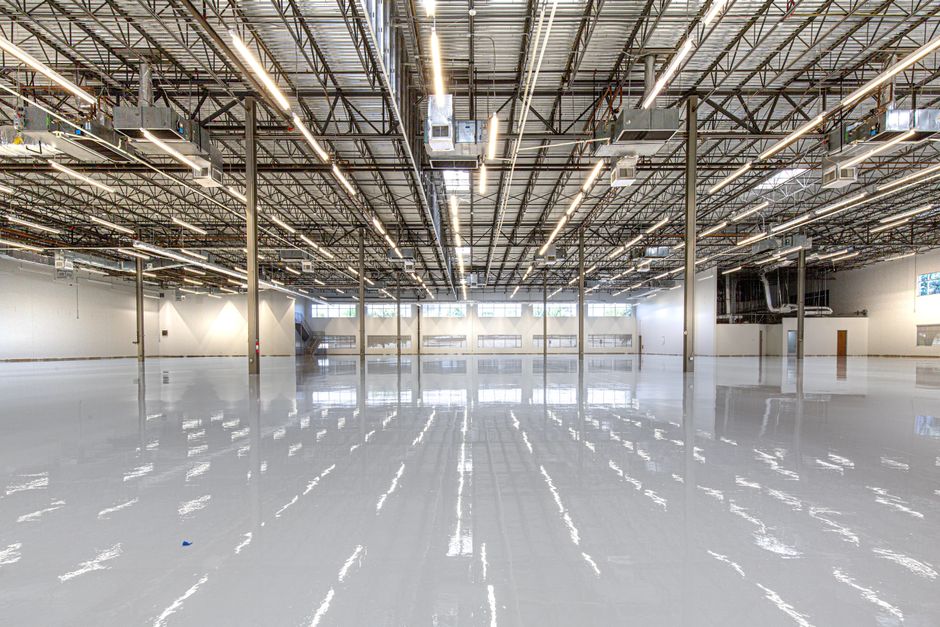
If you’re building a warehouse, distribution center, or large-format commercial slab in Akron or anywhere across Northeast Ohio, you’ve likely heard the phrase “laser screed” thrown around by general contractors and concrete specialists. You’ve also probably noticed it carries a noticeable premium over traditional hand-screeded or vibratory-screeded slabs. The question every owner asks us at Mattucci Construction is the same: Is a laser screed warehouse floor actually worth the extra investment?
The short answer is: it depends on your floor flatness requirements, square footage, racking system, and how many Ohio freeze-thaw cycles you expect the slab to survive. The long answer — and the one that protects your capital investment — requires understanding the technology, the tolerances, and the local conditions that make Akron concrete work uniquely demanding. After two decades of pouring slabs from Hudson industrial parks to Strongsville distribution facilities, here’s our honest, experience-based breakdown.
What Is a Laser Screed and How Does It Differ from Traditional Methods?
A laser screed is a self-propelled, ride-on machine equipped with a telescoping boom, a vibrating screed head, and a laser-guided elevation control system. The receiver on the screed head reads a rotating laser transmitter set up on the jobsite and continuously adjusts the screed head to within ±1/8 inch of design grade. Compared to wet-screeding off form pins or pulling a 2×4 by hand, the difference in flatness and consistency is dramatic.
Traditional screeding methods — strike-off boards, vibratory truss screeds, or hand bull-floating — typically achieve floor flatness (FF) numbers between 20 and 35. A properly executed laser screed pour routinely delivers FF50 to FF75, with super-flat applications pushing FF100+. For a warehouse with 30-foot-tall narrow-aisle racking or automated guided vehicles (AGVs), those numbers aren’t cosmetic — they’re operational.
The machine also places concrete faster. A two-person laser screed crew can finish 12,000–15,000 square feet in a single pour, where a hand-screed crew might top out at 5,000–7,000. On larger Akron-area projects — say, a 60,000 sq ft distribution facility off I-77 — that production rate translates to fewer cold joints, fewer construction joints, and a more monolithic finished surface.
AI-generated video
When the Premium Pays for Itself
A laser screed warehouse floor typically costs 15–30% more per square foot than a conventional slab on grade. That premium is genuinely worth it in the following scenarios:
- Slabs over 10,000 square feet. Economies of scale kick in fast. The mobilization cost of the equipment gets spread over enough area to make the per-foot premium shrink considerably.
- High-rack or narrow-aisle racking. Lift trucks operating above 25 feet are extremely sensitive to floor deflection. An out-of-tolerance slab causes mast sway, slower pick rates, and accelerated equipment wear.
- Defined-traffic aisles requiring FF/FL specs. ACI 117 and F-number specifications written into your lease or build-to-suit contract usually require laser screed placement to be achievable.
- Polished concrete finishes. A polished floor amplifies every dip, hump, and trowel mark. Starting flat is the only way to finish flat.
- Cold storage and food-grade facilities. Tight joint tolerances and surface flatness affect both cleanability and refrigeration efficiency.
For a small contractor’s storage building in Cuyahoga Falls or a 4,000 sq ft pole barn outside Medina, the math usually doesn’t work. A skilled hand-finish crew can hit FF35 all day long, which is more than adequate for forklifts under 20 feet and standard pallet racking.
The Ohio Freeze-Thaw Factor — Why Local Experience Matters
Here’s where Akron-specific knowledge separates the contractors who’ll still be standing behind their work in 2045 from those who won’t. Northeast Ohio averages 50–70 freeze-thaw cycles per year. Each cycle drives water into microcracks, expands, and pries the slab apart at a microscopic level. A laser-screed floor isn’t automatically more durable than a conventional slab — but a properly engineered laser-screed floor, with the right mix design, joint spacing, and curing protocol, absolutely is.
For our Akron and Summit County warehouse clients, we typically specify:
- 4,500–5,000 psi concrete with a 0.45 maximum water-cement ratio
- 6–8% entrained air for freeze-thaw resistance (ASTM C260)
- Fiber reinforcement — usually macrosynthetic at 4–7.5 lb/yd³ — to control plastic shrinkage cracking
- Sawed contraction joints at 12–15 feet on center, cut within 6–12 hours of placement
- Curing compound or wet curing for a minimum of 7 days
We’ve seen too many slabs poured by out-of-state crews in Twinsburg and Hudson that looked beautiful on day one and were spalling at the joints by year three. Ohio doesn’t forgive shortcuts. Whether you choose laser screed or traditional placement, the mix and curing protocol have to be built for our climate.
Understanding FF and FL Numbers — What to Specify
If you’re writing or reviewing specifications for a warehouse floor, two numbers matter more than any others: FF (Floor Flatness) and FL (Floor Levelness). Both are governed by ASTM E1155 and referenced throughout ACI 117.
- FF 25 / FL 20 — Conventional, non-critical warehouse. Hand-screed achievable.
- FF 35 / FL 25 — Standard commercial warehouse. Borderline; good crews hit this without laser screed.
- FF 50 / FL 35 — Lift trucks to 25 ft. Laser screed strongly recommended.
- FF 75 / FL 50 — High-bay racking, AGVs. Laser screed required.
- FF 100+ / Super-Flat — Very narrow aisle (VNA) wire-guided trucks. Specialty laser screed with strike-off shoes.
A common mistake we see in build-to-suit projects across the Cleveland-Akron corridor is over-specifying. If your operation runs 12-foot reach trucks on wide aisles, paying for FF75 is wasted capital. Match the spec to the operation.
What a Laser Screed Floor Should Cost in the Akron Market
As of current Northeast Ohio pricing, expect the following ranges for a properly engineered warehouse slab on grade (6″ thick, fiber-reinforced, 4,500 psi):
- Conventional placement: $7.50–$9.50 per square foot installed
- Laser screed, FF50/FL35: $9.00–$11.50 per square foot installed
- Super-flat, FF75+: $12.00–$16.00 per square foot installed
- Polished overlay add: $3–$8 per square foot depending on level of polish
Pricing fluctuates with cement availability, steel rebar markets, and fuel. We’ve watched ready-mix prices in the Akron market climb roughly 28% since 2020. Lock in your concrete supply early on any project over 15,000 square feet — supply, not labor, is now the most common cause of schedule slippage on local warehouse projects.
Choosing the Right Contractor in Northeast Ohio
Not every concrete contractor in the Akron–Cleveland market owns or even rents a laser screed. Of those who do, fewer still have the trained operators, the finishing crew depth, and the project management experience to consistently hit tight F-number specs. Before signing a contract, ask:
- Can you show me three completed warehouse slabs with F-number test reports?
- Who is your ready-mix supplier, and what’s your backup plan if they’re short on the day of the pour?
- What’s your mix design for freeze-thaw exposure, and why?
- What’s your joint layout strategy, and when do you saw-cut?
- Do you self-perform finishing, or sub it out?
That last question matters. Finishing is where flat floors are made or broken. At Mattucci Construction, our finishers are W-2 employees who’ve been on our crews for years, not day labor. That continuity is why our slabs in Stow, Hudson, and the Bath Township industrial corridor still measure within spec a decade after placement.
Frequently Asked Questions
How long does a laser screed warehouse floor take to cure before forklift traffic?
Concrete reaches roughly 70% of its design strength at 7 days and 100% at 28 days. We typically clear floors for light foot traffic at 24–48 hours, light pneumatic-tire equipment at 7 days, and full forklift / racking loads at 28 days. Cold weather pours in Akron between November and March extend those windows — sometimes by 50% or more — and require heated enclosures or accelerators to stay on schedule.
Will a laser screed floor still crack?
Yes — all concrete cracks. The goal isn’t to prevent cracking; it’s to control where the cracks happen. Properly spaced and timed saw cuts create planes of weakness so the inevitable shrinkage cracks occur within the joints rather than randomly across the slab face. A well-built laser screed floor with correct joint spacing should show essentially no random cracking through 20+ Ohio winters.
Can you laser screed in cold weather in Northeast Ohio?
Yes, but with significant precautions. ACI 306 governs cold-weather concreting, and we follow it strictly. That means heated water and aggregates from the ready-mix plant, hydration accelerators, insulated blankets or heated enclosures, and continuous temperature monitoring for at least 72 hours after placement. We’ve poured laser-screed floors in Akron in January — it’s just more expensive and slower than a May pour.
How do I know if my project really needs FF50 or higher?
Talk to your material handling equipment vendor before you finalize the slab spec. Lift truck manufacturers publish floor flatness requirements for every model. If your operation will run 20-foot reach trucks, FF35 is usually adequate. Above 25 feet, FF50 is the floor (pun intended). For VNA or AGV systems, the equipment vendor will hand you a spec — follow it exactly, because warranty claims hinge on it.
Does Mattucci Construction handles both the concrete and the building envelope?
We coordinate closely with general contractors, steel erectors, and design-build teams across Summit, Medina, and Cuyahoga counties. For residential and small commercial clients, we self-perform site work, foundations, and slabs. For larger industrial projects, we typically partner as the concrete specialist within a larger team. Either way, we manage our scope from subgrade prep through final cure.
Ready to Pour the Right Floor the First Time?
A warehouse slab is the single most important structural element in your facility. It carries every pallet, every forklift, every rack upright, and every freeze-thaw cycle for the life of the building. Choosing between a laser screed warehouse floor and a conventional placement is a capital decision that deserves expert input — not a coin flip.
Mattucci Construction has been engineering, placing, and finishing concrete across Akron, Cleveland, and the surrounding Northeast Ohio suburbs for two decades. We’ll walk your site, review your operational requirements, and give you a straight answer about whether the laser screed premium is justified for your project — not someone else’s.
Explore our concrete services or contact us for a project consultation. We answer the phone, we show up when we say we will, and we stand behind every slab we pour.
About the Author — Mattucci Construction
Mattucci Construction is a family-operated concrete and construction firm serving Akron, Cleveland, and Northeast Ohio. Our crews specialize in slab-on-grade construction, decorative and polished concrete, foundation work, and site development for residential and commercial clients across Summit, Medina, Cuyahoga, and Portage counties. Every project is led by a principal of the firm, and every slab we pour is engineered for Ohio’s freeze-thaw climate. Licensed, insured, and locally accountable since day one.
Get a Free Quote
Send us a message and we’ll get right back to you.
☎ Call 330-992-2617
Request a Free Bid Package
Ready to Get Started?
Mattucci Construction provides expert Home Services in Akron and surrounding areas.
Contact Us Today
Call 330-992-2617
Frequently asked questions
How much does our service cost?
Mattucci Construction offers transparent pricing and a free initial consultation. Final cost depends on your specific situation — contact us for a no-obligation quote.
How long does our service take?
Timelines vary by case, but Mattucci Construction provides a clear estimate up front and same-day scheduling where possible.
Do you serve my area?
Yes — Mattucci Construction actively serves the local area and surrounding communities.
What should I do first?
Reach out to Mattucci Construction for a free consultation; we’ll review your situation and outline the best next step.
contact us for a project consultation
Request an Estimate
Share your project details and we’ll send a free estimate.
☎ Call 330-992-2617
Request My Free Estimate
Frequently asked questions
How much does concrete cost?
How long does concrete take?
Do you serve my area?
What should I do first?
Request an Estimate
Share your project details and we’ll send a free estimate.
☎ Call 330-992-2617