
How Thick Does a Commercial Dumpster Pad Need to Be for Truck Loading?
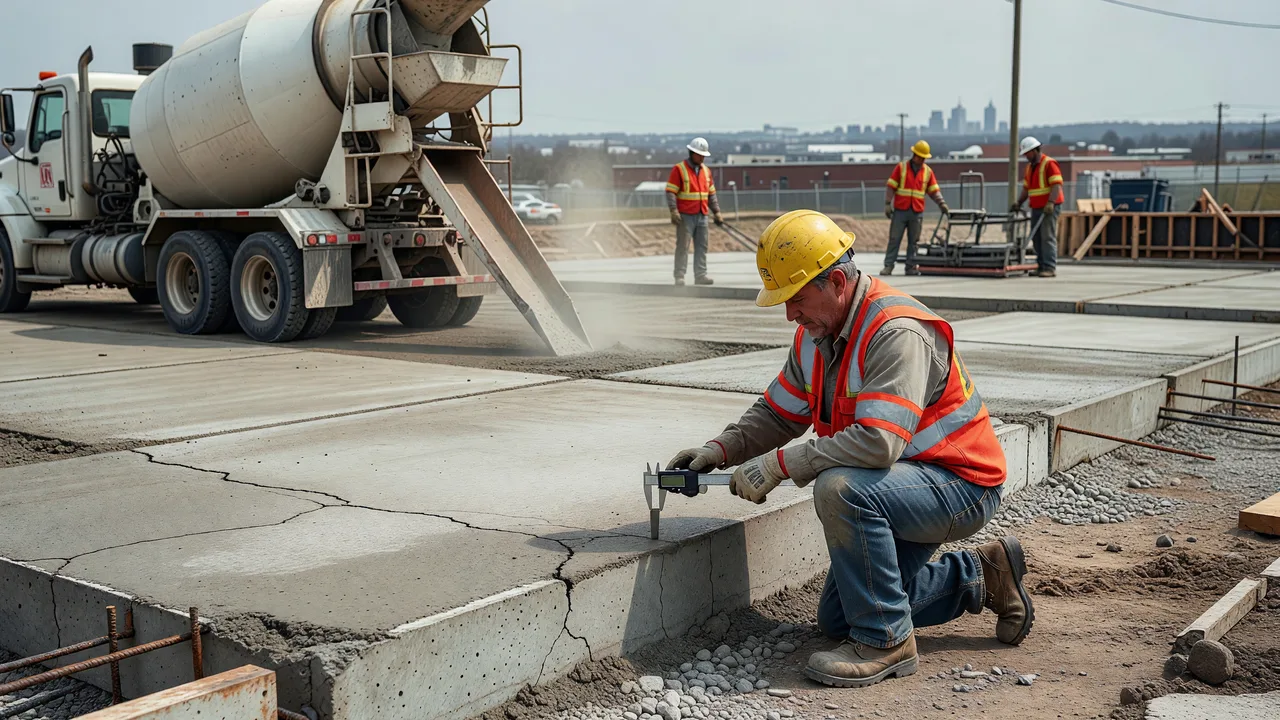
A practical guide for owners, facility managers, developers, and general contractors evaluating reinforced concrete dumpster pads that can handle repeated truck loading without premature cracking, settlement, or drainage problems.
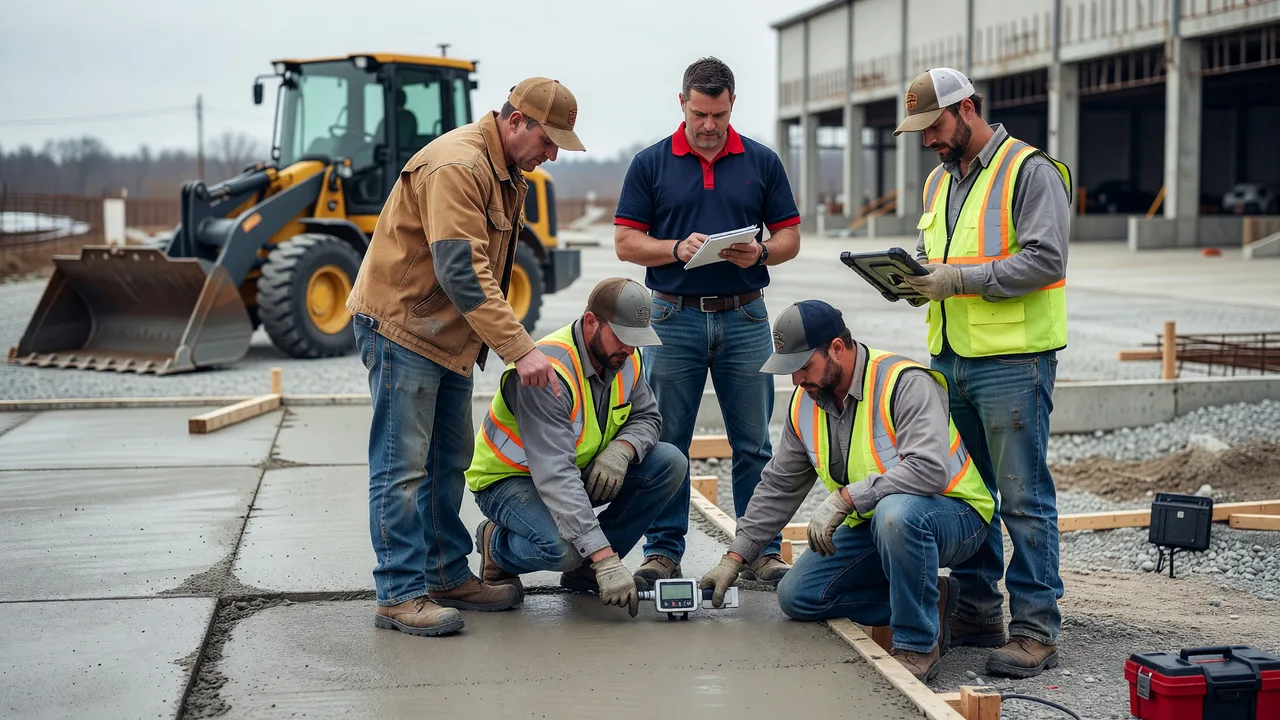
For truck-loaded commercial use, a dumpster pad typically needs to be at least 6 inches thick reinforced concrete, and many heavy-duty applications require 8 inches or an engineered section. The correct thickness depends on front-load or roll-off truck weight, turning stress, subgrade strength, reinforcement, drainage, and freeze-thaw exposure—not just the dumpster itself. Call (330) 992-2617 to discuss your needs and next steps.
Direct Answer: How Thick Does a Commercial Dumpster Pad Need to Be for Truck Loading? OH
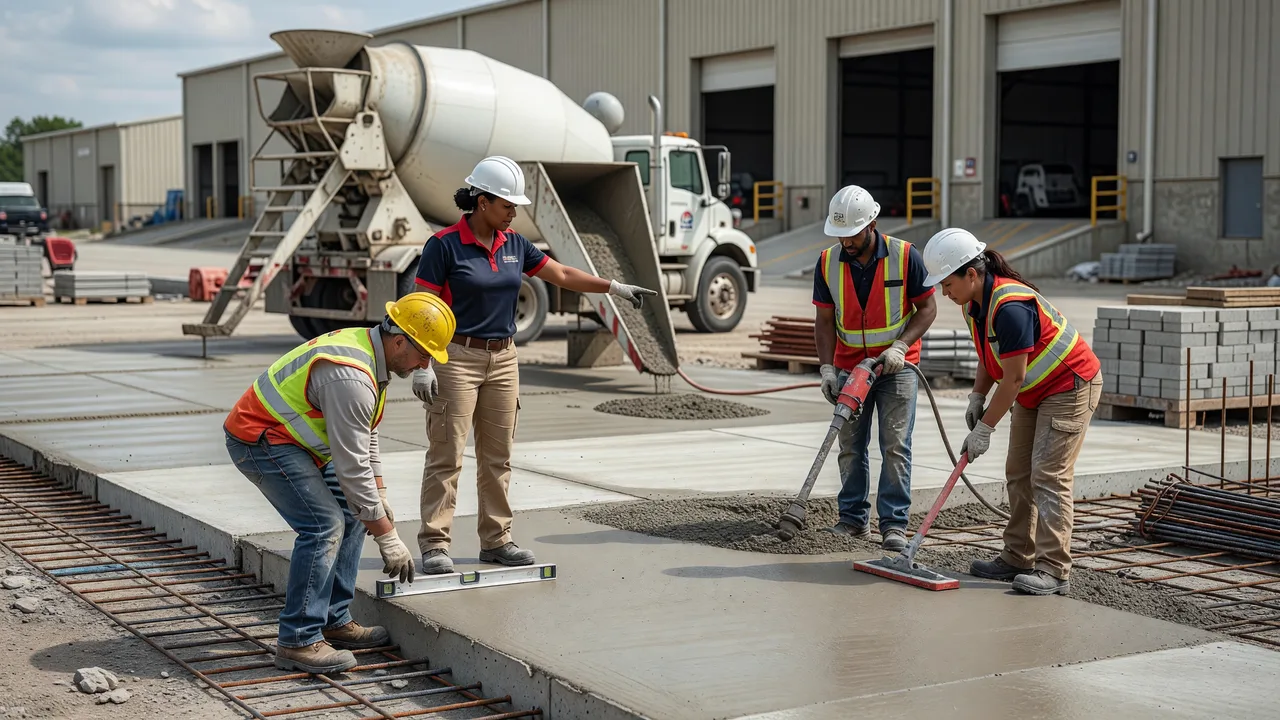 Photo by AI Generated (Grok Imagine)
For most commercial truck loading conditions, a dumpster pad should be at least 6 inches thick in reinforced concrete, while 8 inches thick is common where front-load or roll-off trucks apply heavier wheel loads, impact, and turning pressure. In practice, proper pad performance depends on more than slab depth: reinforcement, stone base, subgrade preparation, joint layout, drainage, and local freeze-thaw exposure all matter.
If you are searching for How Thick Does a Commercial Dumpster Pad Need to Be for Truck Loading? OH, the safest buyer takeaway is simple: do not size the pad for the dumpster alone. Size it for the truck, the approach path, and the repeated loading cycle.

Why dumpster pads fail when thickness is undersized
Dumpster pads rarely fail because a container is sitting still. They fail because the slab is asked to carry concentrated axle loads, stabilizer pressure, impact during pickup, and slow-speed turning movements on a small footprint. That combination produces higher stress than a standard sidewalk or light-duty exterior slab.
The most common failure modes are corner cracking, punched-out wheel paths, rocking slabs, settlement at the truck approach, spalling around joints, and standing water that accelerates surface breakdown. In colder climates, trapped water and repeated freeze-thaw cycles make those issues worse. A pad that looks acceptable on pour day can become a maintenance problem quickly if the base, drainage, and reinforcement are not matched to the use.
This is why the answer to How Thick Does a Commercial Dumpster Pad Need to Be for Truck Loading? best null OH is never just a number pulled from a generic residential concrete detail. Commercial loading conditions are different. Owners and GCs need a slab detail built for repeated service loads and inspection-level durability, not just curb appeal.
Typical commercial dumpster pad thickness ranges
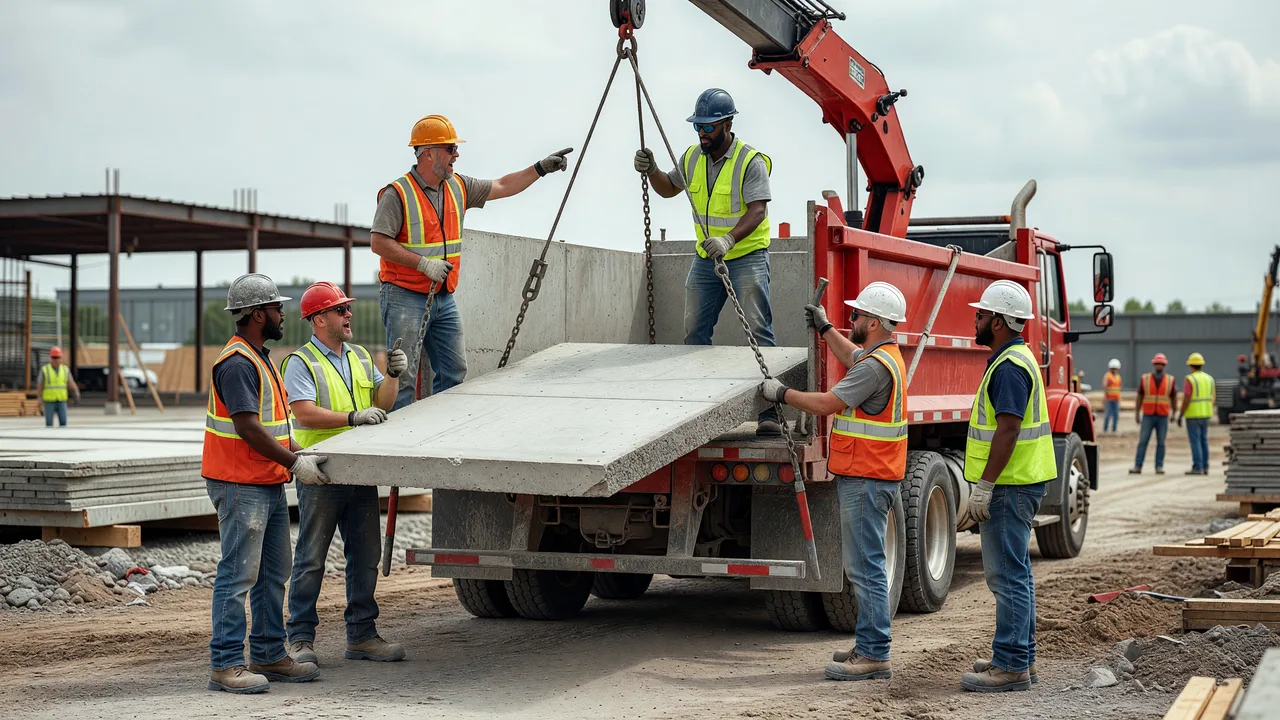 Photo by AI Generated (Grok Imagine)
Across the United States, commercial dumpster pad thickness usually falls into a practical range rather than a single universal rule. The correct section depends on truck type, loading frequency, and underlying soils. The ranges below are a useful planning framework for buyers, but final design should follow project-specific conditions and, where required, engineer or jurisdictional review.
| Use Condition | Typical Concrete Thickness | Common Risk if Undersized |
|---|---|---|
| Light commercial trash service with limited truck access | 6 inches reinforced | Surface cracking and edge distress |
| Regular front-load truck service | 6 to 8 inches reinforced | Wheel-path cracking and settlement |
| Heavy or frequent truck loading, tight turning | 8 inches reinforced | Punching, rocking, joint failure |
| Roll-off service or severe industrial use | 8 inches or engineered section | Major slab breakage and base failure |
For buyers asking the top How Thick Does a Commercial Dumpster Pad Need to Be for Truck Loading? null question, the most important distinction is this: the approach apron and truck maneuvering area often need the same level of attention as the actual dumpster footprint. A thick pad connected to a weak approach section will still fail at the transition point.
That is also why many professional How Thick Does a Commercial Dumpster Pad Need to Be for Truck Loading? null consultations review the entire traffic path, not only the rectangle under the bin.
What actually determines the required thickness
Concrete thickness is one variable in a larger pavement system. Commercial buyers should evaluate the following factors before approving a dumpster pad detail.
Truck type and axle loading
A front-load truck lifting a commercial dumpster applies concentrated wheel loads near the pickup point and can create torsional stress when positioning and backing. A roll-off truck usually imposes even more severe loading because container placement and retrieval create impact and drag forces. If the truck enters at an angle or has to pivot in a confined enclosure, slab stresses increase further.
That is why the best answer to How Thick Does a Commercial Dumpster Pad Need to Be for Truck Loading? contractor questions starts with vehicle type, collection frequency, and maneuver pattern—not a one-size-fits-all slab depth.
Subgrade strength and base preparation
A thick slab on weak subgrade is still a risk. Soft, wet, poorly compacted, or disturbed soils allow the slab to flex under wheel loading. That movement leads to cracking, faulting, and loss of support. In commercial work, proof-rolling, undercutting unsuitable material where necessary, and installing a properly compacted aggregate base are often more important than adding another inch of concrete without fixing the support condition underneath.
Buyers comparing How Thick Does a Commercial Dumpster Pad Need to Be for Truck Loading? services null OH should ask whether the contractor self-performs excavation and base prep oversight or simply pours over existing conditions. The slab only performs as well as the platform below it.
Reinforcement and joint layout
Reinforcement does not replace thickness, but it helps control crack width and maintain slab integrity after shrinkage and service stresses occur. Depending on the design, reinforcement may include rebar or welded wire reinforcement. Joint spacing and layout also matter. Poorly placed joints can force uncontrolled cracking at wheel paths or corners, especially near enclosure walls and gate openings where load concentrations are highest.
Anyone researching What should I look for in how thick does a commercial dumpster pad need to be for truck loading? services? should look beyond the concrete depth line item and ask how the slab will be reinforced and where joints will be located.
Drainage and freeze-thaw exposure
Dumpster areas are wet by nature. Wash-down water, leachate, precipitation, and snowmelt all move across the slab. If the pad is flat or back-pitched, water ponds under dumpsters and beside truck tires. That standing water weakens the base over time and accelerates freeze-thaw distress in cold-weather environments. The result is often scaling, spalling, and differential settlement at exactly the spots that take the highest load.
Commercial slabs should be designed to shed water away from structures, enclosure posts, and access points while preserving functional truck approach grades. In practical field terms, drainage mistakes can ruin an otherwise adequate 6-inch or 8-inch pad.
6 inches vs. 8 inches: when the thicker pad is worth it
Many owners want to know whether 6 inches is enough or whether 8 inches is the smarter long-term choice. In commercial conditions, that decision usually comes down to risk management. If the pad will see routine truck loading, repeated stops in the same tire tracks, and any turning or backing pressure, the thicker section can be a cost-effective way to reduce future repairs.
A 6-inch reinforced pad can perform well when loading is moderate, support conditions are strong, and drainage is handled correctly. An 8-inch reinforced pad becomes more compelling when truck service is frequent, container size is larger, approach geometry is tight, or the site has a history of settlement and slab distress. The price delta at installation is often smaller than the operational cost of patching, tenant disruption, and hauling replacement debris later.
This is the practical answer to Is how thick does a commercial dumpster pad need to be for truck loading? worth the investment? Yes—when the pad is properly sized for the truck loading environment, the investment helps avoid recurring failures that are more expensive than doing the section right the first time.
Dumpster pad thickness compared to other commercial flatwork
One reason this issue causes confusion is that buyers sometimes compare dumpster pads to sidewalks, dumpster enclosures, or general exterior slabs. Those are not equivalent loading conditions. ADA walkways and standard pedestrian concrete are designed around foot traffic and accessibility tolerances, not repeated refuse truck axle loads. Parking lot pavement sections can also differ because asphalt or concrete parking areas distribute loads across larger traffic patterns rather than a concentrated pickup zone.
That distinction matters for commercial portfolios where site concrete scopes overlap. A facility manager budgeting ADA flatwork, parking lot replacement, and dumpster area repairs should not assume all exterior concrete uses the same thickness or reinforcement. This is one reason searches like how much does ada-sidewalk cost in Macedonia OH or how much does parking-lot cost in Twinsburg OH do not translate directly into dumpster pad budgeting. Different use cases require different slab sections, support prep, and drainage details.
Similarly, buyers evaluating best parking-lot near me or commercial-concrete in Twinsburg OH often discover that a credible commercial concrete contractor talks in systems—subgrade, base, reinforcement, drainage, joints, and loading—not just square-foot pricing. The same commercial thinking applies to dumpster pads.
Common design and installation mistakes to avoid
- Sizing for the container instead of the truck. The truck load controls the design in most commercial cases.
- Ignoring the approach apron. Failure often starts where the truck enters, turns, or backs into position.
- Pouring over weak or wet subgrade. Inadequate support leads to slab movement regardless of thickness.
- Underestimating drainage. Standing water shortens service life and creates housekeeping and sanitation issues.
- Using light-duty details from non-commercial flatwork. A dumpster pad is not the same as a patio, basic sidewalk, or residential driveway panel.
- Skipping accountability in execution. If site prep, forming, reinforcement placement, and finishing are split among multiple parties, finger-pointing becomes more likely when the slab fails.
For owners searching How do I choose a how thick does a commercial dumpster pad need to be for truck loading? provider in null?, these mistakes are a useful screening tool. Ask who is responsible for layout, subgrade verification, reinforcement placement, drainage execution, and final slab detail.
Practical recommendations before you approve a dumpster pad
If you are reviewing a proposal or planning a new site package, use the checklist below to make the detail more durable and easier to defend internally.
- Identify the exact truck service type. Confirm whether service is front-load, rear-load, or roll-off, and how often pickups occur.
- Ask for the full paved section. Do not approve concrete thickness alone. Review subgrade prep, stone base, reinforcement, jointing, and edge conditions.
- Review turning movements. Tight enclosures and back-in conditions increase stress and often justify a heavier section.
- Check drainage slopes and discharge path. Water should leave the pad without ponding at the pickup point.
- Coordinate enclosure hardware and adjacent features. Bollards, gates, walls, drains, and utility conflicts affect slab geometry and jointing.
- Plan for maintenance access. Haulers need a stable, predictable approach path to avoid edge breakdown and impact damage.
- Use a commercial contractor familiar with high-load slabs. The detail should be approached like site concrete serving operations, not decorative exterior flatwork.
If you need a How Thick Does a Commercial Dumpster Pad Need to Be for Truck Loading? estimate or How Thick Does a Commercial Dumpster Pad Need to Be for Truck Loading? consultation, the most useful early step is to provide site photos, dumpster type, truck service method, known drainage issues, and any prior cracking or settlement history.
How commercial buyers can evaluate a contractor for this work
Dumpster pads look simple on paper, but in service they behave like small heavy-duty pavement systems. That means contractor selection matters. Commercial buyers should look for a contractor that understands site concrete, loading docks, warehouse and industrial slab behavior, ADA tolerances, and how drainage affects slab life. Those disciplines overlap directly with successful dumpster pad construction.
Mattucci Construction is positioned for that kind of work because the company self-performs commercial concrete and masonry rather than outsourcing field execution to unknown crews. For owners, facility managers, developers, and general contractors, that reduces the accountability gap that often appears when excavation, forming, reinforcement placement, and finishing are split up. Mattucci Construction has been in business 20+ years, is family-owned, bonded and insured, and uses OSHA-compliant crews. Its commercial scope includes parking lots and site concrete, warehouse and industrial floors, loading docks, ADA sidewalks and flatwork, foundations and footers, tilt-up concrete construction, commercial masonry, repair and restoration, retaining walls, and tenant build-outs.
That background is relevant if you are comparing What is the best how thick does a commercial dumpster pad need to be for truck loading? company in null? There is no universal “best” contractor for every project, but buyers should favor firms that routinely build concrete for heavy use, inspection sensitivity, and operational uptime. Mattucci also carries an approximate 4.8 average Google rating from 19 reviews, which offers an additional trust signal without overstating scale.
Searches such as concrete masonry construction in Macedonia OH or commercial-concrete in Twinsburg OH reflect a broader market need: commercial buyers want one accountable contractor who can handle structural and flatwork scopes in real operating environments. That is exactly where self-performing capability matters.
Cost, schedule, and investment expectations
Buyers often ask, How much does how thick does a commercial dumpster pad need to be for truck loading? cost in null? There is no trustworthy national price that applies to every site, because cost depends on demolition needs, access, excavation depth, base repair, slab thickness, reinforcement, drainage work, enclosure coordination, and curing logistics. A pad replacement inside an active commercial property is very different from a new installation on an open site.
The same is true of schedule. If you are asking, How long does how thick does a commercial dumpster pad need to be for truck loading? take?, the answer depends on whether the work includes removal, undercutting, base reconstruction, inspection sequencing, and how long the slab must cure before truck loading resumes. Commercial owners should evaluate schedule in operational terms: how long the waste area is offline, how truck access will be managed during the work, and whether adjacent tenants or deliveries are affected.
For procurement teams searching affordable How Thick Does a Commercial Dumpster Pad Need to Be for Truck Loading? null, affordability should be measured against lifecycle performance. The cheapest initial section is rarely the lowest operating cost if it fails under repeated truck loading. A thicker reinforced pad with proper support and drainage often reduces callbacks, patching, trip hazards, and waste-service disruptions.
Final takeaway
The most reliable answer to How Thick Does a Commercial Dumpster Pad Need to Be for Truck Loading? near me is that most commercial pads start at 6 inches reinforced concrete, while many truck-loaded conditions justify 8 inches or a project-specific engineered section. The real decision is not just slab depth; it is whether the entire system is built for truck loads, water, freeze-thaw exposure, and repeated use.
For commercial buyers, the smartest approach is to evaluate the pad the same way you would a loading dock approach, warehouse service slab, or other high-consequence flatwork: verify loads, prepare the subgrade, specify reinforcement, control drainage, and hold one accountable team responsible for execution.
Frequently Asked Questions About How Thick Does a Commercial Dumpster Pad Need to Be for Truck Loading?
What is the minimum thickness for a commercial dumpster pad?
What is the minimum thickness for a commercial dumpster pad?
In many commercial applications, 6 inches of reinforced concrete is the practical minimum for truck-loaded dumpster service. That said, “minimum” is not the same as “appropriate.” If truck traffic is frequent, the truck turns tightly, or the site has weak support soils, 8 inches or an engineered section may be the better choice.
Is 4 inches of concrete enough for a dumpster pad?
Is 4 inches of concrete enough for a dumpster pad?
Generally, no. A 4-inch slab is typically too light for repeated commercial truck loading. It may crack, settle, or break at wheel paths and edges, especially where a refuse truck stops, lifts, or turns. Four inches is more consistent with light-duty flatwork than a heavy-use commercial waste area.
Does the dumpster itself determine the slab thickness?
Does the dumpster itself determine the slab thickness?
Not by itself. The controlling design factor is usually the truck loading condition, not the static weight of the dumpster. Front-load and roll-off trucks create concentrated wheel loads, impact, and turning stress that are more demanding than the container sitting in place.
Should the approach apron be the same thickness as the dumpster pad?
Should the approach apron be the same thickness as the dumpster pad?
Often, yes—or at least it should be designed for the same loading pattern. Many failures start at the approach where the truck enters, backs, or turns onto the pad. A heavy-duty pad connected to a lighter-duty approach section can create a weak transition that breaks down quickly.
What should I look for in dumpster pad construction services?
What should I look for in dumpster pad construction services?
Look for a contractor that understands commercial site concrete, subgrade preparation, reinforcement, drainage, and truck loading behavior. Ask who is accountable for excavation, base prep, forming, and finishing. For commercial buyers, bonded and insured status and OSHA-compliant crews are also meaningful risk-management signals.
Is thicker always better for a dumpster pad?
Is thicker always better for a dumpster pad?
Not automatically. Thickness helps, but it does not solve poor subgrade, weak base, bad jointing, or drainage problems. A properly designed 6-inch reinforced slab on good support may outperform a thicker slab placed over unstable soils. The best result comes from sizing the whole section correctly.
Can a commercial concrete contractor also coordinate related site work?
Can a commercial concrete contractor also coordinate related site work?
Yes, and that is often beneficial. Dumpster pads interact with parking lots, ADA routes, loading areas, retaining walls, site drainage, and masonry enclosures. A contractor experienced in broader commercial concrete and masonry scopes can identify conflicts earlier and reduce coordination gaps during construction.
Do I need engineering for a dumpster pad?
Do I need engineering for a dumpster pad?
That depends on project requirements, local jurisdiction, truck loading severity, and the owner’s risk tolerance. For heavier or unusual loading conditions, poor soils, or integrated site packages, engineering review can be a prudent step. Even when formal engineering is not required, the slab should still be detailed around actual truck and site conditions.
Need a commercial concrete team to evaluate a dumpster pad or other heavy-use flatwork?
Mattucci Construction works with commercial property owners, facility managers, developers, and general contractors that need concrete built for real service conditions. If you are planning a dumpster pad, loading area, parking lot section, ADA flatwork, warehouse slab, or related site concrete scope, use the quote request form at mattucciconstruction.net to share your plans and site details. You can also call the office to discuss the project with a team that self-performs the work, is bonded and insured, and operates with OSHA-compliant crews.