
ADA Sidewalk Slope Requirements Every Ohio Property Owner Should Know OH
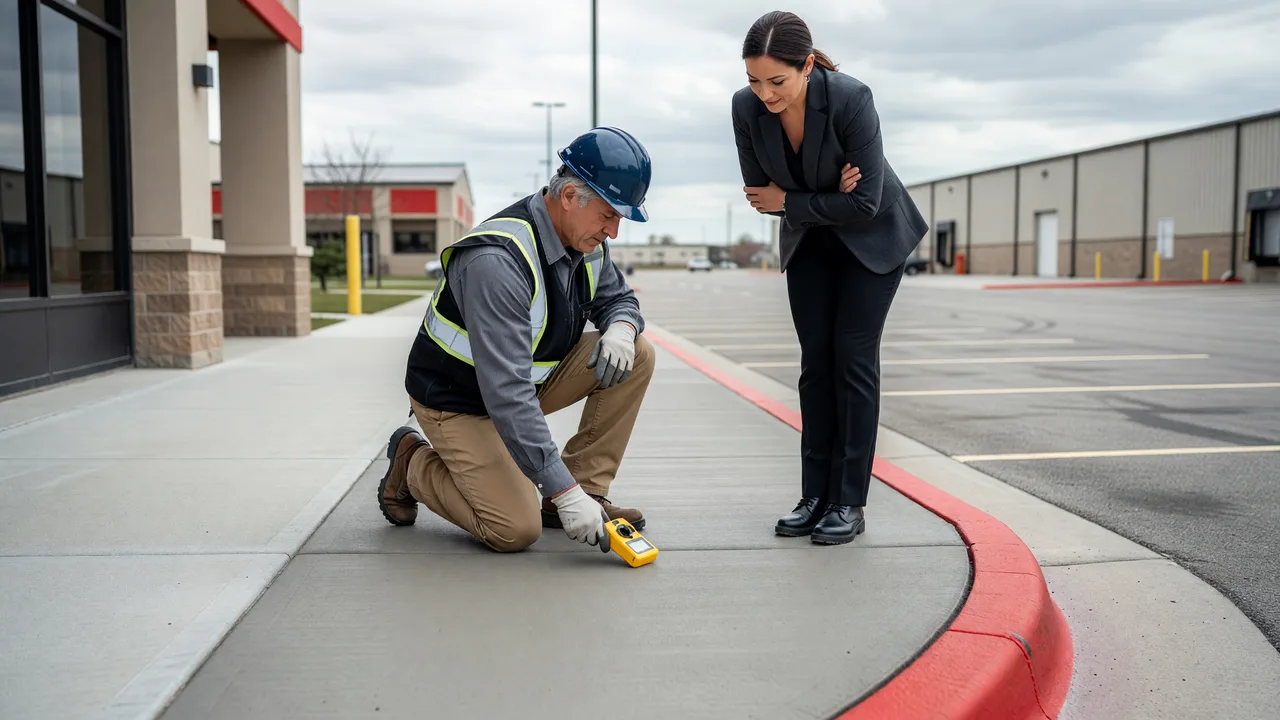
A practical guide for commercial owners, facility managers, developers, and general contractors evaluating sidewalk compliance, drainage, inspection risk, and replacement decisions.
Ohio property owners should know that ADA sidewalk compliance is driven by measured slope, cross slope, running slope, transitions, landings, and detectable warnings—not appearance alone. In practical terms, accessible routes generally target a maximum 2% cross slope, while steeper runs may trigger ramp requirements, handrails, and landing rules. Field verification. Call (330) 992-2617 to discuss your needs and next steps.
Direct Answer: ADA Sidewalk Slope Requirements Every Ohio Property Owner Should Know OH
 Photo by AI Generated (Grok Imagine)
ADA Sidewalk Slope Requirements Every Ohio Property Owner Should Know OH start with one core principle: an accessible pedestrian route must be stable, slip-resistant, and measurable within ADA tolerances. The most common benchmark owners need to remember is a maximum 2% cross slope on accessible walking surfaces. If the running slope becomes too steep, the path may be treated as a ramp, which introduces separate requirements for landings, edge conditions, and in some cases handrails.
That matters because many sidewalk failures are not obvious until a digital level is used. A walk may look flat, but ponding, heaving, settlement, poor transitions at curb ramps, or an overly aggressive pitch for drainage can still create a compliance problem. For owners managing retail, office, warehouse, industrial, medical, or multi-tenant sites, ADA sidewalk work is not just flatwork—it is life-safety access, inspection exposure, and premises liability control.
Why sidewalk slope compliance matters more than most owners expect
On a commercial property, ADA sidewalk slope requirements every Ohio property owner should know OH are not a paperwork issue. They affect who can safely enter and move through the site, whether a project passes inspection, and whether drainage design conflicts with accessibility. The cost of getting slope wrong is rarely limited to one panel of concrete. It can mean rework, delayed turnover, tenant disruption, callbacks, or a documented accessibility complaint.
The risk is higher on hard-use properties. Parking lots, loading docks, warehouse aprons, service drives, and pedestrian links between buildings often need to balance truck traffic, stormwater movement, and accessible routes in tight grades. That is where many contractors miss the mark. They may pour concrete that looks clean on day one but does not account for operational loads, transitions, or the way freeze-thaw cycles can alter elevations over time.
For commercial buyers, the practical question is not whether concrete can be placed. It is whether the sidewalk, curb ramp, landing, and adjoining pavement all work together as a compliant system. That is why a contractor with experience in ADA flatwork, parking lots, industrial floors, loading docks, foundations, and site concrete is typically better equipped to identify grade conflicts before the pour.
The core ADA slope numbers owners should understand
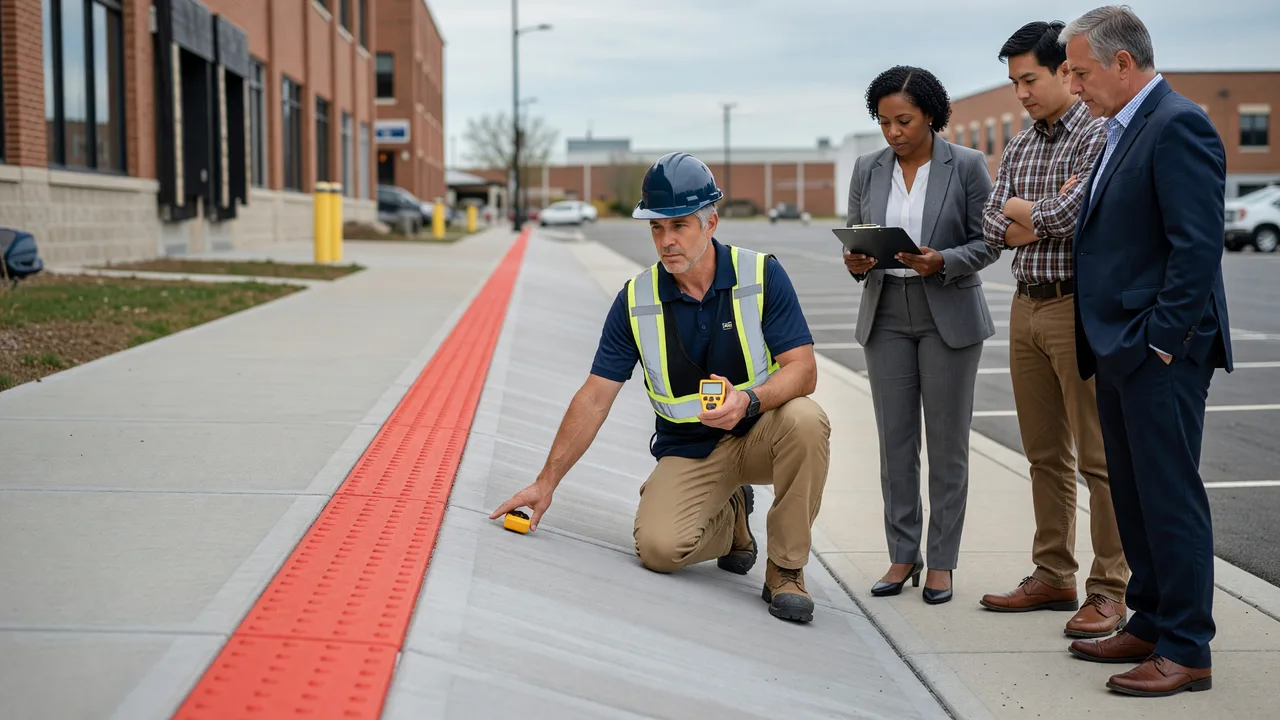
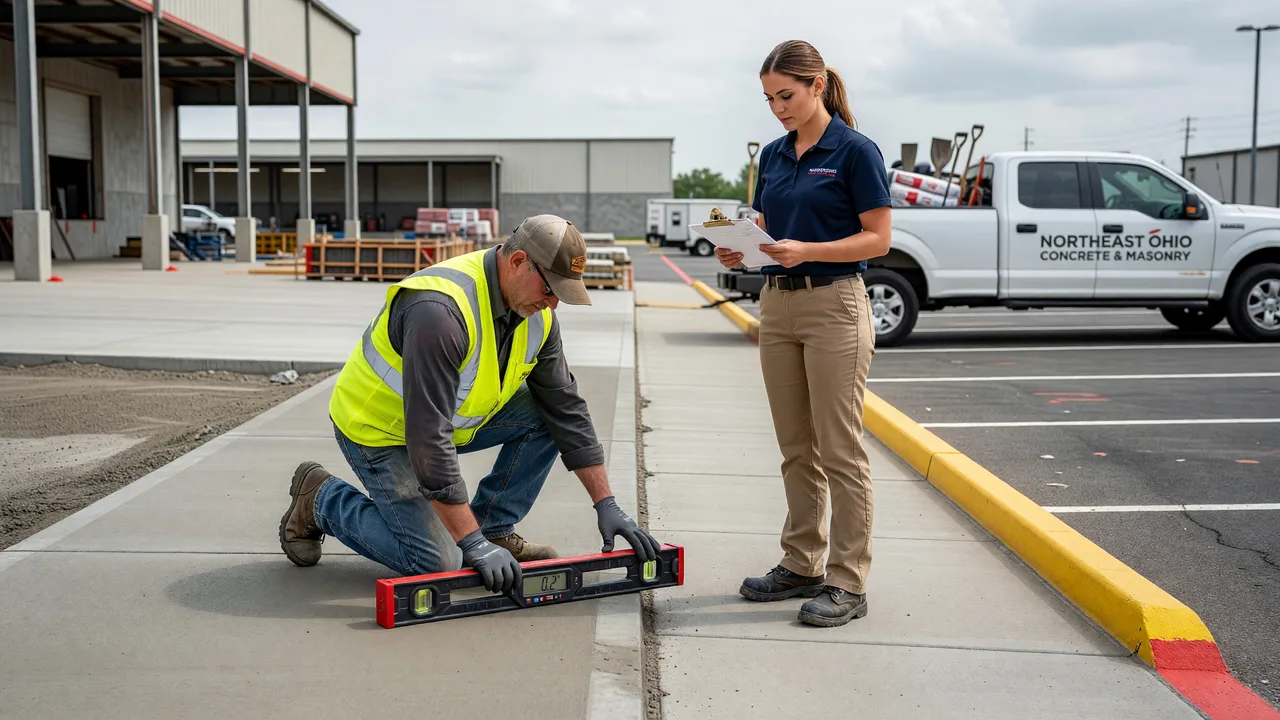 Photo by AI Generated (Grok Imagine)
When people search for ADA Sidewalk Slope Requirements Every Ohio Property Owner Should Know services null OH, they are usually trying to understand a few measurable thresholds. The most important are cross slope, running slope, ramp slope, and landing slope. Even if your contractor handles the technical layout, owners should know the basics well enough to review existing conditions and ask the right questions before replacement begins.
Cross slope
Cross slope is the side-to-side tilt of the sidewalk. On accessible walking surfaces, the general target is a maximum 2% cross slope. This is one of the most common failure points because installers sometimes increase the pitch to push water away faster. That may help drainage on paper, but if the cross slope exceeds tolerance, the route may no longer be accessible.
Running slope
Running slope is the slope in the direction of travel. If the route follows the natural grade, the allowable condition depends on the design context. But when the running slope gets steep enough that the walk functions as a ramp, ramp standards apply. That changes the detailing requirements significantly.
Landings and transitions
Even where the main run is acceptable, a site can fail at the top or bottom of a curb ramp, at a building entry, or where a new sidewalk ties into older pavement. Abrupt changes in level, uneven joints, and short landings often create usability problems that are missed during budgeting but caught during inspection.
Detectable warnings and curb ramps
At vehicular crossings and curb ramp locations, surface geometry and warning treatments matter. Detectable warnings, flare conditions, and approach slopes must work together. A well-finished slab is not enough if the geometry directs wheelchair users into traffic or creates ponding at the toe of the ramp.
ADA sidewalk slope requirements every Ohio property owner should know OH in real jobsite conditions
Field conditions are where compliance is won or lost. In northern climates, a sidewalk can be within tolerance when placed and drift out later because of settlement, curb movement, frost action, or adjacent asphalt failure. That is why ADA Sidewalk Slope Requirements Every Ohio Property Owner Should Know OH should always be evaluated with drainage, base preparation, sawcut limits, and adjacent pavement performance in mind.
Commercial sidewalks fail differently than residential walks. On a warehouse or retail site, repeated plowing, heavy edge loading, snowmelt refreeze, and utility trench settlement can distort grades panel by panel. A small deviation at one joint may not look dramatic, but along an accessible route it can accumulate into a meaningful barrier. Owners who are tired of annual patching should see ADA repairs as grade-control work, not cosmetic touch-up.
This is also where contractor accountability matters. A self-performing concrete contractor can own the layout, formwork, subgrade, pour, finish, and tie-ins rather than blaming a subcontracted crew after the fact. Mattucci Construction operates as a self-perform commercial concrete and masonry contractor, which is especially relevant on ADA flatwork where slope tolerances, drainage, and finish quality all have to align in the field.
Common reasons sidewalks fail ADA slope checks
Most failed accessible routes trace back to a small set of construction or site-design issues. Understanding those issues helps owners know whether a repair is realistic or whether replacement is the smarter path.
- Over-pitching for drainage: Installers sometimes chase surface runoff by increasing cross slope beyond accessible limits.
- Poor tie-ins to existing pavement: A new compliant panel can still fail if it transitions abruptly into older asphalt, curb, or entry slab.
- Settlement from inadequate base support: Weak subgrade, trench backfill movement, or edge erosion can change slope after placement.
- Freeze-thaw movement: In climates with repeated winter cycling, slab heave and joint movement can create vertical displacement and altered drainage paths.
- Improper curb ramp geometry: Ramp runs, flares, landings, and detectable warning placement must work together, not as separate line items.
- Late-stage site changes: Striping, curb revisions, utility adjustments, or grading changes made after form layout often compromise the accessible route.
These are the same reasons property managers often struggle to get permanent results from piecemeal repairs. The immediate symptom may be ponding or a trip edge, but the underlying problem is usually grade control. That is why the best ADA Sidewalk Slope Requirements Every Ohio Property Owner Should Know null information focuses on diagnosis first, not just demo and repour.
Repair vs. replacement: when each option makes sense
Owners often ask whether a sidewalk can be ground, mud-jacked, patched, or sawcut back into compliance. Sometimes it can. But if the route has multiple slope conflicts, drainage failures, or degraded adjoining surfaces, replacement is often more reliable than stacking temporary fixes.
| Condition | Possible Approach | Best Use Case | Main Limitation |
|---|---|---|---|
| Minor isolated height difference | Targeted correction or grinding | Small trip hazard at one joint | Does not solve wider drainage or slope problems |
| Localized settlement | Panel replacement or elevation correction | Single panel or short run affected | Adjacent panels may still fail tie-in requirements |
| Cross slope exceeds tolerance across multiple panels | Full section replacement | Accessible route geometry is wrong | Requires more planning and temporary pedestrian routing |
| Curb ramp and landing conflict | Ramp and landing reconstruction | Entry point or parking access issue | Must coordinate with parking layout and drainage |
| Recurring ponding, cracking, and heaving | Rebuild with grade and base correction | Long-term performance problem | Higher upfront investment than patching |
For hard-use commercial sites, replacement often produces the lower lifetime cost when repeated repairs have already failed. That is especially true where ADA sidewalk slopes interact with parking lots, loading zones, tenant entries, and service circulation. In those environments, the accessible route should be evaluated as part of the site concrete system—not as a standalone strip of pavement.
How long ADA sidewalk work typically takes
There is no universal schedule, because duration depends on square footage, demolition limits, curb ramp complexity, weather, curing needs, traffic control, and whether adjacent pavement or masonry must be adjusted. A short, isolated panel correction may move quickly. A multi-entry commercial route with curb ramps, parking transitions, and drainage revisions can take meaningfully longer.
What owners should watch is not just the pour date but the sequence. A disciplined plan includes layout verification, demolition, subgrade correction, formwork, inspection coordination where required, placement, finish, curing protection, and safe reopening. If the project touches active tenants, deliveries, or customer access, temporary routing needs to be thought through before concrete is removed.
When buyers ask, “How long does ada sidewalk slope requirements every ohio property owner should know take?” the real answer is that the measuring and planning phase is often what protects the schedule. Rushing into replacement without validating slopes, tie-ins, and drainage can create a second shutdown later. Commercial owners usually benefit more from one coordinated mobilization than from multiple reactive visits.
What drives cost on ADA sidewalk projects
People frequently search phrases like how much does ada-sidewalk cost in Macedonia OH, how much does parking-lot cost in Twinsburg OH, and best parking-lot near me because they are trying to benchmark site work budgets. The honest answer is that ADA sidewalk pricing depends less on the label of the job and more on the field conditions. Unit cost changes significantly based on demolition depth, haul-off, access constraints, detectable warnings, utility conflicts, grading corrections, drainage work, and how much adjoining pavement has to be rebuilt to create compliant transitions.
For that reason, no credible contractor should quote a universal national price for ADA sidewalk slope correction without seeing existing conditions. A single compliant replacement panel near open access is fundamentally different from reconstructing a full route through a busy commercial frontage with curb ramps and parking reconfiguration. The second project carries more layout complexity, more risk control, and more operational coordination.
If you are comparing estimates, ask each bidder whether the proposal includes slope verification, transition correction, detectable warnings where applicable, and restoration of adjoining surfaces. Low numbers often exclude the items that make the route actually pass. That is one reason property owners end up paying twice.
For buyers typing “How much does ada sidewalk slope requirements every ohio property owner should know cost in null?” the useful takeaway is this: price follows geometry, access, and rework risk. If the proposal does not describe those variables, it is not detailed enough to compare accurately.
How to choose a provider for ADA sidewalk compliance work
If you are evaluating ADA Sidewalk Slope Requirements Every Ohio Property Owner Should Know contractor options, focus on accountability and relevant project type. Sidewalk compliance on a commercial site is not the same as decorative residential flatwork. You want a contractor that understands parking circulation, industrial loading, tenant access, and inspection risk.
- Look for self-perform capability. If one company sells the work and another crew installs it, slope accountability gets blurry fast.
- Confirm commercial experience. Parking lots, warehouse floors, loading docks, ADA flatwork, foundations, and site concrete require a different field mindset than patio-only work.
- Verify procurement basics. Bonded and insured status matters. OSHA-compliant crews matter. Commercial owners should not have to chase these fundamentals.
- Ask how they handle tie-ins. The new sidewalk is only one part of the route. Existing curb, asphalt, ramps, and entries matter just as much.
- Review their scope language. A serious estimate should mention layout, demolition limits, subgrade, transitions, and surface restoration—not just “replace sidewalk.”
For decision-makers asking, “What is the best ada sidewalk slope requirements every ohio property owner should know company in null?” the stronger question is which contractor is most likely to deliver a measurable, durable result without subcontractor ambiguity. Mattucci Construction’s position is straightforward: self-performed commercial concrete and masonry, family-owned, in business 20+ years, bonded and insured, with OSHA-compliant crews and an approximate 4.8 Google rating from 19 reviews. Those are practical trust signals for buyers who care about execution more than marketing language.
What to look for in ADA sidewalk slope requirements every Ohio property owner should know services null OH
When comparing ADA Sidewalk Slope Requirements Every Ohio Property Owner Should Know professional null OH providers, the scope should cover more than concrete placement. At minimum, owners should expect evaluation of accessible path alignment, slope readings, transitions to adjacent surfaces, curb ramp geometry where applicable, drainage direction, and sequencing that keeps the property functional during work.
The top ADA Sidewalk Slope Requirements Every Ohio Property Owner Should Know null and ADA Sidewalk Slope Requirements Every Ohio Property Owner Should Know top null OH options are usually the firms that can discuss failure points before demolition starts. They should be able to explain whether the issue is isolated settlement, systemic drainage conflict, or broader site grading. If they only talk about square footage and finish texture, they are missing the compliance question.
The affordable ADA Sidewalk Slope Requirements Every Ohio Property Owner Should Know null and ADA Sidewalk Slope Requirements Every Ohio Property Owner Should Know affordable null OH choice is not automatically the lowest bid. Affordable, in a commercial context, means the work holds up and does not need to be redone after the next inspection cycle or winter season. Buyers in active facilities should place a premium on planning that reduces downtime and avoids repeated mobilizations.
Many searches also include ADA Sidewalk Slope Requirements Every Ohio Property Owner Should Know near me, ADA Sidewalk Slope Requirements Every Ohio Property Owner Should Know null near me, and services ADA Sidewalk Slope Requirements Every Ohio Property Owner Should Know null. Those queries usually signal immediate need. In that situation, ask for a documented site walk and a written estimate that identifies why the route is out of tolerance and what adjacent areas are affected.
Practical recommendations property owners can act on now
If you manage or own a commercial property, there are several steps you can take before an issue turns into a failed inspection or injury claim.
- Walk the entire accessible route after heavy rain. Ponding often reveals slope conflicts that are easy to miss in dry conditions.
- Check transitions, not just the middle of the walk. Entries, curb ramps, parking tie-ins, and loading-adjacent paths are where many noncompliant conditions show up.
- Document repeat trouble spots. If the same panel cracks, heaves, or settles every year, the root problem is probably below the surface or outside that panel.
- Avoid isolated patching without grade review. Cosmetic fixes can preserve the underlying noncompliant geometry.
- Coordinate ADA work with broader site concrete needs. If parking lot edges, curbs, or loading areas are also failing, a combined plan can reduce disruption.
- Ask for an ADA Sidewalk Slope Requirements Every Ohio Property Owner Should Know estimate that explains assumptions. A short lump-sum number is not enough for meaningful comparison.
These steps are particularly useful for facility managers balancing tenant operations and deferred maintenance. Sidewalk compliance work is easier to budget and schedule when it is identified early and grouped with related site concrete corrections.
Why commercial buyers look at Mattucci Construction for this type of work
For commercial owners, developers, and general contractors, ADA sidewalk correction is rarely a standalone beautification project. It usually sits alongside parking lot deterioration, warehouse access issues, loading dock use, foundation work, or tenant build-out needs. That is where Mattucci Construction fits: as a self-performing commercial concrete and masonry contractor handling parking lots and site concrete, warehouse and industrial floors, loading docks, ADA sidewalks and flatwork, foundations and footers, tilt-up concrete construction, commercial masonry, concrete repair and restoration, retaining walls, and tenant build-outs.
The company’s value proposition is not broad marketing language. It is operational accountability: no subcontractor roulette, one accountable crew, bonded and insured, OSHA-compliant, family-owned, and in business 20+ years. For buyers who are comparing commercial-concrete in Twinsburg OH, concrete masonry construction in Macedonia OH, or broader site-concrete providers, that distinction matters because ADA work often overlaps with other high-consequence surfaces that must survive heavy use and pass inspection the first time.
There is also a durability mindset behind commercial flatwork in this climate. Owners dealing with freeze-thaw movement, traffic wear, and repeated maintenance calls typically need more than a surface fix. They need proper demolition limits, sound base conditions, accurate grades, and a crew that understands how operational concrete fails in the field.
FAQ: adjacent buyer questions
Is ADA sidewalk compliance worth the investment?
Yes. For commercial properties, ADA compliance investment protects access, reduces liability exposure, and can prevent the larger cost of failed inspections, emergency rework, or documented complaints. It also improves day-to-day usability for customers, staff, tenants, and visitors. On active sites, correcting known slope and transition issues early is usually less disruptive than waiting until adjacent pavement or curb ramps deteriorate further.
What should I look for in ada sidewalk slope requirements every ohio property owner should know services?
Look for a provider that can measure existing conditions, explain why the route is noncompliant, identify how adjacent surfaces affect the accessible path, and provide a written scope that addresses demolition, subgrade, transitions, drainage, and restoration. On commercial properties, self-perform capability and OSHA-compliant crews are significant risk-management advantages.
How do I choose a ada sidewalk slope requirements every ohio property owner should know provider in null?
Choose based on relevant commercial experience, accountability in the field, and clarity of scope—not on a vague low bid. Ask whether the crew self-performs the work, whether the company is bonded and insured, and whether the estimate addresses curb ramps, landings, tie-ins, and drainage. Those details usually separate a durable correction from a cosmetic patch.
Can ADA sidewalk issues be repaired without full replacement?
Sometimes. Minor isolated hazards may be corrected with limited work, but broader slope failures, recurring ponding, or curb-ramp geometry problems often require reconstruction. The right answer depends on whether the problem is a local defect or a route-wide grade conflict.
Do parking lots affect ADA sidewalk slope compliance?
Absolutely. Accessible routes frequently connect accessible parking, curb ramps, sidewalks, and building entries. If the parking lot surface has settled, been overlaid, or drains poorly, the sidewalk may no longer transition correctly even if the concrete itself still looks intact. That is why site concrete and ADA flatwork should be reviewed together.
Get a documented site review and quote
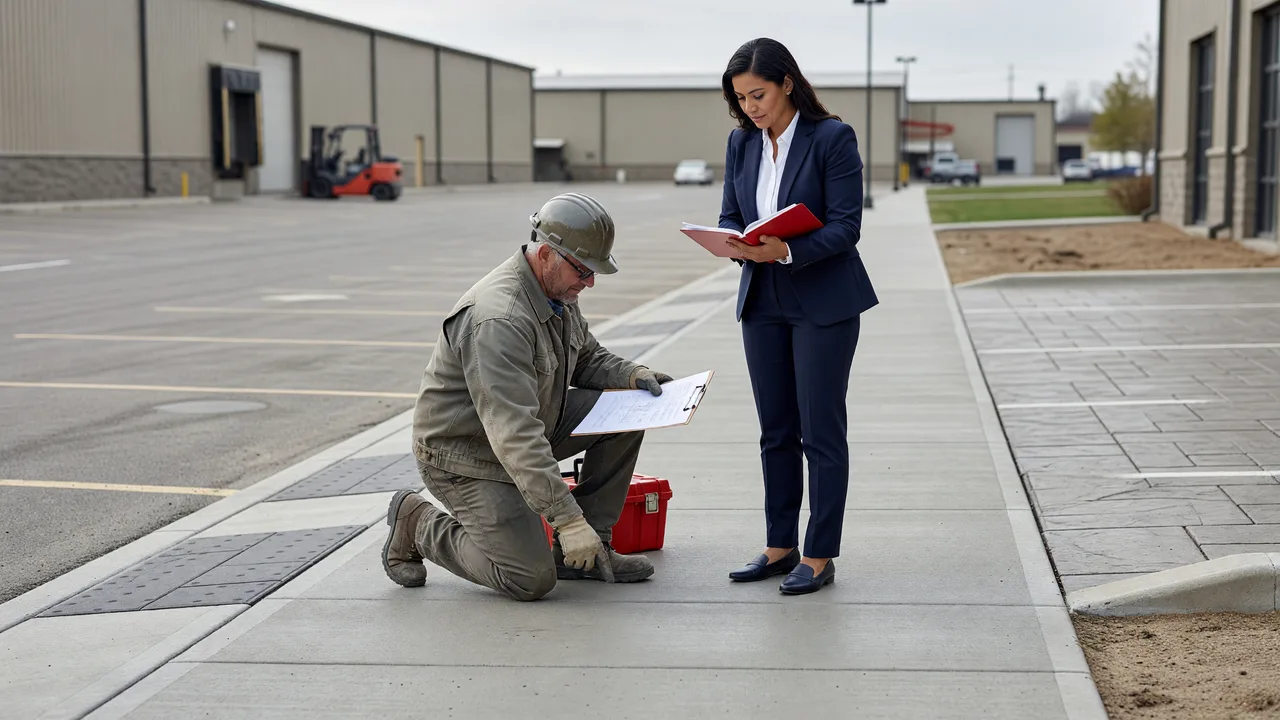 Photo by AI Generated (Grok Imagine)
If you are evaluating ADA sidewalk slope issues on a commercial property, the next step is a documented site review—not a guess from a photo. Mattucci Construction provides self-performed commercial concrete and masonry work for owners, facility managers, developers, and general contractors who need durable flatwork, clear accountability, and a scope built around real field conditions.
To discuss ADA sidewalk compliance, parking lot tie-ins, curb ramps, site concrete, or related repair and replacement work, use the quote-request form at https://mattucciconstruction.net or call (330) 992-2617. That gives you a concrete basis for budgeting, planning access, and deciding whether repair or replacement is the more reliable path.
Frequently Asked Questions About ADA Sidewalk Slope Requirements Every Ohio Property Owner Should Know
How much does ada sidewalk slope requirements every ohio property owner should know cost in null?
Cost depends on existing conditions, not just square footage. Demolition depth, haul-off, access restrictions, subgrade correction, detectable warnings, curb ramps, drainage revisions, and tie-ins to adjoining asphalt or concrete all affect price. A small isolated panel replacement is fundamentally different from rebuilding an entire accessible route through a busy commercial frontage. The best way to compare proposals is to make sure each estimate includes slope correction, transition work, and restoration—not just new concrete.
What is the best ada sidewalk slope requirements every ohio property owner should know company in null?
The best provider is typically the one with relevant commercial concrete experience, clear field accountability, and a written scope that addresses compliance—not the one using the broadest marketing claims. For buyers evaluating commercial ADA flatwork, self-perform capability, bonded and insured status, and OSHA-compliant crews are meaningful differentiators. Mattucci Construction is a family-owned, self-performing commercial concrete and masonry contractor with 20+ years in business and an approximate 4.8 Google rating from 19 reviews.
How do I choose a ada sidewalk slope requirements every ohio property owner should know provider in null?
Ask whether the company self-performs the work, how it verifies slopes and transitions, what adjacent surfaces are included in the scope, and whether it regularly handles commercial site concrete such as parking lots, loading docks, industrial floors, foundations, and ADA flatwork. You also want confirmation that the company is bonded and insured and that crews are OSHA-compliant. Those factors reduce execution risk on active commercial sites.
What should I look for in ada sidewalk slope requirements every ohio property owner should know services?
Look for a service scope that covers route evaluation, slope measurement, drainage review, demolition limits, subgrade preparation, tie-ins, curb ramp and landing geometry where applicable, finish, curing protection, and reopening sequence. The service should address how the accessible route interacts with parking areas and building entries. If the proposal only mentions replacing concrete, it is probably incomplete.
How long does ada sidewalk slope requirements every ohio property owner should know take?
Timing varies with route length, demolition complexity, weather, curing requirements, access management, and whether curb ramps or adjacent parking surfaces are involved. Small repairs can move relatively quickly, while broader route reconstruction takes longer because layout verification, coordination, and protection of pedestrian access are part of the work. Owners should judge schedule quality by the sequencing plan, not by the fastest verbal promise.
Is ada sidewalk slope requirements every ohio property owner should know worth the investment?
Yes—especially for commercial properties. ADA sidewalk correction reduces inspection risk, improves safe access, and can eliminate recurring maintenance in the same trouble spots. It also supports tenant, customer, and employee mobility. In many cases, a properly planned correction costs less over time than repeated patching that never resolves the underlying grade problem.
Need a site-specific ADA sidewalk assessment?
If your property has ponding, settlement, failed transitions, or questionable curb ramp geometry, request a quote through the form at https://mattucciconstruction.net or call for a site review. Mattucci Construction self-performs commercial concrete and masonry work with bonded and insured, OSHA-compliant crews.